Photo: Department of Public Information, Guyana.
Consider a grower who has arranged planting material and labour but is still unsure when a water-management problem will be addressed. The expense is real before a crop produces anything to sell. A decision about drainage or irrigation can therefore influence much more than conditions in a field: it can affect when work begins and when the farmer expects to be paid.
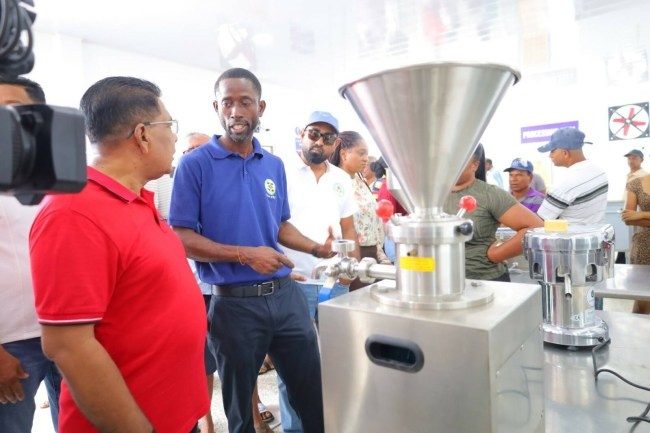
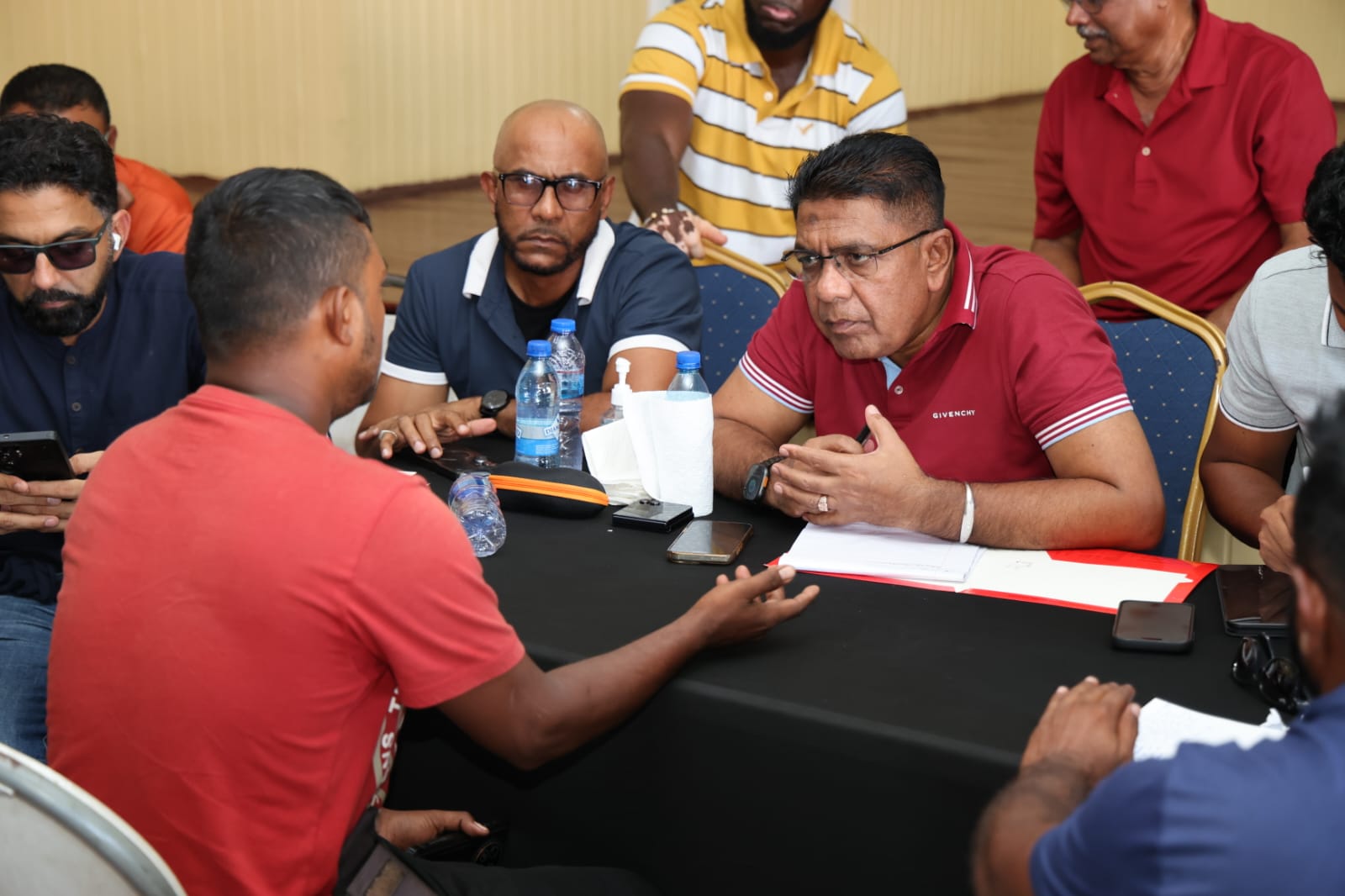
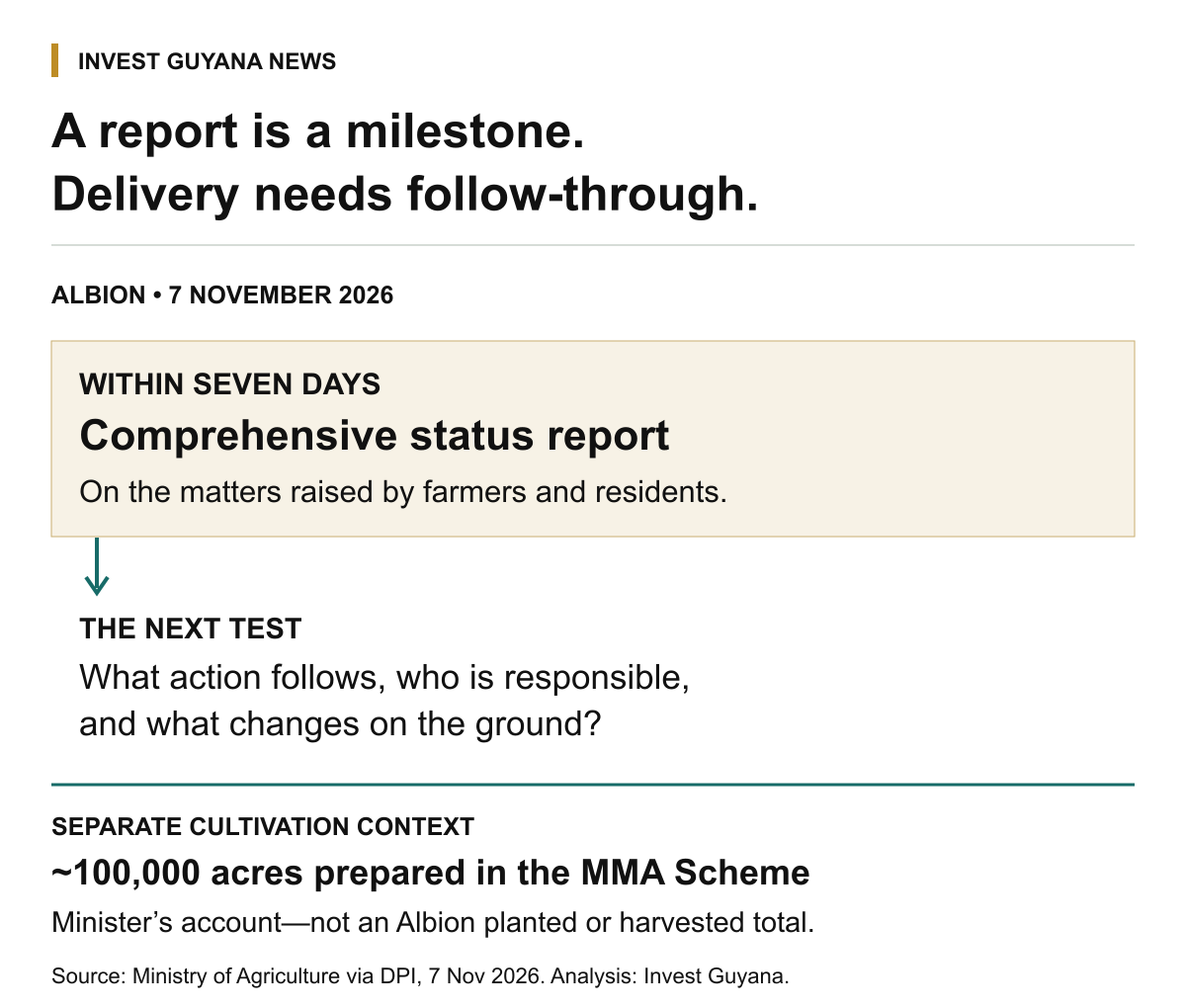
That practical connection between public services and farm operations was at the centre of an Open Day held by Agriculture Minister Zulfikar Mustapha at Albion, Region Six, on 7 November. Farmers and residents raised drainage and irrigation, land clearing, livestock and support-service concerns. According to the official release published by DPI that day, Mustapha instructed officials to provide a comprehensive status report within seven days. That is a reporting deadline, not a promise that all work will be completed within a week.
The minister also reported approximately 100,000 acres prepared for cultivation in the Mahaica-Mahaicony-Abary Scheme, with a Tuesday meeting planned to discuss possible additional cultivation. He expressed optimism about the first crop of 2027 and food-hub completion by the end of June 2027. Those statements describe different stages of development, not one completed expansion programme.
A seven-day report can make follow-up more concrete
A public meeting brings individual problems into view. Its commercial value depends on what happens after the conversation, especially where a farmer's next decision depends on an agency response. The question is not simply whether a concern was heard, but whether the person affected can understand what will happen next.
For a routine issue, an answer might allow work to proceed quickly. For a larger infrastructure problem, useful progress could mean an assessment, a defined scope or a sequence of work rather than immediate completion. A status report is valuable precisely because it can distinguish those situations instead of presenting every referral as a resolved problem.
The Albion instruction creates an identifiable point for checking progress. It does not, by itself, establish the condition of a canal, the cost of an intervention or the resources available to carry it out. Those decisions determine whether administrative follow-up becomes a change that farmers can plan around.
That matters to businesses beyond the farm gate. An input supplier deciding when to replenish stock, or a machinery operator arranging jobs, depends partly on when customers can start or resume activity. A clearer service timetable can reduce uncertainty in those relationships, even where it cannot remove every production risk.
The appropriate measure is therefore not the number of matters referred alone. It is whether the response changes the practical position of the farmer or resident, and whether unresolved matters have a credible next step.
Prepared land is not the same as an additional harvest
The MMA acreage reported by Mustapha is significant as a statement about preparation. It should remain attached to that stage. Land prepared for cultivation is not automatically land planted, additional acreage producing a crop or land available for a new applicant to occupy.
The distinction matters because each stage has different commercial implications. Preparation may create potential for activity. Planting brings further commitments of money and labour. Harvesting produces a volume that can enter a market. Treating the first stage as the last would overstate both current supply and the immediate business available to suppliers, transporters and buyers.
Acreage alone also says little about how activity will be distributed over time. If planting is spread across different dates, demand for services may build gradually. If many growers require the same equipment or labour within a narrow period, capacity can become a more pressing constraint.
For someone evaluating an agricultural service business, that difference affects the case for adding equipment or hiring staff. Potential demand is more useful when it can be connected to realistic timing and the ability of customers to proceed. An acreage announcement is an important starting point, but it is not a substitute for that commercial understanding.
The planned stakeholder discussion should be read in the same way. Considering more land for cultivation is a policy and operational discussion. It is not an allocation decision, a completed project or an offer of land on specified terms. The outcome of that discussion would be a separate development to assess when it is known.
Expansion depends on coordinated services and working capital
Farms operate through linked decisions. Water management, field work and the availability of inputs affect one another; arrangements for moving and selling the eventual output sit further along the same chain. Resolving one problem can be important without resolving all of them.
The opening example illustrates the financial effect. If a grower commits funds before a delay, that money remains tied to an operation that has not yet generated sales. The consequence is different from a simple increase in the price of an input: the delay changes how long the farmer must carry the expense.
Businesses serving farmers face related timing decisions. A transporter can have vehicles available without enough produce ready to move on a particular day. A supplier can hold stock while customers await conditions that allow them to use it. Better coordination could improve the use of those resources; it does not guarantee a particular return or eliminate seasonal uncertainty.
This is why service reliability deserves attention alongside expansion targets. For investors and local enterprises, the opportunity is not solely in bringing additional land into production. It may also lie in supplying an existing operation more dependably or connecting production with buyers more effectively. Whether that opportunity is viable depends on the actual needs, costs and customers involved.
Mustapha's optimism about the first crop of 2027 provides an expectation to watch, rather than a forecast that can be converted into a sales figure. Businesses should distinguish that outlook from confirmed orders or measured output. The commercial significance will become clearer as preparation turns into production and production into transactions.
Operating arrangements matter as much as construction
The food-hub expectation introduces a further stage: what happens to agricultural output after production. A completion target matters to businesses considering future supply arrangements, but the date of a completed facility and the date of a dependable commercial service need not mean the same thing.
For a hub to be useful, growers and buyers need to understand what it will handle and how transactions will work. The relevant considerations could include receiving arrangements, the quality a buyer requires and the timing of payment. These are commercial questions about any such facility, not announced specifications for this project.
A prospective supplier would also need a reason to use the service rather than an existing route to market. A buyer would need confidence in the consistency of what arrives. Bringing those interests together is the operating challenge behind the physical investment. The Albion update should not be treated as a procurement invitation or a supply contract.
The wider message from the Open Day is therefore about converting opportunity into dependable activity. A report on farmers' concerns, land preparation, cultivation and future handling capacity each has a place, but they measure different things. Keeping them separate makes progress easier to judge and commercial decisions less dependent on assumptions.
For the grower in the opening example, the clearest improvement would be a practical answer that supports the next decision. Across a larger agricultural economy, repeated improvements of that kind are what allow production plans, business services and investment to reinforce one another.