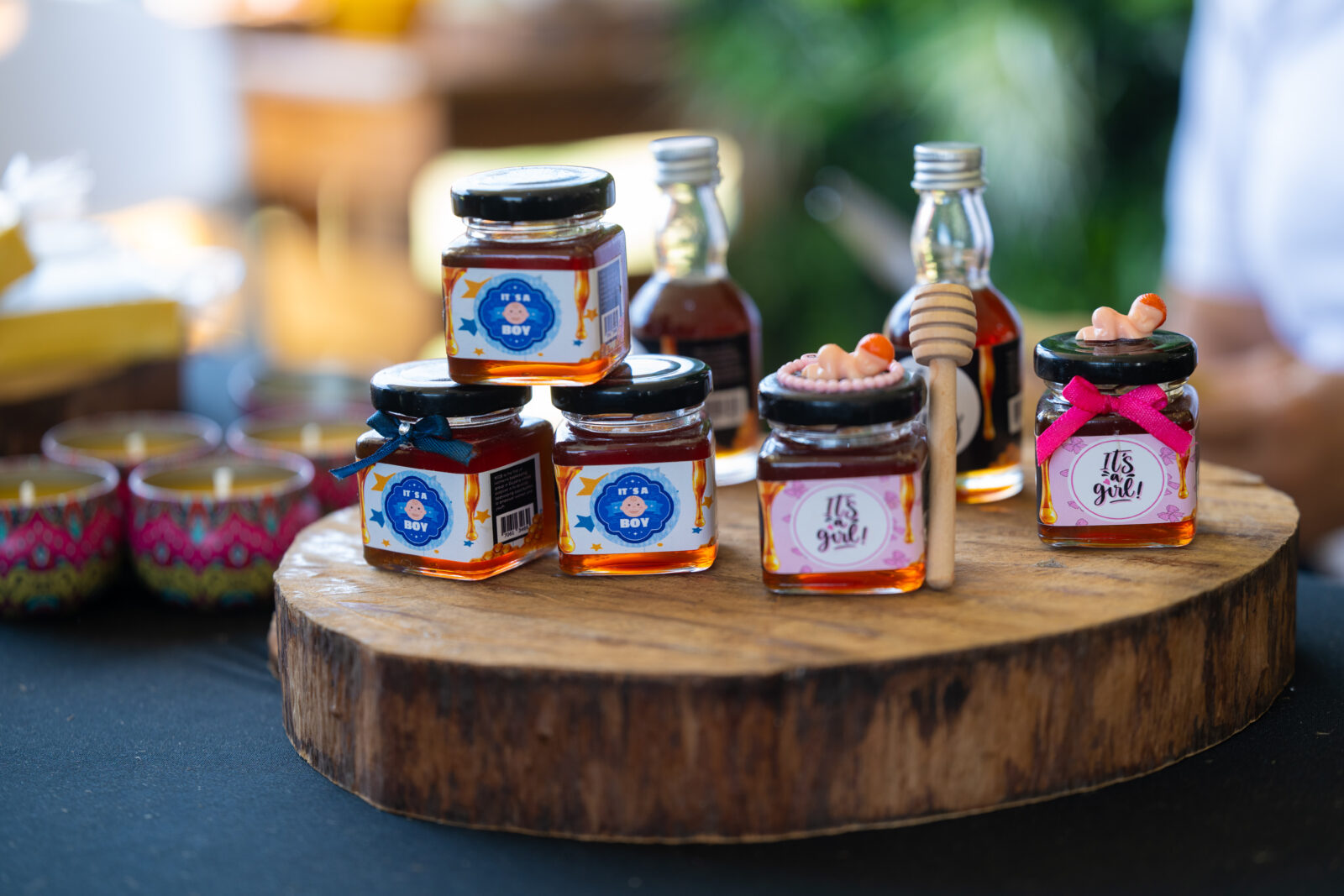
Honey products displayed at Guyana’s 2025 Honey Fest. Contextual image. Photo: Department of Public Information, Guyana.
A national distribution to 280 beekeepers could widen production capacity, but equipment, active colonies and export-ready output are not the same measure.
A wooden hive box is an important production input, but it does not become a honey business on delivery.
It must house a healthy colony. The beekeeper must manage pests, disease, weather and the availability of flowering plants. Honey must then be harvested, handled, tested, packaged and sold under conditions that protect its quality. An exporter faces another layer of traceability, documentation and destination-market requirements.
That value chain is the practical context for Guyana’s latest apiculture announcement.
The government plans to provide ten hive boxes each to 280 beekeepers, amounting to 2,800 boxes, as part of an effort to expand production while domestic demand exceeds supply. Agriculture Minister Zulfikar Mustapha announced the initiative at the country’s third annual Honey Festival, according to the official 1 November update.
The scale is significant for a still-developing industry. It also needs to be interpreted carefully: a hive box is equipment, not proof of an occupied colony, a productive hive or a quantity of honey ready for market.
At a glance
- 280 beekeepers are expected to receive boxes.
- Ten boxes each would produce a planned distribution of 2,800.
- Officials report that active hives increased from 1,145 to 1,983.
- Approximately 2,500 honey samples have been tested at the Guyana Livestock Development Authority laboratory.
- Government says investment in the industry has exceeded G$241 million, covering equipment, protective gear, inputs, training and technical support.
- The announcement does not state the distribution timetable, recipient locations, colony arrangements or the expected production increase.
A substantial addition to the equipment base
The agriculture minister said 3,320 hive boxes were distributed between 2020 and 2026, together with frames, stands, tools and other equipment. The new commitment of 2,800 boxes is therefore large when compared with the cumulative figure cited in the latest release.
An older November 2024 DPI report said more than 5,000 hives had been distributed. The newer release reports 3,320 hive boxes from 2020 to 2026; because the scope and definitions are not reconciled, the figures should not be combined.
It should not, however, be added automatically to the active-hive count.
Boxes may be held as replacements or used when colonies are divided. Some may await captured swarms or newly established colonies. Productivity can also vary sharply between occupied hives. What matters commercially is not simply how many boxes exist, but how many contain viable colonies, how consistently they are managed and how much marketable honey they produce.
The Ministry of Finance’s 2026 Mid-Year Report provides additional implementation evidence. It records 499 boxes distributed during the first half of 2026, 44 beekeepers receiving start-up kits, 228 people trained to rear bees and 18 trained in capturing wild swarms for relocation.
Those interventions demonstrate that the programme includes skills and colony development as well as equipment. The report does not publish yield or sales results for the recipients, so it cannot yet establish the commercial return from that support.
Official output has risen, but a complete series is needed
The Ministry of Agriculture reported that Guyana produced 27,601 gallons of honey in 2024. A subsequent May 2026 ministry update placed 2025 production at 38,574 gallons.
On those two precise official figures, reported production increased by approximately 39.8 per cent from 2024 to 2025. A later 31 October 2026 DPI report described 2025 output as 40,000 gallons. It is not clear whether that was a rounded figure or a revised total, so the figures should not be treated as an identical series.
For broader context, Invest Guyana has also examined the reported rise in Guyana’s priority agricultural output and the data needed to assess growth across individual value chains.
The May update projected an additional 2,000 to 5,000 gallons during 2026, but that was a forecast rather than a final production result. The latest Honey Festival announcement does not provide a year-to-date 2026 volume.
A consistent annual dataset would strengthen investment analysis. It should identify occupied and productive hives, honey harvested, average yield, losses, farmgate and retail prices, imports, domestic sales and exports. Without those measures, equipment and production announcements show direction but do not provide a complete market size.
Domestic demand creates an opening, not a guaranteed market
The minister said Guyana’s demand for honey is higher than local production. That is an important commercial signal, but the public release does not quantify the shortfall.
It does not provide annual consumption, import volumes, the value of imported honey, the share of demand supplied locally or the prices paid at different points in the chain. It also does not identify purchase agreements for the additional production expected from the programme.
Producers considering expansion therefore need their own market assessment. Potential customers include households, supermarkets, hotels, restaurants, food and beverage manufacturers, personal-care producers and businesses using honey or beeswax in value-added products.
The opportunity will depend on dependable volume, uniform quality, packaging, delivery and price—not merely the general existence of unmet demand.
The opportunity extends beyond raw honey
The immediate beneficiaries are beekeepers, but a larger production base could create demand across the supporting value chain.
Potential commercial areas include:
- hive construction, frames, stands and protective equipment;
- queen-rearing and colony-management services;
- swarm capture and relocation;
- extraction, filtration and hygienic handling equipment;
- food-grade containers, labels and tamper-evident packaging;
- laboratory testing and quality-control services;
- aggregation and transport from dispersed production areas;
- wholesale, retail and hospitality distribution; and
- value-added products using beeswax, propolis, royal jelly or honey.
These are possible areas of demand, not announced contracts. The latest release does not publish procurement schedules, private-participation terms or guaranteed purchase arrangements.
The 2025 Honey Festival record shows that the official development strategy extends beyond raw honey. It identifies beeswax, royal jelly, propolis and differentiated honey as potential products while emphasising better hive management, disease control and value addition.
Testing is becoming part of the production system
The government says approximately 2,500 honey samples have been tested at the GLDA laboratory. That is relevant because expanding volume without consistent quality would weaken both consumer confidence and market access.
Laboratory testing is only one part of the control system. Producers and processors also need appropriate handling, storage, traceability and record keeping.
The Guyana Food Safety Authority describes responsibilities that include registering farms and food businesses, inspecting premises, sampling food, conducting chemical and microbiological testing, issuing certificates of analysis, and providing guidance on packaging, labelling, storage and transport.
The authority also issues food-safety and sanitary certificates for eligible export consignments and supports businesses working toward CARICOM, Codex and destination-market requirements. Its public information notes that the Food Safety Act is undergoing amendment, so producers should confirm current procedures directly before relying on a compliance checklist.
Export ambition still requires market-by-market work
Officials have stated an ambition to prepare producers for regional and international markets. That objective should not be reported as confirmation that all participating beekeepers—or Guyana’s honey sector as a whole—are export-ready.
Exporting depends on the requirements of the importing country and the buyer. Those requirements can cover composition, contaminants, residues, hygienic processing, traceability, labelling, packaging, registration and certification. Invest Guyana’s explainer on product standards and compliance in Guyana sets out why applicable requirements and supporting evidence must remain connected to the actual goods being supplied. Commercial buyers may impose specifications beyond the legal minimum.
The New Guyana Marketing Corporation provides an export-documentation desk for non-traditional agricultural products, conducts market studies and assists agro-processors with promotion and market access. The Food Safety Authority handles relevant food-safety and sanitary controls.
Those services can support exporters, but they do not replace an identified buyer, a negotiated price or the ability to supply consistent quantities.
No new export contract, approved export facility, destination-country clearance or shipment volume was announced with the 2,800-box programme.
Participation is expanding, but implementation details matter
The 2025 Honey Festival update reported 213 registered beekeepers and apiculturists, up from 160 one year earlier. The latest announcement refers to approximately 280 beekeepers and a planned allocation to 280 recipients.
Before the programme can be evaluated, the implementing agency should clarify whether the recipients are all registered producers, how they will be selected, where they operate and whether every box will be supplied with or assigned to a colony.
Other relevant questions include:
- Will recipients own the boxes outright?
- Are frames, protective equipment and extraction tools included?
- What training or technical support is mandatory?
- How will colony health and productivity be monitored?
- Will honey testing be subsidised?
- What records will show whether recipients remain active?
- How will boxes be allocated among established producers and new entrants?
Answers would help determine whether the intervention primarily expands existing enterprises, establishes new ones or combines both approaches.
What investors and producers should watch next
The distribution represents a credible capacity-building signal, but the next disclosures will determine its commercial importance.
The most useful information would include:
- a distribution schedule and regional allocation;
- recipient and eligibility criteria;
- the number of boxes placed with active colonies;
- 2026 production and yield data;
- quantified domestic consumption, imports and the supply gap;
- processing, testing and aggregation capacity;
- current food-safety, packaging and labelling requirements; and
- confirmed buyers or export-market approvals.
Guyana is building a wider apiculture base through equipment, training and laboratory support. The planned 2,800 boxes could accelerate that expansion.
The real test will be whether they become productive, well-managed hives supplying consistent, tested honey—and whether producers can turn that output into durable businesses at home and, eventually, abroad.