

Photo: Invest Guyana
Two investors agree to build a food-processing business in Guyana. One will contribute cash and export relationships; the other will provide a site, local operating knowledge and management time. They settle on a 60–40 share split, shake hands and ask their lawyers to “put it into an agreement”.
This is an illustrative scenario, not a reported investment or shareholder dispute.
The percentage feels like the main decision. It is not. Six months later, the company needs more capital, the first budget is overrun and the partners disagree about appointing a finance director. The 60% investor expects to decide. The 40% investor believes the original bargain gave both parties a say in major matters. Neither assumption, by itself, answers who can approve the next step.
A shareholder agreement is meant to convert a commercial bargain into operating rules. It can address voting, board appointments, future funding, information, transfers and exit. But it sits within a wider company-law structure. The percentage on a share certificate is only one part of that structure.
A company has more than one rulebook
Under Guyana’s Companies Act, Cap. 89:01, incorporation creates a company with its own legal identity. Its articles identify matters including the authorised share classes and the rights, privileges, restrictions and conditions attached to them. By-laws can govern internal procedures. Directors and shareholders also make resolutions, while contracts allocate obligations among the people who sign them.
These documents do not automatically do the same job. A private shareholder agreement may bind its parties, but it should not be assumed to override the Act, bind a non-party or alter a company’s public constitutional record. A negotiated protection may need a corresponding provision in the articles, by-laws, corporate approvals or another instrument to operate as intended. Guyanese counsel should test that alignment when the venture is formed and whenever the ownership structure changes.
That distinction matters because investors sometimes use labels borrowed from other jurisdictions. The legal effect of a “unanimous shareholder agreement”, “reserved matter” or “drag-along right” cannot be assumed from the name alone. The question is what Guyanese law permits, what the company’s constitutional documents say, who has signed, and what corporate action is still required.
Ownership and control can point in different directions
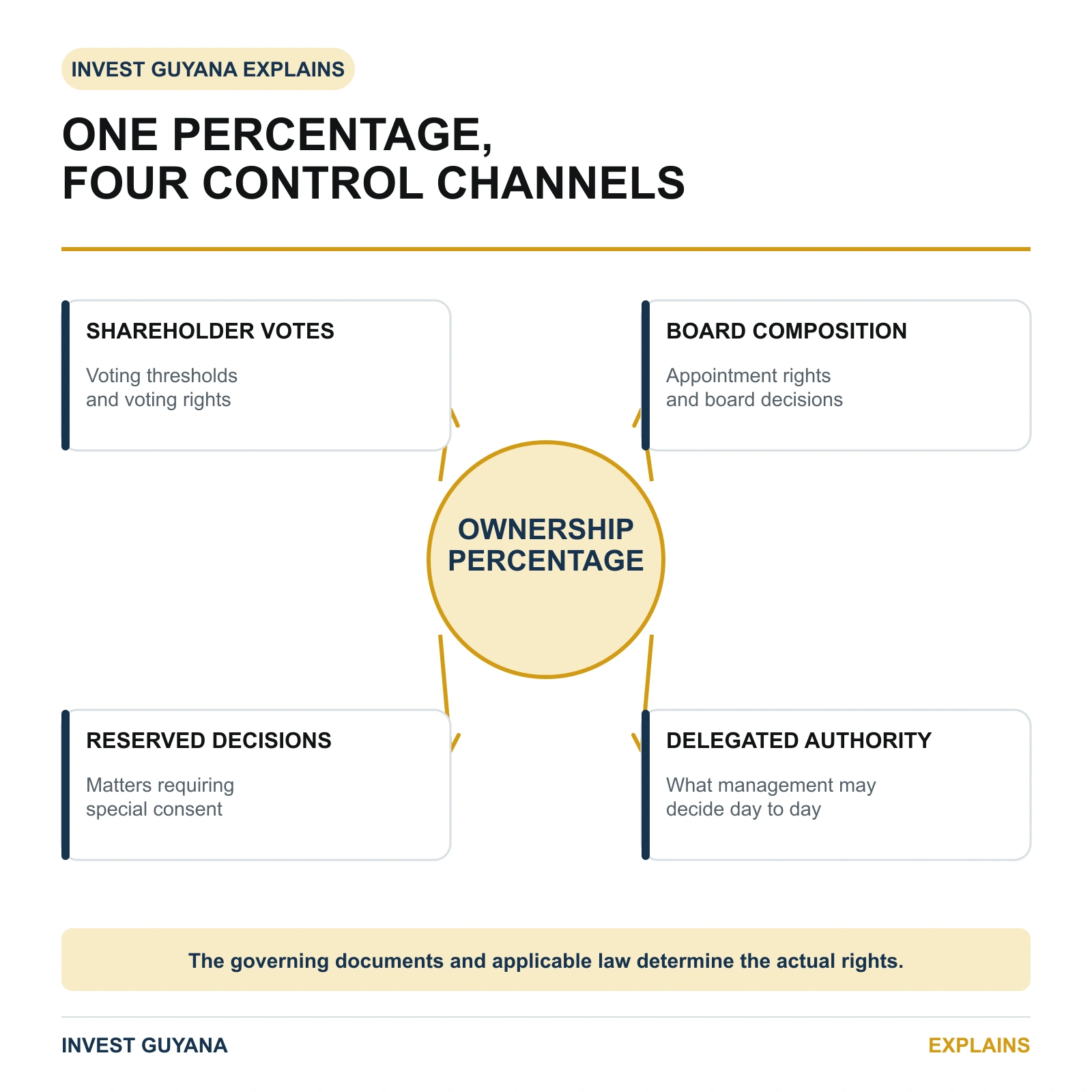
A 60% economic interest may carry a majority of ordinary votes, but practical control can depend on several channels. Who appoints directors? What is the board quorum? Does a chair have a casting vote? Which matters need an ordinary majority, a special resolution or the consent of both investors? Who can bind the company under its banking and signing authorities?
The World Bank’s institutional joint-venture checklist treats equity, board appointments, management authority, quorum and reserved decisions as separate design questions. That is useful because a single percentage cannot explain all of them. A minority investor might accept 40% of the economics only if it has reliable information rights, board representation and a voice over a short list of decisions that could fundamentally change the investment.
Reserved matters are often discussed as veto rights, but an undisciplined list can make ordinary management impossible. If both shareholders must approve every supplier contract, staff appointment or small capital expense, the company may be unable to operate at commercial speed. The agreement should distinguish genuine investor-protection decisions—such as changing the business, issuing shares, taking major debt or selling a material asset—from delegated management within an approved plan and budget.
Directors also do not become simple delegates who may ignore company law. The Act requires directors and officers to comply with the legislation, regulations, articles and by-laws. A shareholder’s nomination right does not erase the duties of the person appointed. Governance should therefore give investors oversight without pretending that every board decision belongs to the shareholder who nominated a particular director.
Dilution begins with the next funding decision
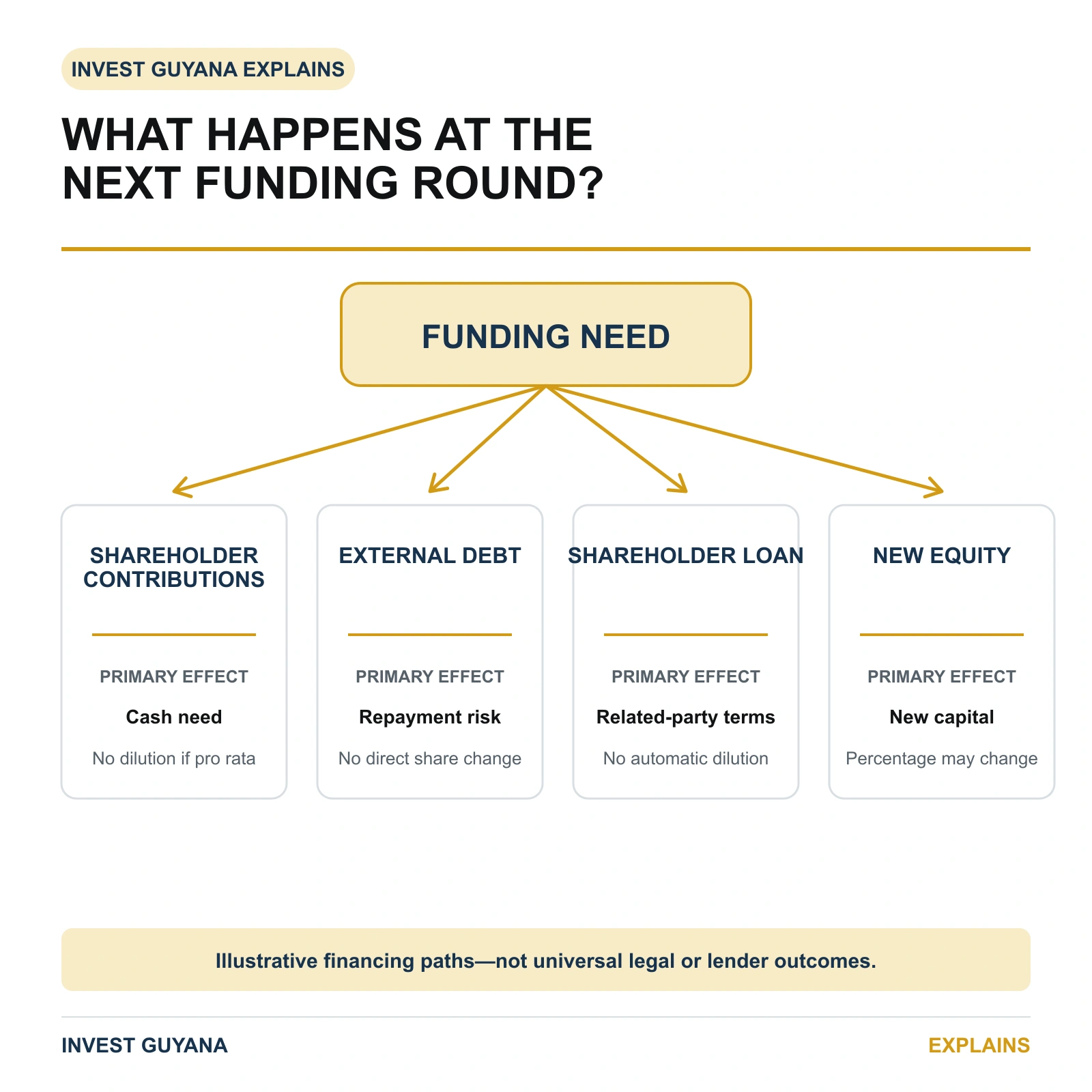
The first share issue rarely answers how the company will finance growth. If the processing plant needs another G$200 million, will both shareholders contribute in proportion to their holdings? May the company borrow instead? What happens if one investor cannot or will not fund? Can the other advance a shareholder loan, subscribe for additional shares or bring in a new investor?
Those choices affect risk, return and control differently. Debt may preserve percentages while increasing repayment pressure. New equity may strengthen the balance sheet while diluting a shareholder who does not participate. A shareholder loan can rank differently from share capital and may create connected-party questions. The agreement, financial model and corporate documents should tell the same story about funding priority, approval and consequence.
Guyana’s Companies Act does not make pre-emptive protection automatic in every company. Section 33 says that if the articles so provide, shares of a class generally must first be offered to holders of that class in proportion to their holdings, subject to listed exceptions. An investor who expects the opportunity to maintain its percentage should therefore verify the articles and the proposed contractual mechanism rather than relying on the word “pre-emption” in a presentation.
Dilution is not only mathematical. A new issue can change board influence, the ability to block a threshold decision and the share of future distributions or sale proceeds. The proper question is not simply “What percentage will I own?” but “What rights and obligations change at each funding outcome?”
Exit provisions are part of the original investment case
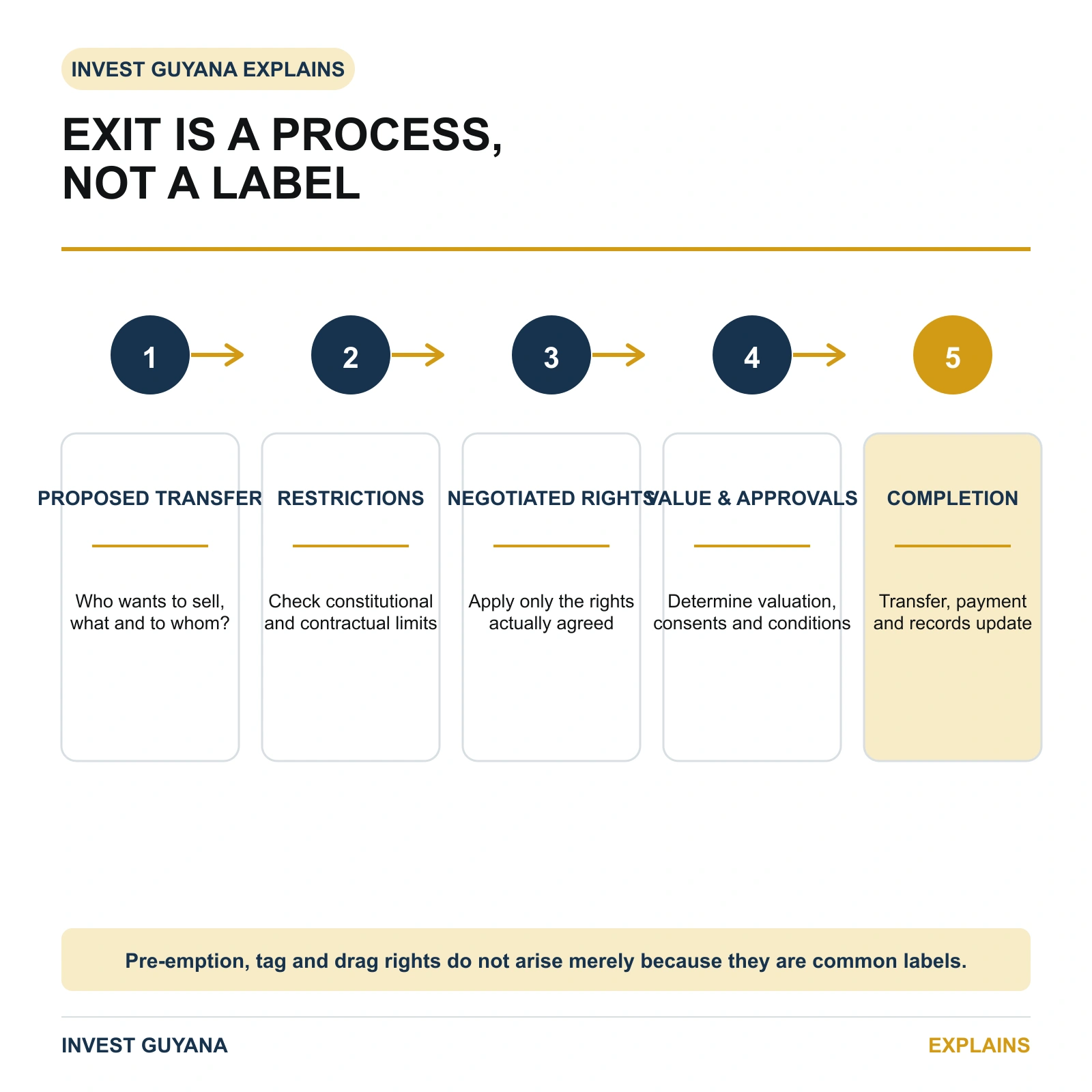
Partners often postpone exit discussions because they sound pessimistic at the start of a venture. Yet a shareholding in a private company may be difficult to sell without an agreed process. A buyer may want control; the remaining shareholder may not want an unknown partner; and permits, financing or commercial contracts may contain separate change-of-control requirements.
Section 199 of the Companies Act addresses transfer by a written instrument and recognises that a company’s by-laws may prescribe the instrument to be used. That statutory process is not a complete commercial exit plan. Parties may negotiate rights of first offer or refusal, consent requirements, tag-along protection for a minority, drag-along arrangements for a whole-company sale, or put and call options triggered by specified events. These are not interchangeable labels or guaranteed statutory defaults. The drafting must define the trigger, price, timing, eligible buyer, conditions and relationship with the company’s constitutional documents.
Valuation language deserves equal attention. “Fair value”, “market value” and a price set by formula can produce different outcomes. The agreement should identify who values the shares, the information available, the valuation date and whether control premiums, minority discounts, debt or unresolved shareholder loans are considered. A mechanism that merely says the parties will agree later may reproduce the dispute it was supposed to solve.
The Act also provides statutory approval and dissent mechanisms for specified fundamental actions, and section 224 permits a complainant to seek court relief where conduct is oppressive, unfairly prejudicial or unfairly disregards relevant interests. Those remedies matter, but they are not a substitute for a workable investment arrangement. Litigation is an end-stage protection, not an operating model.
Deadlock exposes the quality of the design
A 50–50 company can deadlock because neither side has a majority, but a 60–40 company can also stall where both parties must approve a reserved matter. A useful deadlock process first identifies whether the disagreement concerns routine management, an investor-protection matter or a failure to meet an agreed obligation. It can then move through defined escalation stages rather than immediately forcing a sale.
Some ventures refer disputes to senior representatives, mediation, expert determination or arbitration. Others create a buy-sell mechanism or allow an orderly wind-down after persistent deadlock. Each route has different financial and bargaining consequences. A mechanism that lets the better-funded party force a rapid purchase, for example, may be formally equal while producing a predictable commercial advantage.
Default provisions need the same discipline. A missed capital contribution, unauthorised related-party transaction, insolvency, change of control or material breach may justify different responses. Automatic forfeiture or transfer language can have serious legal and valuation consequences and requires specific advice. The agreement should not use one vague definition of default to cover every problem.
The investor should test the system, not just read the percentage
Before investing, a shareholder should reconcile the agreement with the current articles, by-laws, share register, beneficial-ownership filings, board authorities and financing documents. The Government’s company-incorporation service notes continuing obligations including annual returns, financial statements, beneficial-ownership declarations and notices of specified corporate changes. A signed agreement does not cure missing filings or an inaccurate ownership record.
The investor should then run scenarios: a budget overrun, a new share issue, a director appointment, a related-party contract, a major borrowing, a proposed sale and a partner default. For each event, who receives information, who recommends, who approves, what document records the decision and what happens if agreement is not reached?
Back at the processing company, the 60–40 split still matters. It determines part of the economics and voting position. But the investment becomes governable only when the parties understand how the company will make decisions, fund itself, protect against dilution and permit an orderly exit. A shareholder agreement is valuable not because it predicts every disagreement, but because it makes the consequences of the most important ones less uncertain.
The companion Invest Guyana Guide, How to Prepare a Joint-Venture Due-Diligence File in Guyana, turns these concepts into an evidence-led review process before the parties commit.
Editorial note: This article provides general information, not legal, tax, valuation or investment advice. The Act, current amendments, constitutional documents, transaction terms and project-specific approvals should be reviewed by qualified advisers before reliance.