
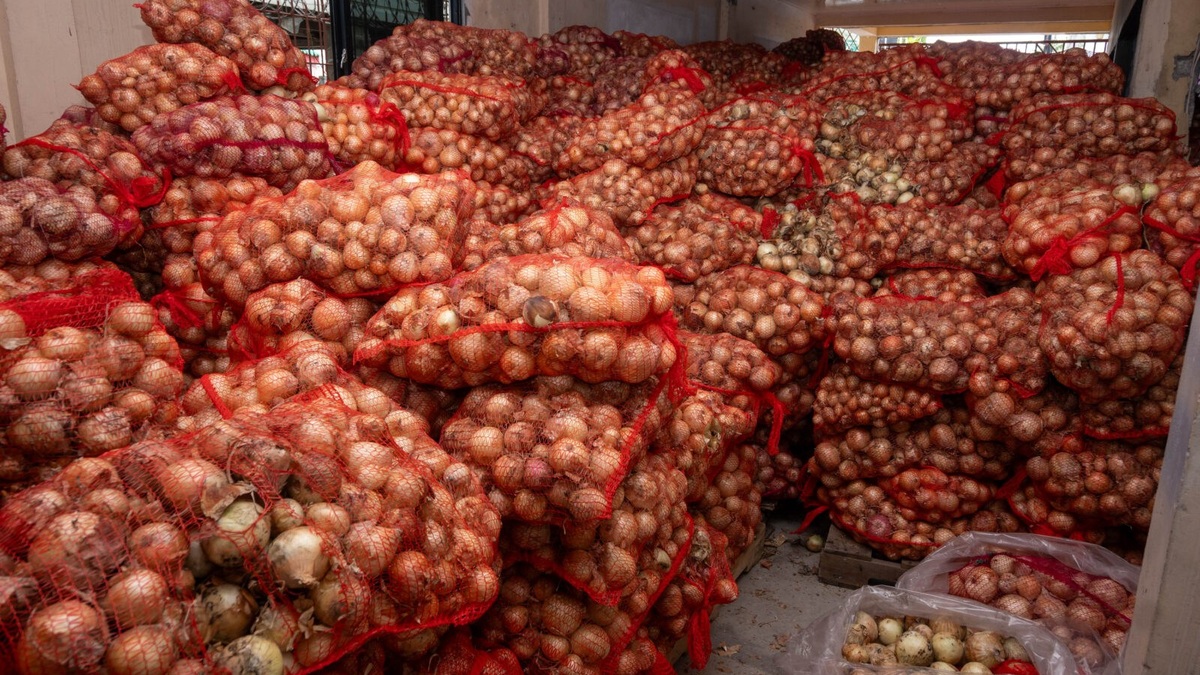
Guyana is targeting approximately 500 acres of onion cultivation across Regions Two, Five, Six and Nine as it seeks to replace imports with domestic production by the end of 2026.
Photo: Department of Public Information, Guyana.
The new target materially expands a crop-development programme that began with pilot production in Region Nine. It also creates a defined entry point for smaller growers: the government says farmers with one or two acres can seek planting material and technical support through the National Agricultural Research and Extension Institute.
The end-of-year import-replacement objective is a policy target, not a completed result. Actual output will depend on acreage planted, yields, seed availability, irrigation, crop protection, storage and the ability of local supply chains to deliver consistent quality at competitive prices.
The cultivation target has increased sharply
The Department of Public Information reported on 10 October that Region Nine is expected to provide the largest share of production, supported by cultivation in Regions Two, Five and Six. Agriculture Minister Zulfikar Mustapha placed the national target at about 500 acres.
That represents a significant increase from the programme’s earlier scale. In April, the Ministry of Agriculture said the Region Nine pilot had produced about 2,600 bags of onions, with roughly 2,000 bags retained for planting-material distribution. At that stage, the government was working toward approximately 200 acres nationally.
Official updates in May reported a 48-acre pilot for Region Two and expectations that Region Nine cultivation could reach about 300 acres. The newer 500-acre target therefore signals a broader and faster production push, although it does not establish how much of that land has already been planted.
Small growers are being invited into the programme
The support offer is commercially relevant because onion production can be undertaken on comparatively small plots. The government says NAREI will work with interested farmers who have one or two acres, providing technical guidance and attempting to supply planting material.
For growers, the opportunity is not limited to the crop itself. A larger onion programme can generate demand for seed and planting material, irrigation systems, soil testing, fertiliser, crop-protection services, mechanised land preparation, drying and curing equipment, storage, packaging and transport.
Prospective participants should confirm the availability and terms of public support directly with NAREI. The announcement does not guarantee inputs, financing, market contracts or minimum prices for every applicant.
The pilot has demonstrated local production potential
The Region Nine pilot provides the programme’s clearest production evidence. DPI reported that its harvest was valued at more than G$15 million. Earlier ministry reporting said the crop performed well at Manari Creek, supporting the decision to distribute planting material and expand cultivation to other parts of the country.
Local performance in one region, however, should not be assumed to translate automatically across all production zones. Soil conditions, rainfall, irrigation access, disease pressure and post-harvest handling will vary. Expansion will require region-specific agronomy and reliable extension support.
Import substitution is the central commercial test
Onions are a staple product with year-round domestic demand, which makes import substitution attractive. Successful local production could retain more spending in the domestic economy and create new income streams for farmers, input suppliers, aggregators and distributors.
The commercial benchmark is more demanding than simply producing a harvest. Local supply must be dependable throughout the year, graded consistently and delivered at prices that can compete with imported onions. Adequate curing and storage will be especially important because weak post-harvest systems can turn higher field output into spoilage rather than usable market supply.
The programme also supports the wider CARICOM objective of reducing the regional food-import bill by 25 per cent by 2030. Guyana has positioned agricultural diversification as both a food-security policy and a private-sector development opportunity.
What investors and suppliers should watch next
The next material indicators are verified planted acreage, the volume and source of planting material, regional yield data, storage capacity and evidence that local onions are replacing imports in wholesale and retail channels.
Businesses should also watch for official notices involving irrigation, extension services, input supply, cold or dry storage, packaging and agricultural finance. No open procurement opportunity is established by the October announcement itself; suppliers should monitor NAREI, the Ministry of Agriculture and the National Procurement and Tender Administration Board for formal notices.
Guyana’s 500-acre target is therefore best understood as a material project-advancement signal. It expands a proven pilot into a multi-region programme and opens a clearer route for small growers, while leaving execution, productivity and market competitiveness as the decisive tests.
Primary update: Department of Public Information, 10 October 2026.