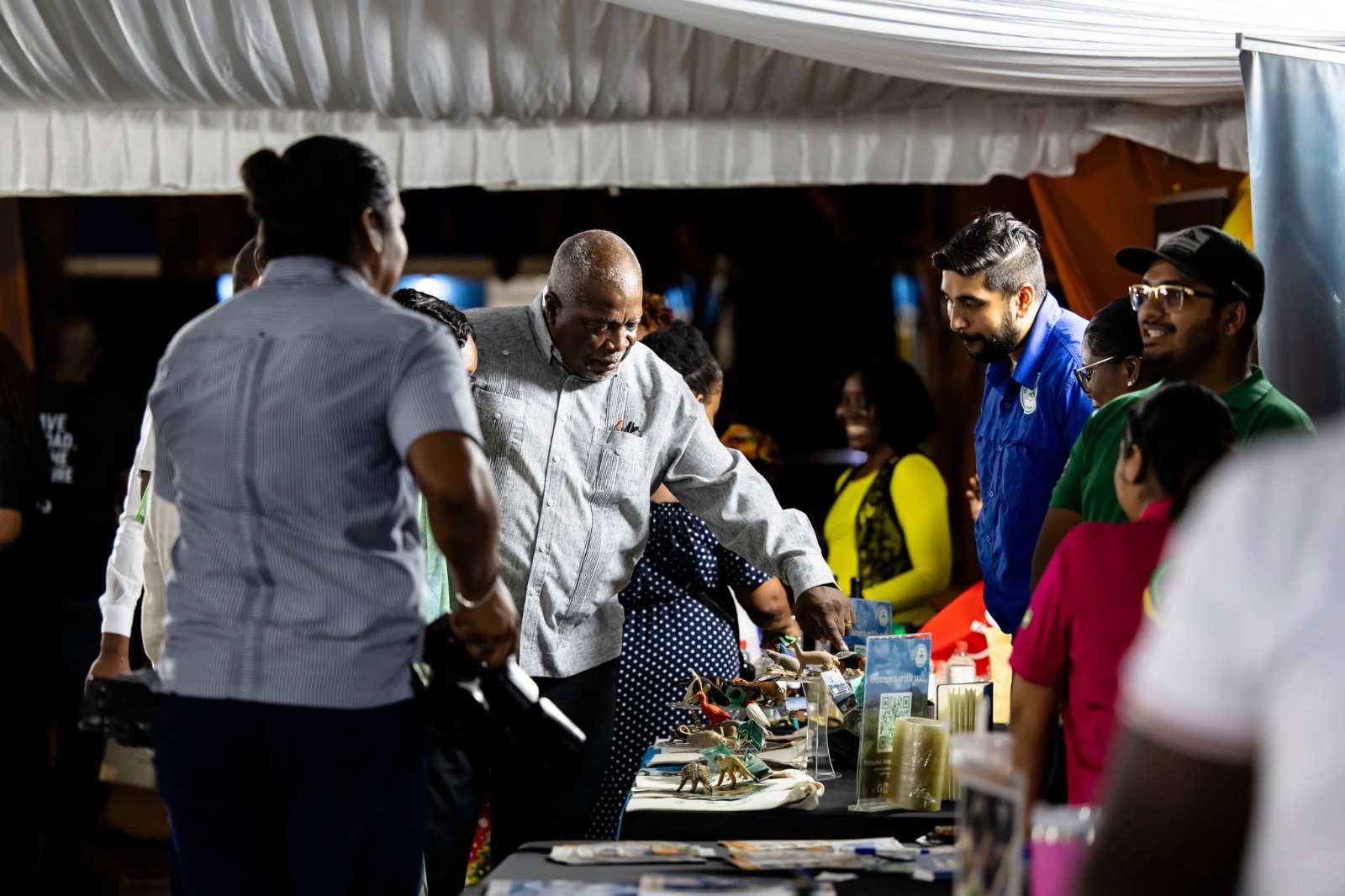
Visitors view products at an earlier GuyExpo. Photo: GuyExpo official website.
A Guyanese food producer may arrive at an exhibition with a product that sells well locally but few connections to hotels, retailers or overseas distributors. A potential buyer may arrive with a different problem: finding a supplier that can deliver consistent quantities, reliable packaging and the documentation a commercial relationship requires. GuyExpo is designed to put those conversations in the same place, but what happens after the first meeting matters just as much as the meeting itself.
The 2026 edition of Guyana's longstanding trade exhibition will run from 12 to 15 November at the National Exhibition Centre in Sophia, Georgetown. Its official event website describes four days bringing together exhibitors, investors, consumers and public-sector organisations under the theme Creating Tomorrow's Opportunities Through Today's Investments. The Ministry of Tourism, Industry and Commerce launched this year's event on 24 September.
For companies considering whether to exhibit, the central question is not simply how many people might walk through the gates. It is whether the event can help them reach the right people: prospective customers, distributors, financiers or partners capable of moving a business beyond a one-off sale.
More than a consumer showcase
GuyExpo has a public-facing side, where visitors encounter local products, services, food, tourism experiences and entertainment. It also has a business-facing purpose. The event's exhibitor information offers space in exhibition halls, pavilions, outdoor areas and food courts, allowing businesses with different products and presentation needs to consider how they might take part.
The official programme says the 2026 exhibition will place greater emphasis on the creative industries and include a second edition of BizLink, a business-to-business forum intended to connect entrepreneurs with investors, financial institutions, government agencies and strategic partners. Those are planned features described by the organisers; a detailed meeting schedule and confirmed outcomes have not yet been published on the event site.
That distinction matters. A crowded stand can generate visibility, but visibility is not the same as a purchase order. A useful business meeting tests whether there is a real fit between what a company can supply and what a buyer or partner needs. Price, capacity, quality, delivery times and follow-up all become important once the event is over.
For a small manufacturer, the most valuable contact may be a retailer looking for a dependable local line. For a services firm, it could be a developer seeking a specialist contractor. An overseas investor may use the event to compare local partners and understand the depth of Guyana's supplier base before making a commitment. These are possible uses of the exhibition, not deals that organisers have announced.
The distinction between a consumer sale and a commercial lead is useful here. A sale at a booth proves that one visitor wanted a product on one day. A repeat supply relationship asks much more of a business: dependable volumes, predictable pricing, appropriate standards and the ability to respond when demand rises. GuyExpo can create the introduction, while those operating questions determine whether the relationship can grow.
Where the commercial opportunity lies
The mix of exhibitors matters because Guyana's growth does not create opportunities for a single kind of company. The official site identifies spaces for small businesses, international exhibitors, tourism operators, manufacturers, service providers and creative enterprises. A company supplying packaging, transport or technology may find potential customers among the exhibitors themselves, even if it does not sell directly to the public.
Tourism offers one illustration of the broader market context. The Ministry of Finance's 2026 Mid-Year Report records 226,465 visitor arrivals in the first half of 2026, up 12% from the comparable period in 2025, and says 404 rooms were added to the national room stock during that half-year. More visitors and accommodation can increase demand for food, excursions, maintenance, furnishings and other services. Whether an individual GuyExpo exhibitor captures any of that demand depends on its product, competitiveness and ability to deliver.
The organisers are also giving exhibitors several routes into the event. The published space options include standard booths, higher-traffic positions, larger outdoor plots and food-court spaces. Businesses can review floor plans and submit a vendor registration form through the official site. The secretariat says it will confirm availability and next steps, so an application should not be treated as an allocated booth until that confirmation arrives.
For investors, the opportunity is not an exhibition stand alone. It is a concentrated chance to observe local firms, ask detailed questions and begin the due diligence that any serious partnership requires. GuyExpo may shorten the distance between an introduction and a substantive conversation, but it does not replace checks on a company's financial position, production capacity, legal standing or contractual obligations.
A practical test for exhibitors
The event's investment theme invites businesses to think beyond four days of foot traffic. A company that wants a distributor should know which markets it can serve and what volumes it can supply. A company seeking finance should be ready to explain how it earns revenue, what capital it needs and how that capital would be used. A producer hoping to enter a hotel or supermarket supply chain should understand the buyer's specifications and delivery expectations.
Those are general commercial considerations, not entry requirements announced by GuyExpo. They are what make an exhibition conversation more likely to continue after the venue closes. A contact list has limited value unless the business can turn initial interest into a proposal, a sample, a site visit or a negotiated agreement.
For a producer hoping to sell beyond Guyana, the questions become more exacting. A distributor may want to know whether labelling and packaging suit its market, how long a product can be stored, who manages shipping and whether the producer can maintain supply after an initial order. Exhibiting does not answer those questions automatically, but it gives both sides a reason to ask them early. The same applies to technology and service providers, whose prospective clients may need evidence of technical support, staffing and past delivery.
An exhibitor can also assess whether the event fits its own commercial objective. A company seeking broad public awareness may benefit from a different stand location and presentation than a firm hoping to arrange a handful of serious buyer meetings. The official site provides floor plans and contact details, but it does not yet publish a complete business-meeting timetable. Companies interested in BizLink or particular buyers should check directly with the secretariat rather than assume that booking a booth includes a scheduled introduction.
The same discipline applies to potential buyers and investors. An appealing display is only a starting point. Before signing contracts or advancing funds, they need to establish whether the supplier can meet the required standards and sustain performance over time.
This is especially important when the word investment is used broadly. A manufacturer buying equipment, a bank considering a loan and an investor taking an ownership stake are making different decisions, with different risks and obligations. GuyExpo's theme can bring those interests into conversation, but it does not turn them into a single financing programme. Each proposed transaction would still need its own terms, checks and approval process.
What remains to be confirmed
The core event details—dates, venue and the opportunity to register as an exhibitor—are published on the GuyExpo website. The site also provides a secretariat contact route for questions about exhibition space and sponsorship.
Other details may develop between launch and opening day. Businesses should confirm current space availability, fees, terms, programme times and any sector-specific participation requirements directly with the organisers before making travel or marketing commitments. The event's investment language should not be read as a promise that a particular company will obtain funding, secure a contract or reach an export market.
That measured view does not diminish GuyExpo's value. In a fast-changing economy, a well-run marketplace can help firms see demand that was previously hard to identify, while allowing buyers to discover suppliers they might otherwise miss. The real measure of the 2026 event will be what those introductions lead to after November: stronger commercial relationships, better-informed investment decisions and businesses able to meet the opportunities they encounter.