
Drone photograph from Invest Guyana’s media archive; contextual image, not the hypothetical project described.
Imagine a warehouse owner discovering storm damage after a difficult night. Stock has been affected, part of the building needs repair and deliveries to customers have stopped. The business has insurance, so the first reaction is relief: at least the financial consequences should be covered.
The next conversation introduces questions the owner had not separated before. What event caused the damage? Which property is insured? Does the cover extend to the interruption of trading, and what limits or conditions apply? One incident has produced several losses, but a policy does not necessarily answer all of them in the same way.
Insurance is most useful when understood before the incident. It is a contract for specified financial protection, not a general promise that every setback affecting a business will be made good.
Transferring defined financial consequences
A business pays a premium in exchange for protection described by an insurance contract. The insurer’s obligations depend on the covered risks, relevant terms and circumstances of the claim. The policy therefore matters as much as the fact that a premium has been paid.
The Bank of Guyana’s insurance information explains the roles of insurer, policyholder and premium, together with the relevance of limits, conditions and exclusions. These features establish the boundaries of the protection rather than being minor details added after it. Bank of Guyana insurance information.
For our warehouse owner, the commercial purpose is to transfer specified financial consequences that might otherwise fall entirely on the business. The contract does not prevent the storm, repair the supply chain in advance or guarantee that customers will never be inconvenienced.
This distinction is important because prevention and financial protection solve different problems. Maintaining premises, protecting stock and planning for disruption can remain valuable even where suitable insurance is in place. Insurance is part of risk management, not proof that the underlying risk has disappeared.
One event can create different losses
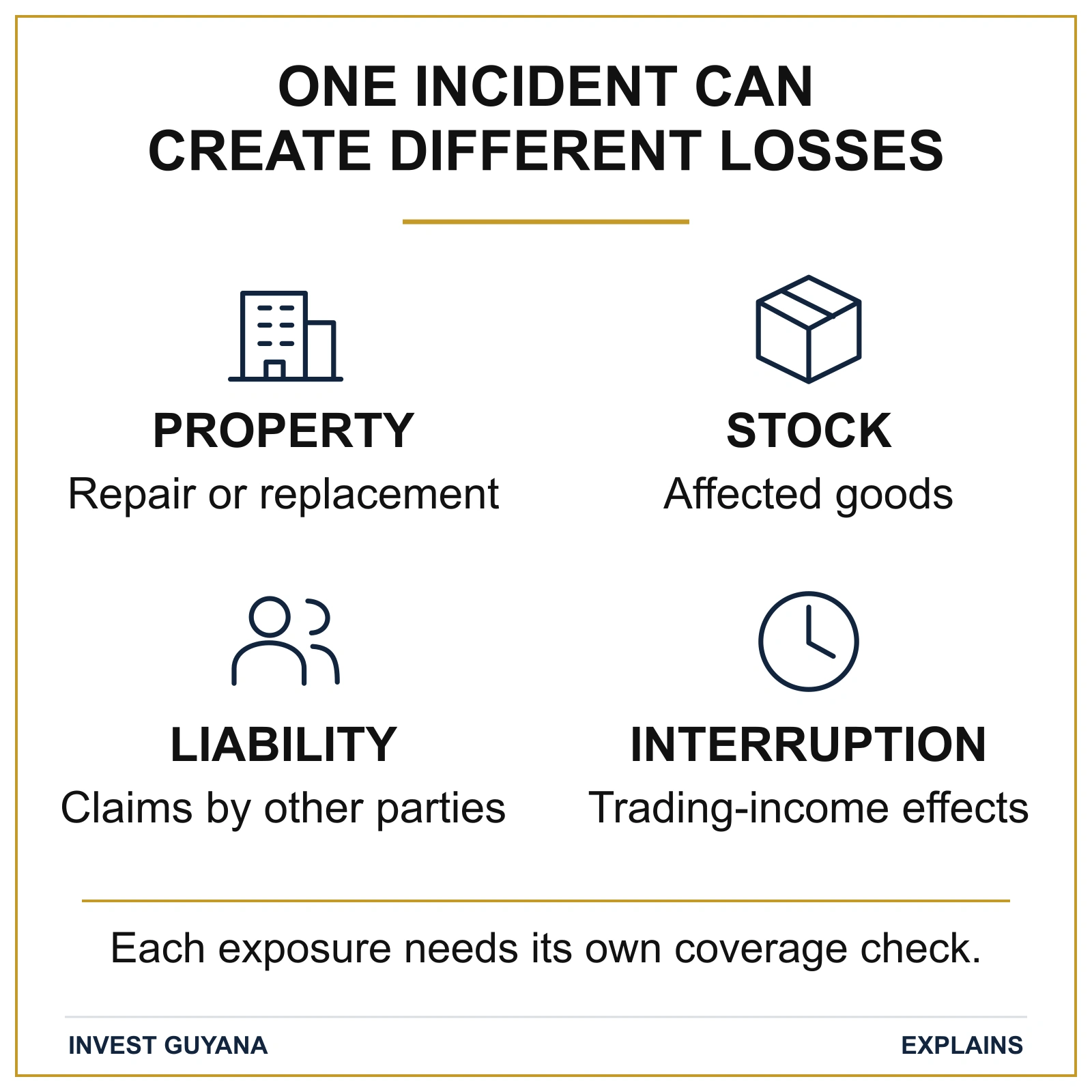
Damage to a building, damage to stock and interruption of income are related but distinct exposures. An incident might also create liability to another person. The fact that all these consequences arise on the same day does not make them one undifferentiated insured loss.
The National Association of Insurance Commissioners distinguishes business property, liability and interruption protection in its educational material. These are useful conceptual categories, while US policy forms and compulsory-cover rules do not establish Guyana requirements. NAIC explanation of small-business insurance.
Imagine the warehouse’s stock remaining intact while damage to access or equipment prevents normal dispatch. The business could experience lost trading income without losing the goods themselves. Alternatively, replacing damaged stock might still leave a period in which customers cannot be served.
Understanding the separate exposures makes the insurance discussion more precise. Instead of asking whether “the business” is covered in the abstract, the owner can understand what the contract says about particular assets, events and financial consequences.
Limits describe the extent of protection
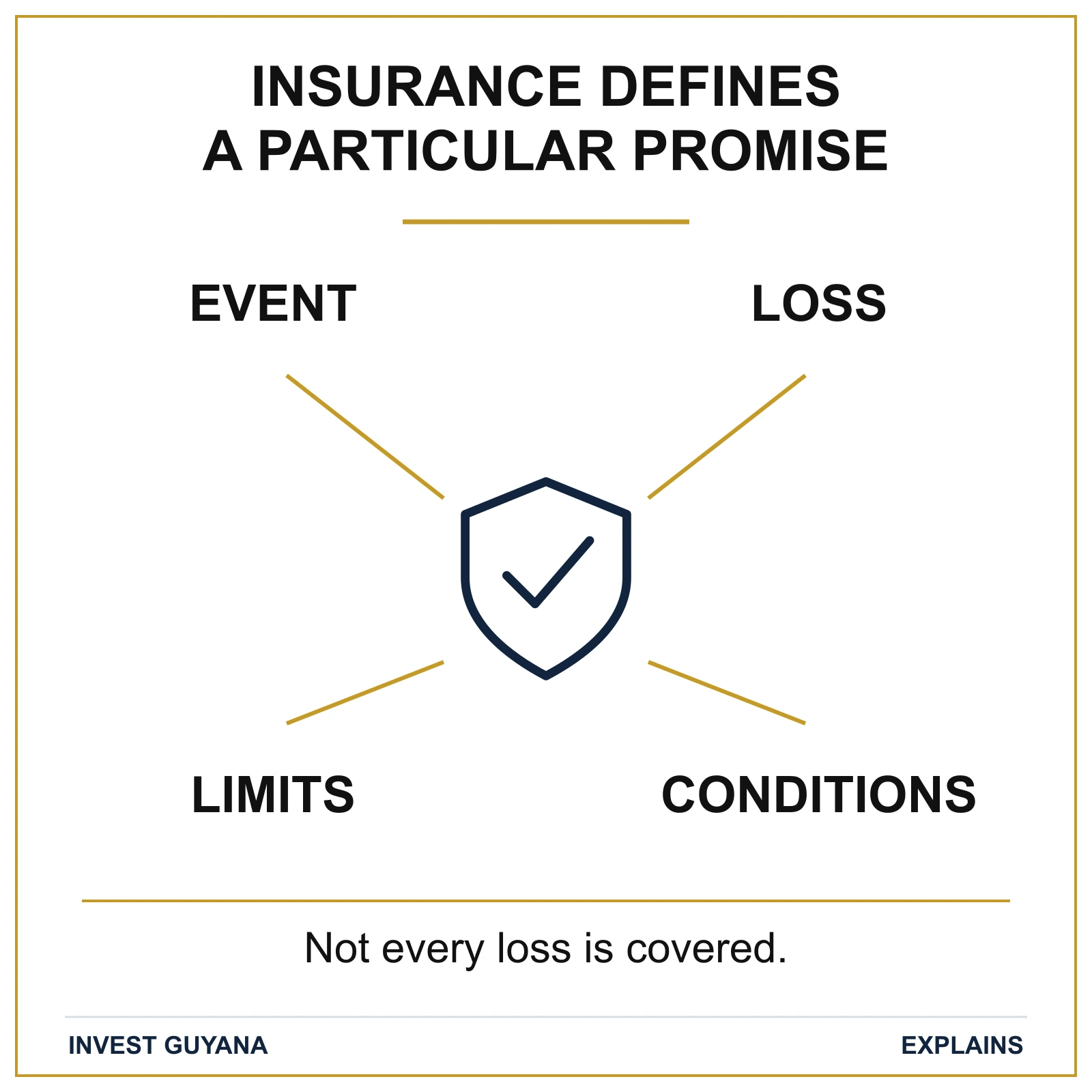
Insurance cover can be subject to limits, including different limits for different parts of a policy. A limit is not an assurance that the maximum amount will be paid whenever something goes wrong. The covered loss and other terms still determine the claim’s treatment.
Consider an original hypothetical example in which a covered loss is assessed at G$1 million and a G$100,000 excess applies to that loss. If there are no other adjustments or limiting conditions, G$900,000 would remain after that excess. The example explains the arithmetic only; actual policies can apply excesses and limits differently.
This distinction is especially important when discussing deductibles or excesses. They may operate per event, per claim or on another specified basis. A reader should not assume that one general description applies to every policy or that the amount always resets in the same way.
The warehouse owner therefore needs to understand the protection as a set of defined commitments. The headline sum insured is useful information, but it does not alone explain the amount recoverable from a particular incident.
Exclusions and conditions change the answer
An exclusion removes specified circumstances or losses from coverage. A condition sets a requirement relevant to the policy or claim. These are different features, although both can affect the result when an incident occurs.
Suppose the owner assumes that every form of water damage is treated alike. The cause and policy wording may matter considerably. It would be unsafe for a general article to promise that flooding, storm damage, gradual deterioration or a plumbing failure receive identical treatment.
The same care applies when the business changes. Additional premises, different stock or a new activity can change the risk being carried. Whether and how the insurer must be informed depends on the policy and circumstances, so the business should not assume that an old description automatically covers a substantially changed operation.
The practical value of reading conditions is not limited to avoiding disagreement. It helps the owner understand what information and conduct the insurance arrangement expects throughout its life, rather than treating the policy as something that becomes relevant only after a loss.
Interruption cover has its own boundaries
Business interruption protection is not a promise to replace every disappointing month’s revenue. The trigger, covered consequences, calculation and period of cover are determined by the policy. Ordinary weak demand and an insured interruption are not interchangeable concepts.
NAIC’s explanation emphasises policy wording and the circumstances triggering interruption cover. The principle is that lost income must fall within the agreed protection, not merely appear in the business’s accounts after an unwelcome event. NAIC on business interruption.
For our warehouse, one question concerns physical repairs and another concerns the trading consequences while normal operations are unavailable. A suitable policy may address specified interruption losses, but the owner cannot assume that supplier failure, every utility outage or every external disruption is included.
This is also why the duration of a disruption matters commercially even where some financial protection exists. Customers may find alternatives, staff may need different arrangements and deliveries may require reorganisation. An insurance recovery and restoration of ordinary business are related outcomes, not the same event.
A claim requires an account of what happened
After an incident, the business needs to establish the circumstances and losses relevant to its claim. Records of assets, purchases, stock and trading can help explain the position, subject to the insurer’s requirements. The availability of such evidence can matter when memories and estimates are not enough.
Imagine two identical warehouses experiencing similar damage. One has clear records of the affected stock and the other can only offer a rough recollection of what was present. Their evidence differs even before any question about policy coverage is decided.
This article does not set a universal claim deadline or submission process. Those matters require the actual policy and current insurer instructions. The conceptual point is that insurance responds to an evidenced event and loss under an agreement, rather than to an unsupported expectation about what should be paid.
It is equally important not to promise a particular settlement timetable. Assessment, documentation and the nature of the claim can vary. A business considering how it would continue after disruption should distinguish a possible insured recovery from cash already available today.
The same boundary is useful when a business acquires premises. The private-property purchase roadmap addresses the acquisition journey, while insurance concerns specified financial exposures under a separate agreement. Completing a purchase does not describe which losses a policy covers, and obtaining a policy does not establish that the property transaction is legally complete. Readers need both kinds of understanding when relevant, but combining them into a single supposed approval would conceal the very questions each process is designed to answer. A future insurance Guide can address policy-review preparation without duplicating this explanation of coverage.
Different losses can also reach the accounts at different times. Repair payments, replacement stock and lost receipts may affect cash before a claim is resolved, so the insured position and the immediate ability to continue trading deserve separate consideration.
Returning to the warehouse
The owner can now approach the insurance conversation with more precise expectations. The building, stock, liability exposure and interruption of income are separate questions. Cover depends on the event and policy, while limits, excesses and conditions shape the extent of protection.
That understanding does not make insurance less valuable. It makes the value clearer by identifying the risks transferred and those the business still carries. It also allows professional advice to focus on the actual operation rather than a vague request to “insure everything”.
The next explainer moves from the financial consequences of disruption to its operational path. Supply chains connect suppliers, transport, inventory and customers, and a delay in one small component can interrupt a much larger business.