

Drone photograph from Invest Guyana’s media archive; contextual image, not the hypothetical project described.
Imagine a business owner comparing two finance proposals for the same equipment purchase. One highlights a lower monthly payment, while the other appears to offer a more attractive interest rate. The owner assumes that one of those numbers must reveal which arrangement costs less, but the comparison becomes less obvious when the full terms are considered.
Borrowing creates both a price and a pattern of cash commitments. The rate helps determine interest, while the amount advanced, repayment timetable and applicable charges influence what the business pays and when. A proposal can look easier in a particular month while costing more over its full life.
Understanding these relationships does not require selecting a lender or predicting future rates. It begins by separating the cost of finance from the size of an instalment and then asking what assumptions make the comparison meaningful.
The amount borrowed is not the cost of borrowing
The principal is the amount borrowed that remains to be repaid. Interest is a charge associated with borrowing, calculated according to the agreement. A payment may include both principal repayment and interest, so the whole payment should not automatically be described as the lender’s charge.
The Bank of Guyana’s educational material explains loans in terms of money advanced and repayment with interest. This basic relationship is the starting point, but the actual finance agreement determines how it operates for a particular borrower. Bank of Guyana explanation of loans.
Consider a simplified interest-only illustration: G$1 million outstanding for one year at 10% simple annual interest produces G$100,000 of interest, before fees. Repaying principal during the year would change that illustration if interest were instead calculated on the reducing balance. The example shows why a percentage needs a calculation basis.
Our equipment buyer therefore cannot compare two rates responsibly without understanding what amount each applies to and how the balance changes. The same printed percentage can be uninformative when the surrounding assumptions differ.
Smaller payments can extend the commitment
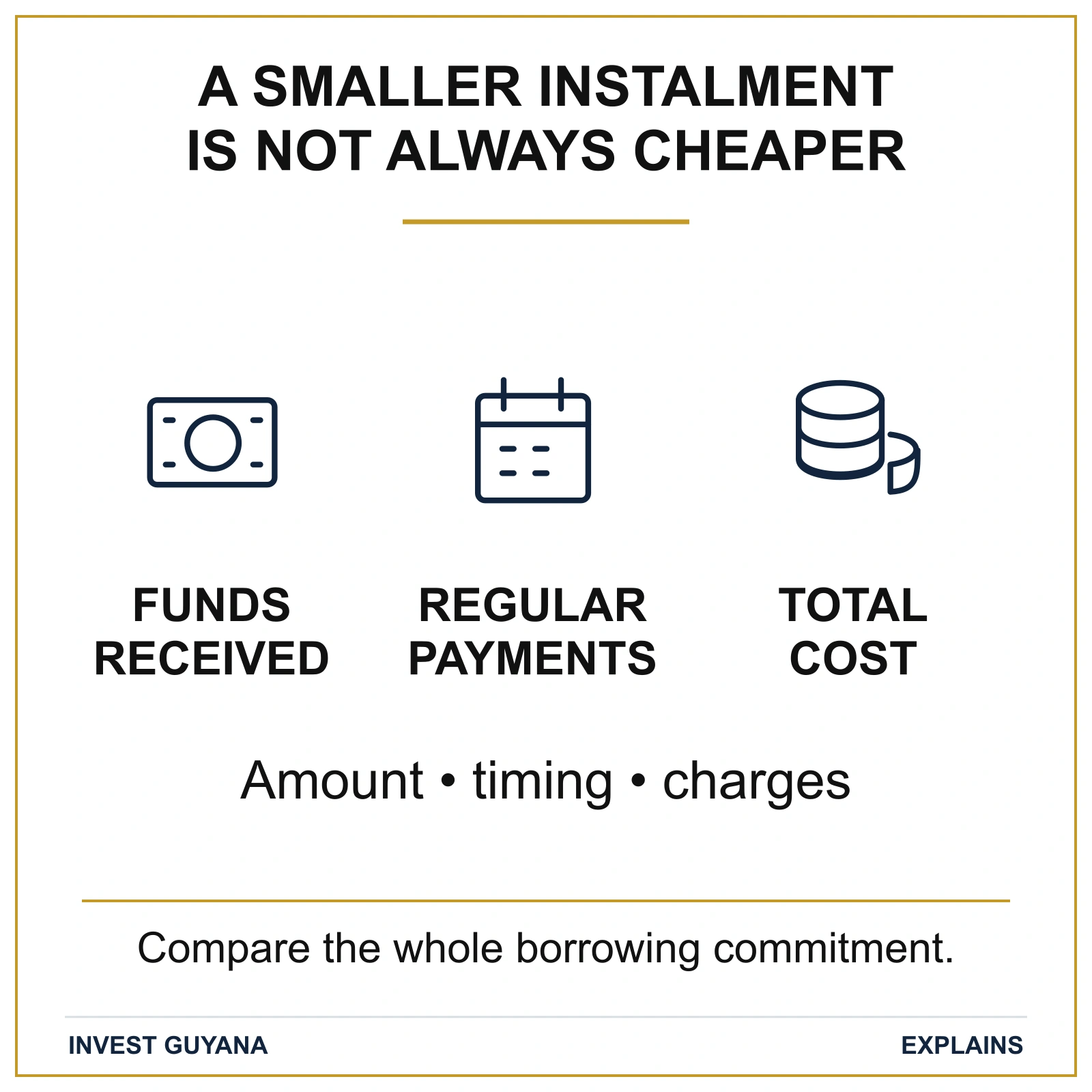
Spreading repayment over a longer period can reduce the amount due in each instalment, all else equal. However, the borrower may then pay interest for longer. A lower monthly burden and a lower total cost are therefore different potential benefits, not two names for the same outcome.
BDC’s discussion of business lending distinguishes repayment structure and amortisation from the quoted rate. The general principle applies to interpreting a proposal, while its Canadian lending examples and product conditions should not be treated as Guyana requirements. BDC explanation of loan terms.
The distinction can matter for a seasonal enterprise. Smaller regular payments might leave more operating cash during quiet months, but the owner still needs to understand the longer commitment. A shorter schedule might reduce the period of indebtedness while demanding more cash before the business is comfortable generating it.
Neither pattern is automatically superior. The point is to identify the trade-off accurately. A finance decision should not be presented as a saving merely because one instalment is smaller than another.
Term and repayment profile are separate details
The contractual loan term and the period used to calculate repayment need not always be identical. Some arrangements can leave a balance due at a particular date even though the regular instalments were calculated over a longer period. The details come from the agreement, not from the product’s everyday description. BDC’s explanations of loan term and amortisation and balloon payments illustrate these distinctions; their Canadian product examples are not Guyana lending requirements.
Imagine a proposal that seems affordable because its regular payments are modest, but includes a substantial final amount. The enterprise must understand how that final obligation will be met. It cannot assume that refinancing will be available simply because the early instalments fit its current budget.
The same care applies to payment holidays or an initial period with reduced payments. Such features may change the timing of the burden without eliminating it. Interest treatment, later payments and any remaining balance determine the actual effect.
For our equipment buyer, this turns the comparison from a single monthly figure into a view of the entire commitment. The timing of each obligation can matter as much as its total, particularly if the machine takes time to enter productive service.
Fixed and floating rates allocate uncertainty differently
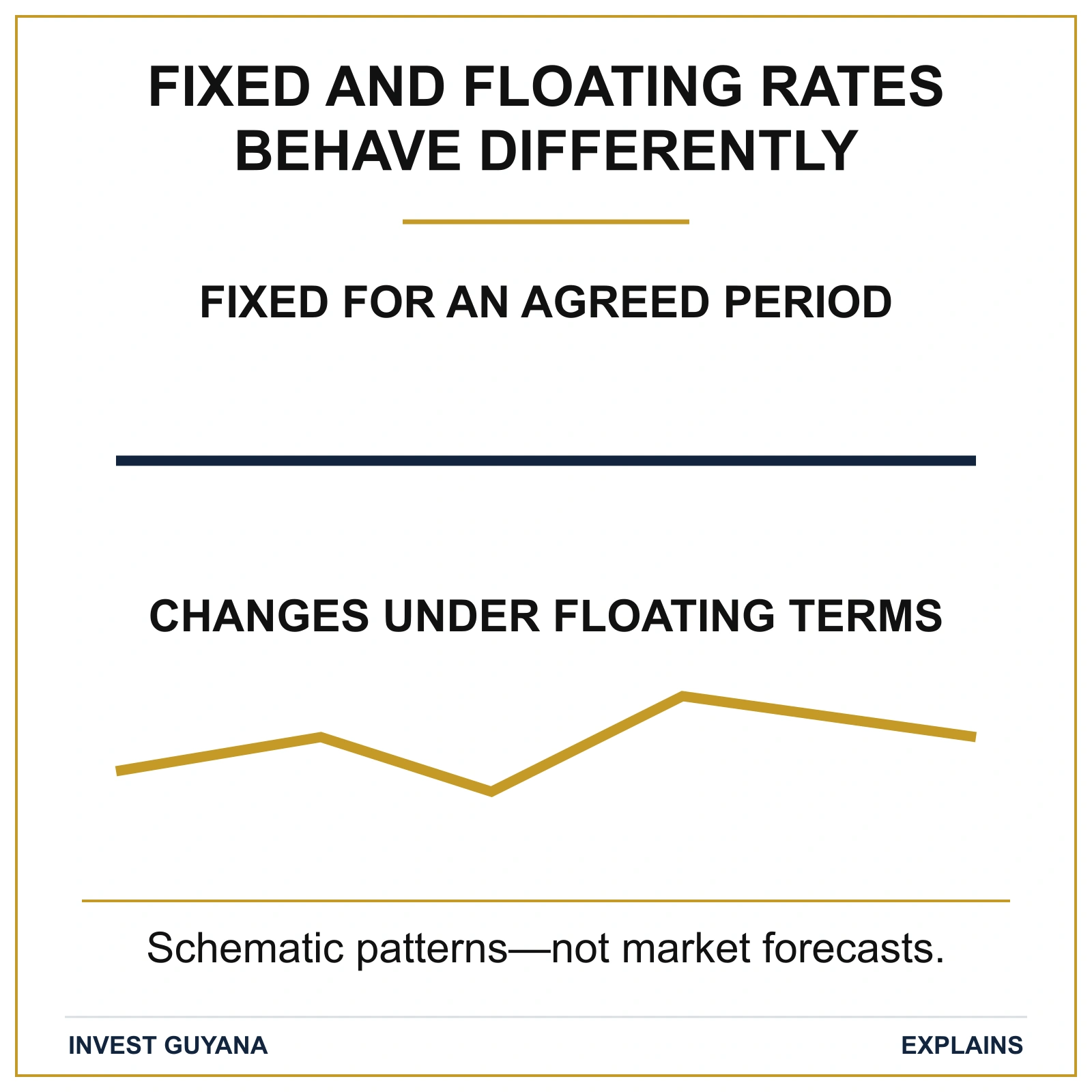
A fixed rate remains unchanged for the period specified by the agreement. A floating rate changes under an agreed mechanism, commonly involving a reference rate and a margin. The actual reset conditions determine how changes affect the borrower. BDC explanation of fixed and variable rates.
The practical difference concerns exposure to future changes. A fixed-rate period can make that element of borrowing more predictable, while a floating arrangement leaves it responsive to the agreed benchmark. This does not establish which will prove cheaper, and a fixed interest rate does not make every possible fee or contractual consequence fixed.
Suppose our owner plans the expansion on the assumption that sales will take a year to develop. If the financing cost can change during that interval, the forecast needs to acknowledge the uncertainty. Predictability itself may have value, but its price and limits must be understood rather than assumed.
A comparison should also distinguish an initial rate from the rate applying later. A favourable beginning does not describe the entire borrowing period when the terms provide for a subsequent reset or different calculation.
Fees belong in the cost discussion
Interest is not necessarily the only charge associated with a financing arrangement. Application, arrangement or other applicable charges can affect the amount of usable money received and the overall cost. Their names, amounts and treatment depend on the proposal, so they should not be assumed from a generic list.
The Guyana Association of Bankers’ published Code of Banking Practice treats interest calculations, charges and repayment information as separate matters. It is an industry code, not legislation, but it illustrates why the headline rate cannot describe the entire agreement. Guyana Association of Bankers’ code.
Imagine two hypothetical advances with the same stated principal and interest rate. If one deducts a charge before disbursement, the cash available to buy equipment differs. The borrower needs to distinguish the nominal advance from the net funds received and the payments required afterwards.
Flexibility can also have economic value or cost. Early repayment, changes to the schedule or other adjustments may have conditions. The business should understand those terms before treating an ability to change course as an automatic feature of the loan.
Affordability is a cash-flow question
A low total cost does not by itself prove that a business can meet every payment on time. Repayment capacity depends on the cash available when obligations fall due, including the other demands placed on that cash. This connects borrowing directly to the earlier cash-flow explainer.
Suppose the equipment generates additional revenue only after installation, testing and customer orders. Payments beginning before those receipts arrive must be supported from somewhere else. A projected annual profit does not automatically finance the opening months.
The converse also matters. A comfortably affordable payment is not evidence that the financing represents the lowest total cost or the best fit for every future situation. The business is evaluating several dimensions, and it should name the one it is discussing rather than compressing them all into “cheap”.
Currency can add another dimension when repayments and operating receipts are in different currencies. The exchange-rate article explains that separate exposure. It should not disappear inside a borrowing comparison simply because the interest rate is clearly stated.
The distinction between a financial concept and a practical application route is particularly important for readers who have used the residential mortgage preparation Guide. That Guide concerns a specific preparation task; this article explains how to interpret borrowing costs more generally. A business equipment loan should not inherit a residential product’s conditions merely because both involve interest and instalments. The mechanics help readers ask better questions, while the actual proposal supplies the answers for the transaction being considered.
The machine’s expected working life also deserves separate attention. A long repayment schedule does not ensure that the asset remains productive for the whole period, which is another reason to consider the financing alongside the investment itself.
Comparing the whole commitment
The owner can now return to the two proposals with a more disciplined interpretation. The interest rate concerns one part of the price, the instalment concerns a payment at a particular time, and the complete schedule and applicable charges describe a broader commitment.
An informed comparison holds the relevant assumptions together: what money is available, what must be paid, when it must be paid and which elements can change. This is a way to understand the offers, not a recommendation to accept one or a substitute for reviewing their documents.
The next explainer examines another part of many lending discussions: collateral and guarantees. These concern what supports a lender’s claim if repayment fails, which is a different question from either the interest charged or the business’s capacity to pay normally.