

Drone photograph from Invest Guyana’s media archive; contextual image, not the hypothetical project described.
Imagine two business partners preparing to expand a small manufacturing operation. They have customers, a workable production process and a need for additional capital. One proposes a bank loan, while the other suggests bringing in an investor who would receive a share of the company.
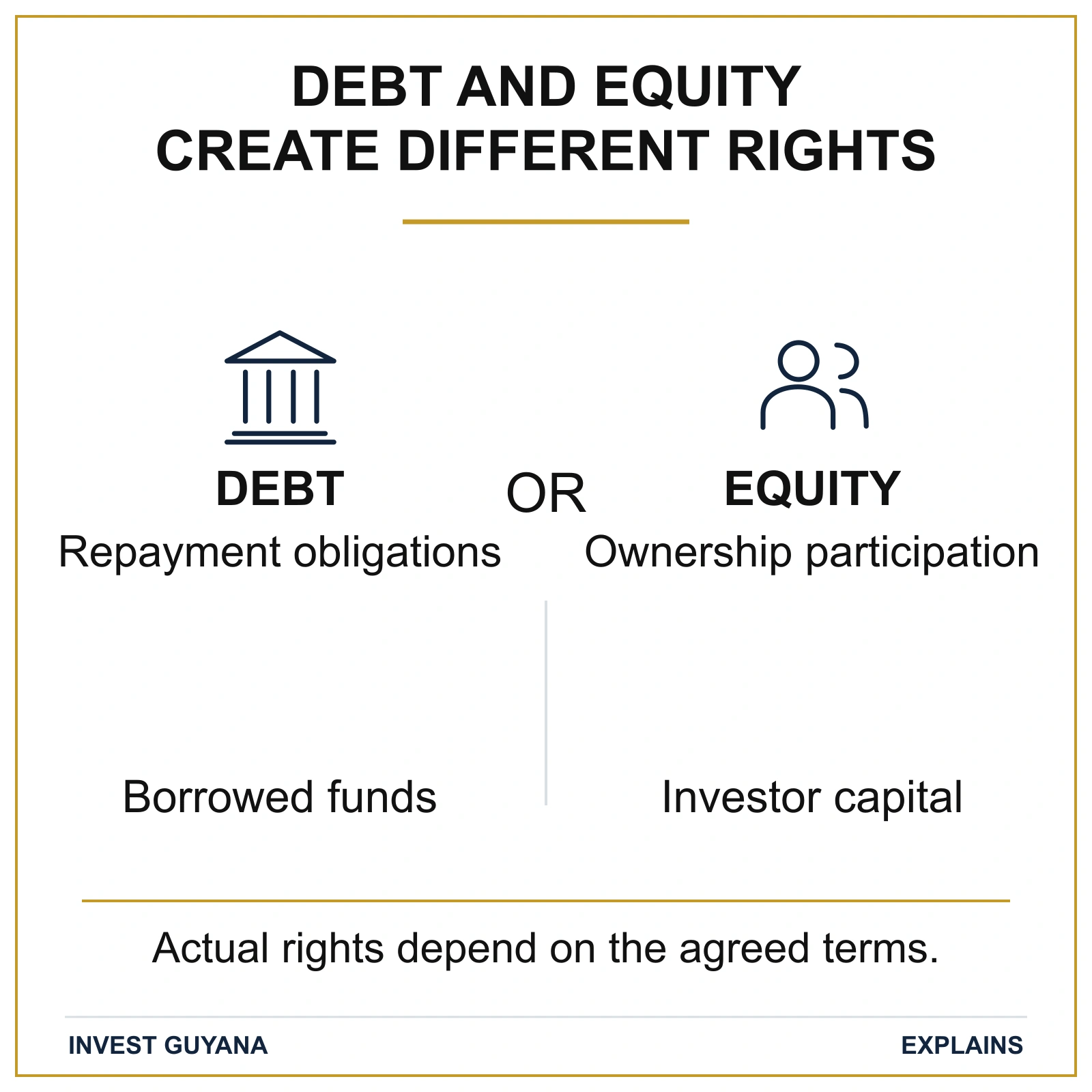
Both options could put money into the business, but the partners would not be exchanging the same promises. A lender ordinarily expects repayment under agreed terms. An equity investor acquires an ownership interest whose value and returns depend on the business and the rights attached to that investment.
The choice therefore concerns more than finding someone willing to provide funds. It changes how financial pressure, potential rewards and decision-making are distributed. Understanding those relationships is the foundation for discussing a financing structure without assuming that one form of capital is always better.
Borrowing creates an obligation
A conventional business loan advances money that the borrower must repay according to its agreement, normally with interest and potentially other charges. The lender assesses the borrower and applies its lending policy when deciding whether to offer finance. The Bank of Guyana’s financial-literacy material presents repayment and credit assessment as central features of a loan. Bank of Guyana explanation of loans.
For our manufacturer, the important consequence is that a slower sales month does not automatically suspend the agreed payment. The business must understand how the repayment schedule relates to its expected cash generation. A profitable project can still experience pressure if money arrives later than instalments fall due.
Borrowing does not ordinarily require the owners to sell shares in the company. However, preserving share ownership is not the same as preserving complete freedom over every business decision. A finance agreement may include conditions concerning reporting, further borrowing or other matters, depending on what the parties agree.
The practical question is therefore broader than whether the bank “owns part of the business”. The owners need to understand the obligations they are accepting and the room those obligations leave for ordinary operations, unexpected problems and future opportunities.
Equity introduces an owner
An equity investment provides capital in exchange for an ownership interest. In an ordinary share investment, the investor’s economic outcome is linked to the business’s performance and the value of that interest, rather than a standard loan repayment schedule. Specific rights vary, and more complex instruments can combine features of different forms of finance.
The US Small Business Administration’s general explanation of equity funding describes the exchange of capital for ownership. That principle is useful internationally, but its descriptions of US programmes or legal arrangements should not be treated as Guyana rules. SBA explanation of business funding.
Suppose the partners admit a third shareholder. They may gain capital, experience or commercial relationships, but they also share the economic value of the enterprise. If the business becomes much more valuable, the new shareholder participates according to the rights acquired rather than receiving only the return associated with an ordinary loan.
Control also requires careful interpretation. A shareholding does not automatically give every investor identical voting power or a board seat. Decision-making depends on the relevant rights, company arrangements and agreements, so the label “investor” alone does not explain who can decide what.
Different capital asks different questions
A lender and an equity investor may examine the same business but emphasise different aspects of its future. The lender needs a credible route to repayment. An equity investor considers how the ownership interest could generate an acceptable return and how the business might develop over time.
BDC’s comparison of lenders and investors highlights these differing perspectives. Neither perspective excuses unrealistic forecasts: both depend on reliable information about customers, costs, operations and risk. The difference is in the relationship the capital provider is being asked to enter. BDC on lenders and investors.
Our manufacturer could illustrate this with a proposed production line. A lender may focus on whether the expected cash generated by the investment can support the agreed payments. A prospective shareholder may also examine the line’s longer-term expansion potential, competitive position and effect on the company’s overall value.
The partners should not interpret different questions as evidence that one provider understands the business and the other does not. Each is assessing a different claim on the future. A financing conversation improves when the owners understand that claim before presenting the proposal.
Timing connects the capital to the investment
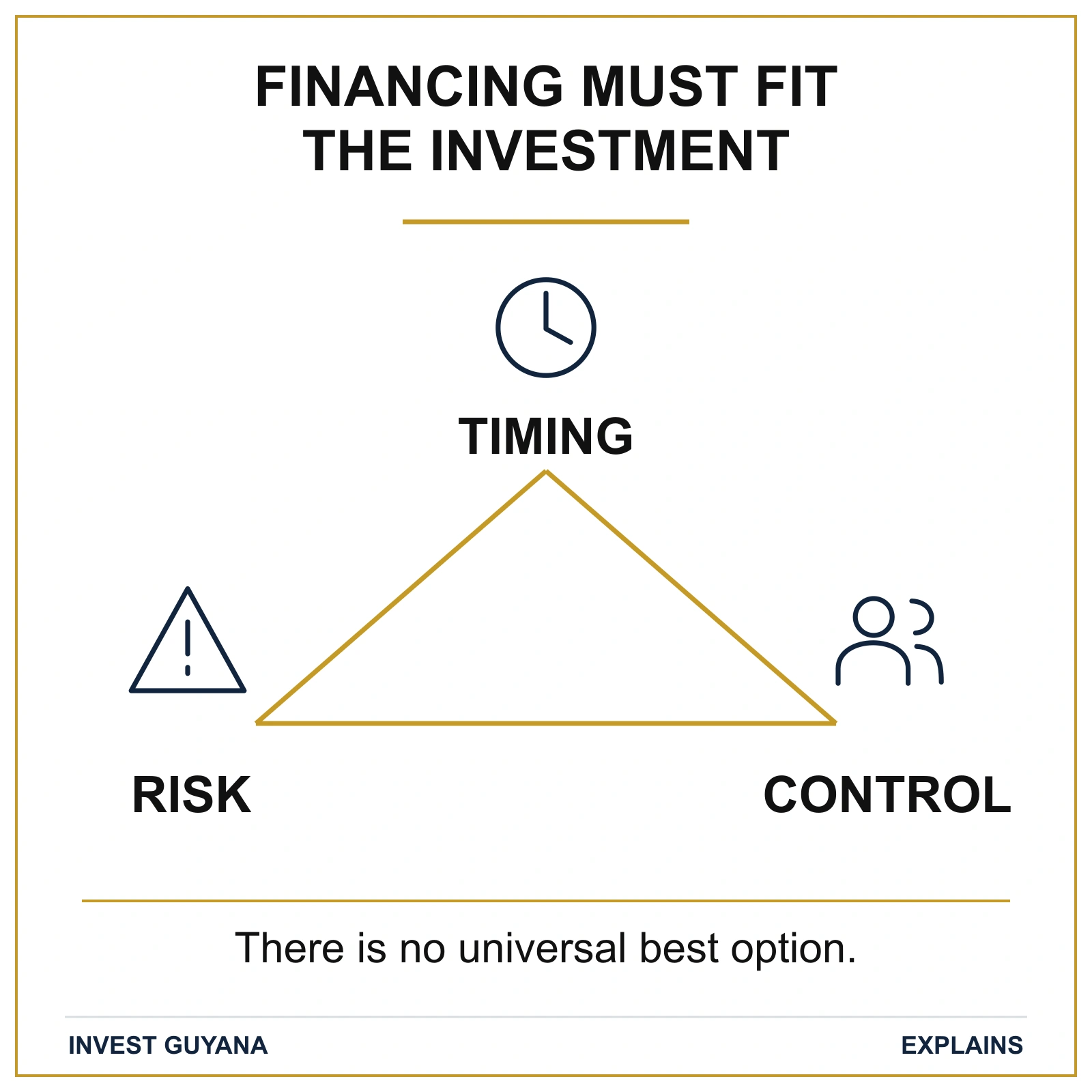
An enterprise may need finance for a short interval between buying stock and collecting customer payments, or for equipment expected to operate over many years. These needs differ even if the amount of money happens to be the same. The timing of the investment’s benefits influences how a funding arrangement fits.
Consider using short-term funding for an expansion that takes a long time to generate receipts. The business may face a refinancing or repayment event before the project is ready to support it. Conversely, surrendering an ownership interest to solve a brief, predictable cash gap has implications extending well beyond that immediate shortage.
These examples do not establish a universal rule about which instrument belongs to which purpose. They show why the duration and uncertainty of the need should be visible. The partners are designing a relationship between money committed now and value expected later.
The earlier cash-flow explainer helps here. A financial structure must accommodate the pattern of receipts and payments, not merely a favourable annual profit forecast. The same investment can look manageable under one timetable and much more difficult under another.
Sharing risk also means sharing consequences
Debt and equity distribute risk differently, but neither removes it from the business. Borrowing can create pressure when performance falls short of expectations. Selling equity can reduce the founders’ share of future value and introduce disagreements over strategy, distributions or the eventual direction of the company.
Imagine the factory expansion taking longer than expected. Under a loan, the partners would examine the contractual consequences for payments and any available arrangements. With a shareholder, they might face a different discussion about further capital, revised expectations or management decisions. Neither conversation becomes unnecessary simply because finance was successfully raised.
Good outcomes also have consequences. A rapidly successful company may repay a conventional loan under its terms while the founders retain their shares. An equity investor may continue participating in the enlarged business. That continuing participation is part of what the investor acquired, not an unexpected cost invented after success.
This is why comparing only the immediate cash received can be misleading. The financial structure concerns how the enterprise’s future is shared, including both disappointing and favourable outcomes.
A business can combine forms of capital
Many financing discussions involve a combination rather than an exclusive choice. Owners may contribute funds, outside shareholders may invest and lenders may provide debt. The resulting structure must be understood as a whole, because its different obligations and rights interact.
The International Finance Corporation’s proposal framework asks about anticipated debt and equity financing as part of a broader investment assessment. It illustrates the relevance of capital structure without implying that every business qualifies for IFC funding or must follow its application process. IFC financing framework.
For our partners, combining capital might allow the expansion to proceed under a different balance of ownership and repayment commitments. However, the mere presence of several funding sources does not prove that the arrangement is sustainable. The total commitments must still fit the business’s expected performance and capacity to absorb setbacks.
Nor should every instrument be forced into a simple two-column description. Special rights, conversion arrangements or redemption terms can change the economics. Where the documents create a more complex relationship, the business needs advice on those terms rather than relying on the everyday name of the funding.
Practical company-registration Guides establish how the enterprise is formed and recorded. Financing raises a subsequent question about how capital enters that enterprise and what commitments accompany it. A future funding-preparation Guide can organise the information needed for a proposal, while this explainer supplies the conceptual distinction between the relationships being proposed.
Returning to the partners’ decision
The partners can now discuss their expansion with a clearer understanding of what they are choosing. A loan is not simply money without an investor, and equity is not simply money without a monthly bill. Each establishes a different relationship concerning repayment, ownership, control and future value.
That understanding does not select a provider or determine the appropriate structure for every enterprise. It makes the discussion more informed by connecting the source of capital to the purpose, timing and uncertainty of the investment.
The next article narrows the focus to borrowing itself. Even after deciding that a loan belongs in the financing structure, a business still needs to understand why the headline interest rate, the monthly payment and the total borrowing cost can tell different stories.