
Drone photograph from Invest Guyana’s media archive; contextual image, not the hypothetical project described.
Imagine a supplier winning its largest order yet. The goods have been delivered, the invoice has been issued and the sale appears profitable. Then the owner checks the bank balance before paying staff and discovers that the successful month has left the business short of usable cash.
The customer has not yet paid, but the business has already paid its stock supplier. Wages and other bills cannot wait for the accounting result to become a bank deposit. The business has earned a margin on paper while financing the interval between paying for goods and receiving money from its customer.
This is the central distinction behind cash flow. Profit describes financial performance under the relevant accounting treatment, while cash flow follows the movement of money. Both are essential, and neither should be asked to answer the other’s question.
A sale and a receipt can happen at different times
Many businesses supply goods or services before receiving payment. Under accrual accounting, income and expenses can be recognised in periods that differ from the dates cash moves. That is why a profit figure may need adjustments before it explains the change in available cash. IFRS Foundation overview of IAS 7.
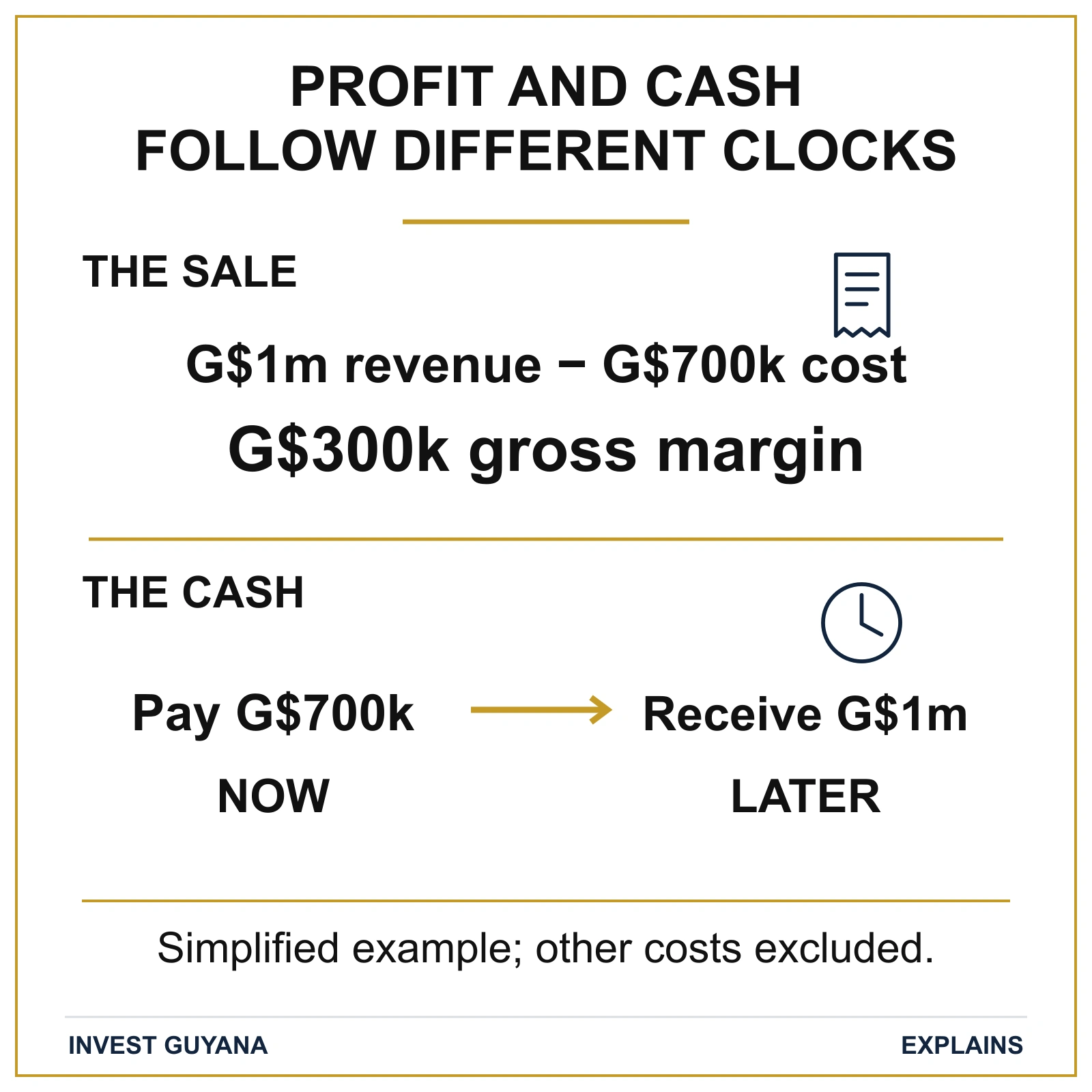
Consider an original, simplified example. A company pays G$700,000 for goods and subsequently invoices a customer G$1 million for them. Assuming the sale is appropriately recognised and ignoring all other expenses and taxes, the difference is a G$300,000 gross margin. If the customer has not paid, however, the sale has brought no cash into the bank account yet.
The example does not describe a loss disguised as success. It describes two different states of the same transaction. The company may have a valid amount due from its customer while lacking the cash needed to meet a bill today.
For the owner, this explains why “we made money on that order” does not settle the next payroll question. The amount earned and the date it becomes available must both be understood before the business can judge its immediate financial position.
Stock holds money in another form
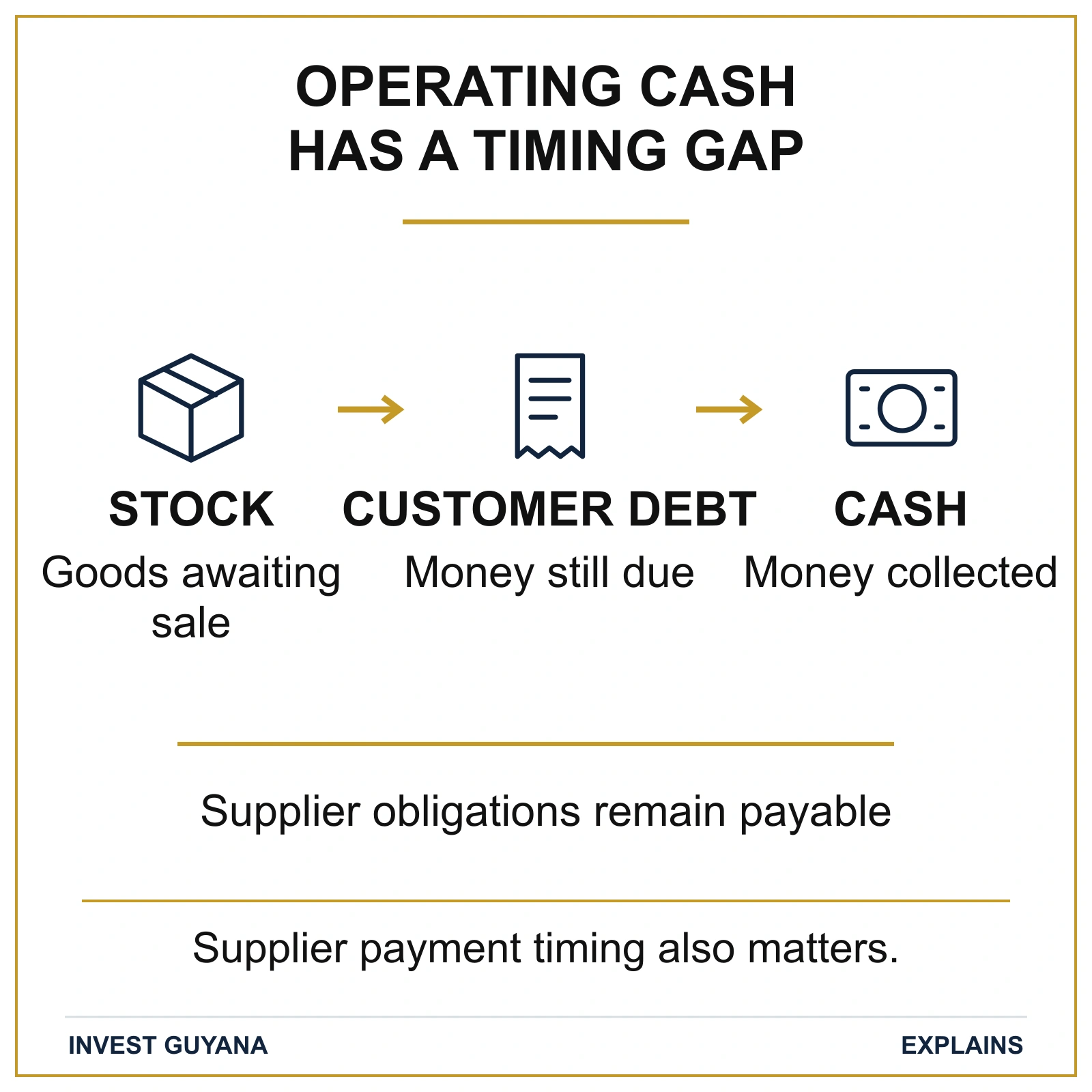
Cash can also leave a business before a sale exists. A retailer purchases inventory, stores it and waits for customers. During that interval, money has been converted into goods that may be valuable but cannot necessarily pay the electricity bill.
A company expanding its product range can therefore look stronger on the shop floor while becoming tighter in the bank account. More shelves are stocked, more customer needs can be met and more sales may follow. The financing need nevertheless arrives before those expected receipts.
The same issue arises when stock turns more slowly than planned. Goods may remain unsold because demand is weaker, the product mix is wrong or delivery to customers is delayed. A recorded inventory balance does not tell the owner how quickly those goods can become usable cash at the expected price.
This is one reason working capital matters during growth. BDC’s explanation follows the interval through inventory, sales and collection, showing how a growing enterprise may need to fund more activity before customer cash arrives. The principle is general business finance, not a Guyana-specific reporting requirement. BDC on working capital.
Supplier credit changes the timing
Not every purchase requires immediate payment. A supplier may allow time to settle an invoice, temporarily reducing the amount of cash needed at the point goods are received. That can help bridge the interval before a customer pays, but it also creates an obligation with its own due date.
Imagine our company obtaining thirty days to pay for stock while offering a customer sixty days to settle. Even if both parties meet those illustrative terms exactly, the company still faces a period in which the supplier must be paid before customer money arrives. The profit margin alone does not fund that interval.
Alternatively, a customer deposit could bring some cash in earlier. Its effect depends on the agreed arrangement and the costs that must be covered before delivery. Receiving money early does not make every part of it free for unrelated spending, because the business still has promises to fulfil.
These examples explain why cash flow is a relationship among dates as well as amounts. Inventory, customer receivables and supplier payables can move differently, and their combination determines how much money is tied up in ordinary operations.
Growth can widen the gap
It is tempting to assume that more sales automatically cure a cash shortage. Sometimes stronger sales generate more receipts, but rapid growth can initially increase the shortage when every additional order requires spending before collection. Success then increases the size of the interval the business must finance.
Suppose the supplier wins three orders instead of one, each with the same payment pattern. The expected margin rises, but so does the amount needed to buy goods before customers pay. Hiring additional staff or renting more space can add further payments before the enlarged business reaches a stable rhythm.
This is not a reason to avoid growth. It is a reason to understand what growth asks of the balance sheet and bank account. An opportunity can be commercially attractive while requiring more funding than the existing business can comfortably provide.
A useful distinction is between growth that generates cash quickly and growth that consumes cash before producing it. Two enterprises reporting the same percentage increase in revenue may experience very different pressure because their customers, suppliers and stock cycles differ.
Not every cash movement is a profit
Money can enter a business for reasons other than a sale. A loan brings cash into the account, but it also creates a repayment obligation. An owner’s capital contribution can increase available funds without representing income earned from customers.
Money can also leave for reasons that do not become an immediate equivalent expense. Buying a long-lived machine is different from paying for a month of routine services. Accounting and cash-flow reporting distinguish such categories because they describe different aspects of the business. IAS 7, operating, investing and financing cash flows.
For our supplier, a comfortable bank balance immediately after borrowing could conceal a weak operating pattern. The cash is real, but its source matters. If the business repeatedly needs new borrowing simply to replace money lost in ordinary trading, the issue is different from a temporary collection gap on profitable orders.
The reverse can also occur. A sound enterprise may show a lower balance after a planned investment that expands future capacity. Understanding the cause of the movement is more informative than deciding that every rise is success and every fall is failure.
A forecast is a view of timing
A cash-flow forecast places expected receipts and payments into the periods when money is expected to move. Its usefulness depends on the assumptions beneath it. A total for the year can conceal a difficult month in the middle, particularly when major payments arrive before seasonal or contract receipts.
Imagine a business expecting enough receipts over twelve months to cover its planned payments. That does not establish that it can meet a large equipment instalment in the second month. The later receipts do not travel backwards in time to settle an earlier obligation.
Uncertainty also belongs in the discussion. A customer may pay later than expected, stock may sell more slowly or a project may begin after its original date. Recognising those possibilities helps explain why an enterprise can need financial room even when its central forecast appears positive.
This article is not a spreadsheet tutorial or a prescription for a particular cash reserve. It explains why the timing assumptions deserve attention alongside the profit forecast. The appropriate response depends on the actual business, its commitments and the terms available to it.
The same distinction complements practical compliance Guides. An obligation can be correctly calculated while the business has failed to anticipate when the payment will require cash. Understanding the liability and funding its due date are connected responsibilities, but one does not automatically complete the other. A future cash-planning Guide can address the working document without repeating this explanation of why timing creates pressure.
Returning to the successful order
The owner now understands why the large sale and the small bank balance can coexist. The business has paid for goods, delivered them and earned a margin under the example’s assumptions, but it is still waiting for the receipt that replenishes cash. Its next decision concerns financing that interval and understanding whether the pattern is sustainable.
Cash flow gives that decision a clearer language. It separates trading performance, investment and funding, while showing how growth can increase the amount of money temporarily tied up in operations.
The next explainer considers where additional capital can come from. Borrowing and bringing in a shareholder may both put money into the account, but they create different relationships, obligations and claims on the business’s future.