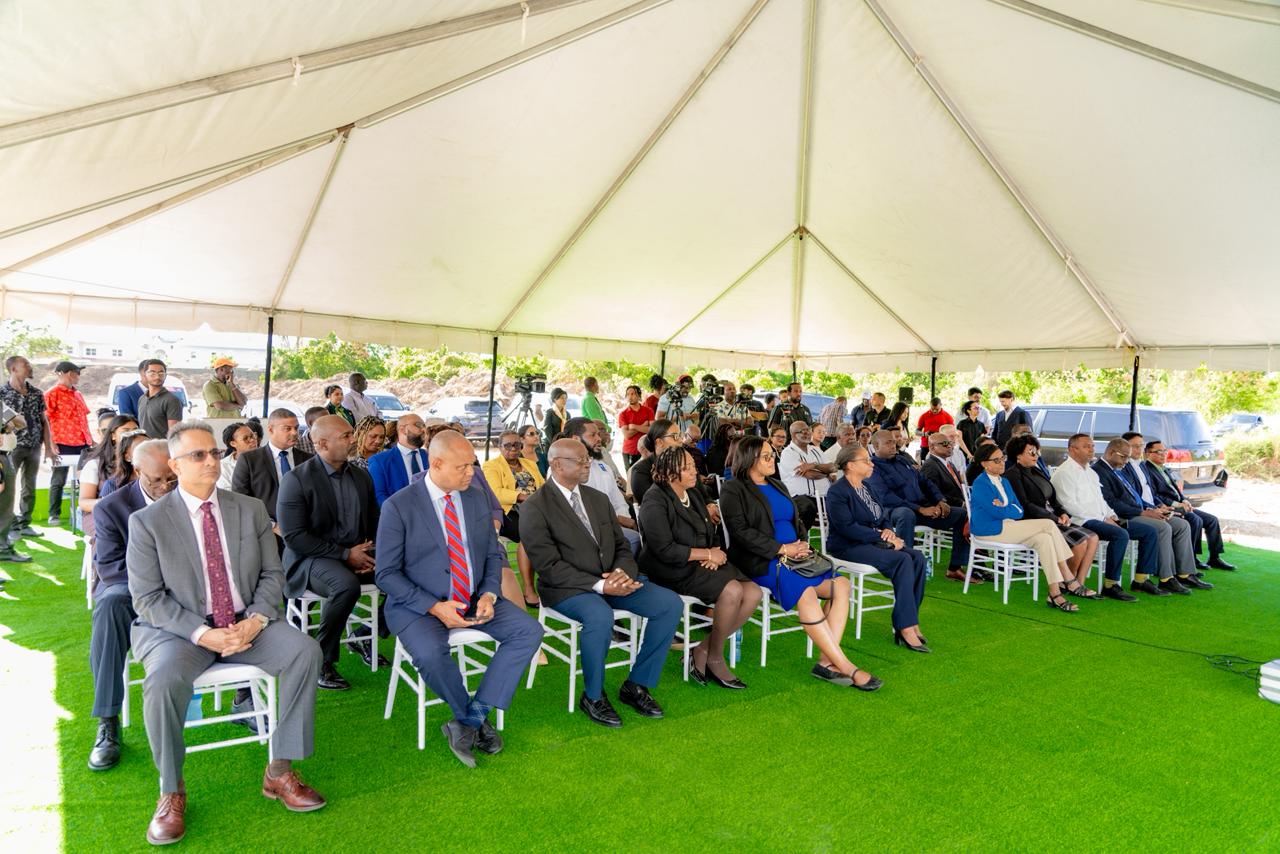
Officials and stakeholders attend the sod-turning ceremony for the regional law school at Turkeyen (Source: Department of Public Information).
Ground has been broken for a Council of Legal Education law school at the University of Guyana’s Turkeyen Campus, marking the start of Guyana’s planned role as the location of the Caribbean’s fourth regional institution for professional legal training.
The September 3 ceremony followed the Council of Legal Education’s endorsement of Guyana’s bid in September 2025 through the Bahamas Resolution and a subsequent framework agreement between the government and the regional body.
The project is planned for an eight-acre site at Turkeyen and is intended to serve students from across the Caribbean. The official update says the decision followed a feasibility assessment of long-term viability and demand for legal education.
The release confirms the site, regional purpose and groundbreaking, but it does not state the construction cost, financing structure, contractor, student capacity, completion date, opening date or official name of the school.
Expanding regional training capacity
The Council of Legal Education currently operates three regional law schools: Norman Manley Law School in Jamaica, Hugh Wooding Law School in Trinidad and Tobago, and Eugene Dupuch Law School in The Bahamas.
The Council was created under a 1971 regional agreement to provide professional legal education and practical training in the Caribbean. Students generally enter after completing an eligible Bachelor of Laws degree and pursue the Legal Education Certificate required for admission to practise in participating English-speaking Caribbean jurisdictions.
Guyana’s new institution is therefore intended to expand the region’s existing professional-training network rather than replace the University of Guyana’s undergraduate law programme.
The government said the project is aimed at addressing demand and capacity constraints at the existing schools. The September announcement does not quantify that unmet demand or provide projected enrolment by country.
An education-services investment
Locating the school at Turkeyen could strengthen Guyana’s position as a destination for regional professional education. Students arriving from other territories would create demand for accommodation, transportation, food, financial services and other supporting activities.
Those effects remain potential outcomes. No official forecast has been published for student numbers, employment, operating expenditure or the wider economic contribution of the institution.
The government has described the school as part of a broader cluster of specialised training facilities in Guyana, including institutions focused on oil and gas, hospitality, nursing and teacher education.
Plans also contemplate collaboration with the Caribbean Court of Justice to establish a CCJ Academy of Law on the site. The release does not say whether that component is included in the initial construction scope or will proceed under a separate timetable and agreement.
What remains to be confirmed
Groundbreaking is an important project milestone, but it does not by itself establish that the main construction contract has been awarded or that full site mobilisation has begun.
The next official disclosures should identify the approved design, project budget, source of financing, procurement record, contractor and supervising consultant. A construction schedule and planned opening date will also be needed before the project’s delivery risk can be assessed.
For prospective students, the key operational details will include the school’s name, governance, admissions rules, tuition and fees, programme capacity, faculty arrangements, accreditation and the first academic intake.
Until those details are released, the confirmed position is that Guyana has held a sod-turning ceremony for an eight-acre regional CLE law-school development at Turkeyen following regional endorsement and a feasibility process.