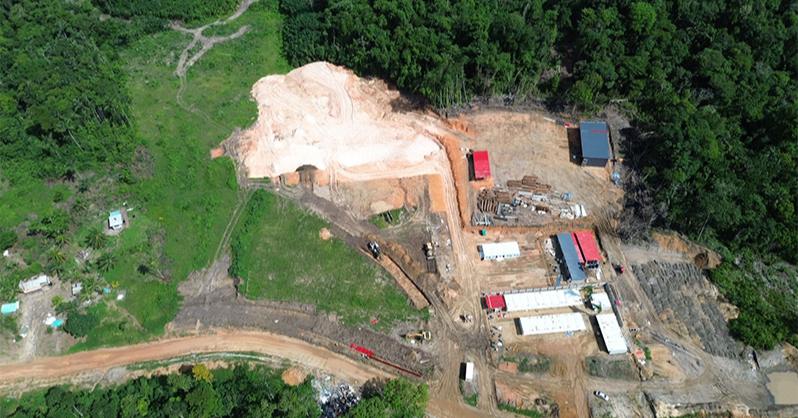
Construction site for the 50-bed Moruca Regional Hospital in Region One. Source: Department of Public Information.
Guyana is advancing a multi-region hospital construction programme intended to expand emergency, diagnostic, surgical and specialist services outside Georgetown, with individual projects at different stages of delivery.
The Ministry of Health’s latest update covers new facilities in Regions One, Three, Seven, Eight and Nine. Health Minister Dr Frank Anthony said a series of hospitals is expected to come into service between 2027 and 2028, but the stated dates remain project targets rather than completed milestones.
The largest project described in the update is the new 120-bed West Demerara Hospital in Region Three. The ministry is targeting completion by the end of 2027.
The planned facility is to include at least four operating theatres, an accident and emergency department, an imaging suite capable of X-rays, CT scans and MRI examinations, and a cardiac catheterisation laboratory.
According to the minister, the catheterisation laboratory is intended to allow some cardiac procedures, including the placement of stents, to be delivered in Region Three rather than requiring every patient to travel to Georgetown.
New capacity planned for hinterland regions
The programme also includes hospitals at Kato in Region Eight, Moruca in Region One and Lethem in Region Nine.
The Kato facility is planned as a 50-bed hospital that will complement the existing hospital at Mahdia. The Moruca Regional Hospital is also designed with 50 beds, together with imaging, accident and emergency services, specialist care and two operating theatres.
Construction excavation for the Moruca project began in February 2026. The government reported the project value at G$4.6 billion in its announcement marking the start of works.
The planned Lethem hospital is expected to have approximately 100 beds. The ministry said it has begun positioning specialist staff in the region in preparation for the expanded facility. Lethem already attracts some patients crossing from neighbouring Brazil for surgical services, according to the minister.
That cross-border demand is important context, but it should not be treated as a forecast of medical-tourism revenue. No patient-volume projection, commercial model or revenue estimate was included in the official update.
Bartica construction and Kamarang design remain separate stages
The government is targeting completion of the new Bartica Regional Hospital in 2028.
A deferred-payment agreement for the project was signed with China CAMC Engineering Co., Ltd. on 15 April 2026. The Ministry of Finance said the agreement supports engineering, design, procurement, construction, equipping, commissioning, testing, training and warranty work, with deferred financing of RMB190.95 million.
Kamarang is at an earlier stage. The community has allocated land for a proposed hospital, but the project remains in design. It should therefore not be described as being under construction.
The ministry also reported that theatres have been added at the existing district hospitals in Karasabai, Annai and Sand Creek to support visiting surgical teams. Those upgrades are distinct from the new-build hospital programme.
A combined national allocation, not individual project prices
Budget 2026 allocated G$24 billion for construction work on the paediatric and maternal hospital and six regional hospitals at Moruca, West Demerara, New Amsterdam, Bartica, Kato and Lethem.
That figure is a combined annual allocation across several projects. It should not be presented as the cost of the hospitals covered in this article or divided among them without project-level budget and contract documentation.
The broader health-sector allocation for 2026 was G$161.1 billion, covering infrastructure as well as equipment, digital systems, medicines, training and other services.
Delivery will depend on more than buildings
New regional hospitals can change where patients receive treatment only when the buildings, equipment, utilities, information systems and trained clinical teams are all ready to operate.
For businesses assessing the programme, the relevant opportunities will depend on procurement actually issued for construction, medical equipment, maintenance, logistics, technology and support services. A national budget allocation or announced facility does not by itself establish that a particular contract is open to suppliers.
Investors and service providers should watch for project-specific construction progress, equipment procurement, commissioning dates, staffing plans and confirmation that each facility has entered operation.
The latest update establishes a substantial pipeline of regional health infrastructure. It does not mean that all facilities are at the same stage or that every target date has been secured.