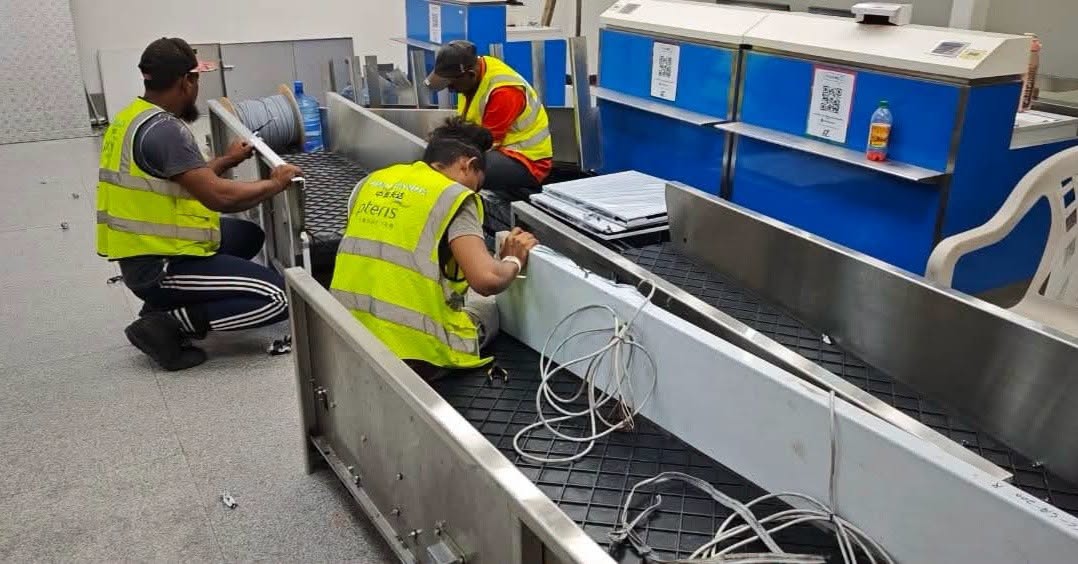
Installation work on CJIA’s new inline baggage-handling system. Source: Department of Public Information.
The Cheddi Jagan International Airport is targeting the end of September 2026 to complete installation, testing and commissioning of a new inline baggage-handling system intended to reduce congestion at check-in and strengthen the monitoring of checked luggage.
CJIA Engineering and Maintenance Manager Voshana Lall said the system is currently being installed and is expected to become operational after the testing and commissioning process.
The project changes the sequence used for departing baggage. Under the current arrangement described by airport officials, passengers must take checked luggage to a separate screening point before completing the check-in process, contributing to congestion in the terminal.
Under the new system, passengers will check in and have their bags weighed at the airline counter. The luggage will then move by conveyor for screening before being transferred for loading onto the aircraft.
Security and accountability form part of the upgrade
The airport says the new process will be supported by continuous closed-circuit television coverage from check-in to aircraft loading.
Baggage screeners and law-enforcement personnel stationed at the airport will also be required to wear body cameras, according to the official update.
Those measures are intended to provide greater visibility over the movement and handling of checked luggage. The update did not specify the system’s hourly processing capacity, equipment supplier, contract value or performance standards, so no claims should be made about those matters without additional project documentation.
The completion target should likewise be treated as a target. The system will not be operational merely because installation work is visible; testing and commissioning must still be completed.
Passenger and cargo growth are increasing operating demands
The baggage project forms part of a wider effort to expand CJIA as passenger and cargo volumes increase.
Official airport data reported in July show that total passenger movements rose from 182,736 in 2020 to 973,016 in 2025. Available seats increased from 341,506 to 1,708,095 over the same period, while cargo imports and exports rose from 7.66 million kilograms to 14.43 million kilograms.
The 2020 comparison provides useful scale but requires context because international travel was heavily disrupted during the COVID-19 pandemic. The absolute 2025 figures are therefore more useful for assessing the current operational demands placed on the airport.
International aircraft landings reached 5,827 in 2025, according to the same data release.
For airlines and ground handlers, the practical test will be whether the new system reduces the check-in bottleneck while maintaining screening integrity and reliable baggage transfer during peak travel periods.
Part of a larger airport investment programme
Other CJIA projects include a new air-traffic-control tower and a planned 150,000-square-foot arrivals terminal, commonly described as Terminal 2.
The government is targeting completion of Terminal 2 in 2028. A EUR61.43 million facility agreement with Banco Santander, backed by UK Export Finance, was signed on 12 June 2026 to finance the design and construction of the new arrivals terminal and the reconfiguration of the existing arrivals terminal. BHM Construction International (UK) Ltd. is identified as the exporter delivering that work.
That financing relates to the arrivals-terminal project. It should not be described as financing the baggage-handling system unless the relevant contract or financing documents expressly establish that connection.
The baggage system is a nearer-term operational intervention within the broader airport programme. Its investment significance lies less in the machinery alone than in whether it increases throughput, reduces passenger-processing friction and supports dependable airport operations as traffic expands.
What to verify after installation
The next confirmed milestone should be successful commissioning rather than physical installation alone.
Invest Guyana should verify the date the system enters service, whether all airline counters are connected, the screening and tracking capabilities actually commissioned, and any operational changes announced for passengers.
Performance information—including baggage-processing capacity, downtime and handling reliability—would provide a stronger basis for assessing the system’s impact after launch. Those metrics were not included in the current official update.