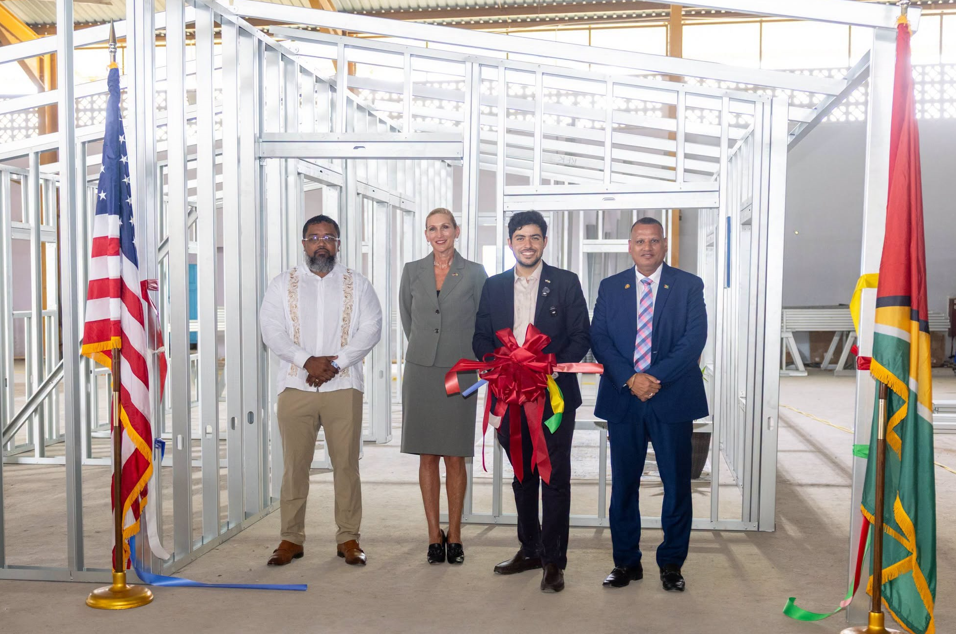
A steel-frame factory opening at Cove and John adds a new construction-input option as Guyana seeks to expand housing delivery. The immediate development is the factory and demonstration of its building system, not the delivery of thousands of completed homes.
Photo: Department of Public Information, Guyana.
Housing Minister Collin Croal attended the ribbon-cutting for the US Frame Factory on the East Coast of Demerara on Wednesday, according to an October 15 report from the Department of Public Information. The event included a steel-frame home designed for the low-income category of the national housing programme and a tour of a three-storey building using the company’s technology.
A manufacturing step within a larger housing plan
DPI reports that Golden Shield Homes plans to work with the housing ministry and US Frame Factory to produce components for 10,000 houses. That is a proposed contribution to the government’s target of 40,000 homes by 2030; it is not evidence that 10,000 houses have been built, ordered or handed over.
The distinction also separates this opening from the partnership plans already discussed publicly. A September 30 DPI report described US Frame Factory and Golden Shield Homes as expected partners in an affordable-housing initiative. The new report adds a specific factory-opening and demonstration milestone at Cove and John.
What changes for the construction supply chain
Steel framing shifts part of a building’s production into the preparation of repeatable components. For contractors and suppliers, the commercial question is how those components will fit into actual housing designs, procurement arrangements and site work, rather than the national target alone.
Croal said modern methods, including steel framing, modular and prefabricated housing, could shorten construction timelines, improve quality control and support more durable, energy-efficient and climate-resilient buildings. These are the minister’s stated potential benefits, not independently measured results from the new factory.
He also pointed to potential employment, technical-skills development and participation by local contractors, suppliers and service providers. The official account does not give a factory investment value, annual production capacity, confirmed job total, unit price or a timetable for delivering the proposed components. Those numbers should not be inferred from the 10,000-house plan.
Opportunity depends on execution
For businesses, a new component supplier can create scope for installation skills, transport, complementary materials and coordination between factory production and construction sites. Participation will depend on the actual commercial arrangements and required specifications. The opening is not itself an invitation to bid or a guarantee of work for any supplier.
The next useful evidence will be production schedules, technical specifications, confirmed project allocations and clear contracting arrangements. Demonstration buildings show an application of the system, but they do not establish output at programme scale or prove savings across every housing design.
Guyana’s housing programme gives the investment a substantial potential market. The investor-relevant milestone now is the addition of a factory and a demonstrated construction approach. Progress should be assessed through verified production and delivery information, while keeping the government’s housing target and the companies’ proposed contribution distinct from completed outcomes.