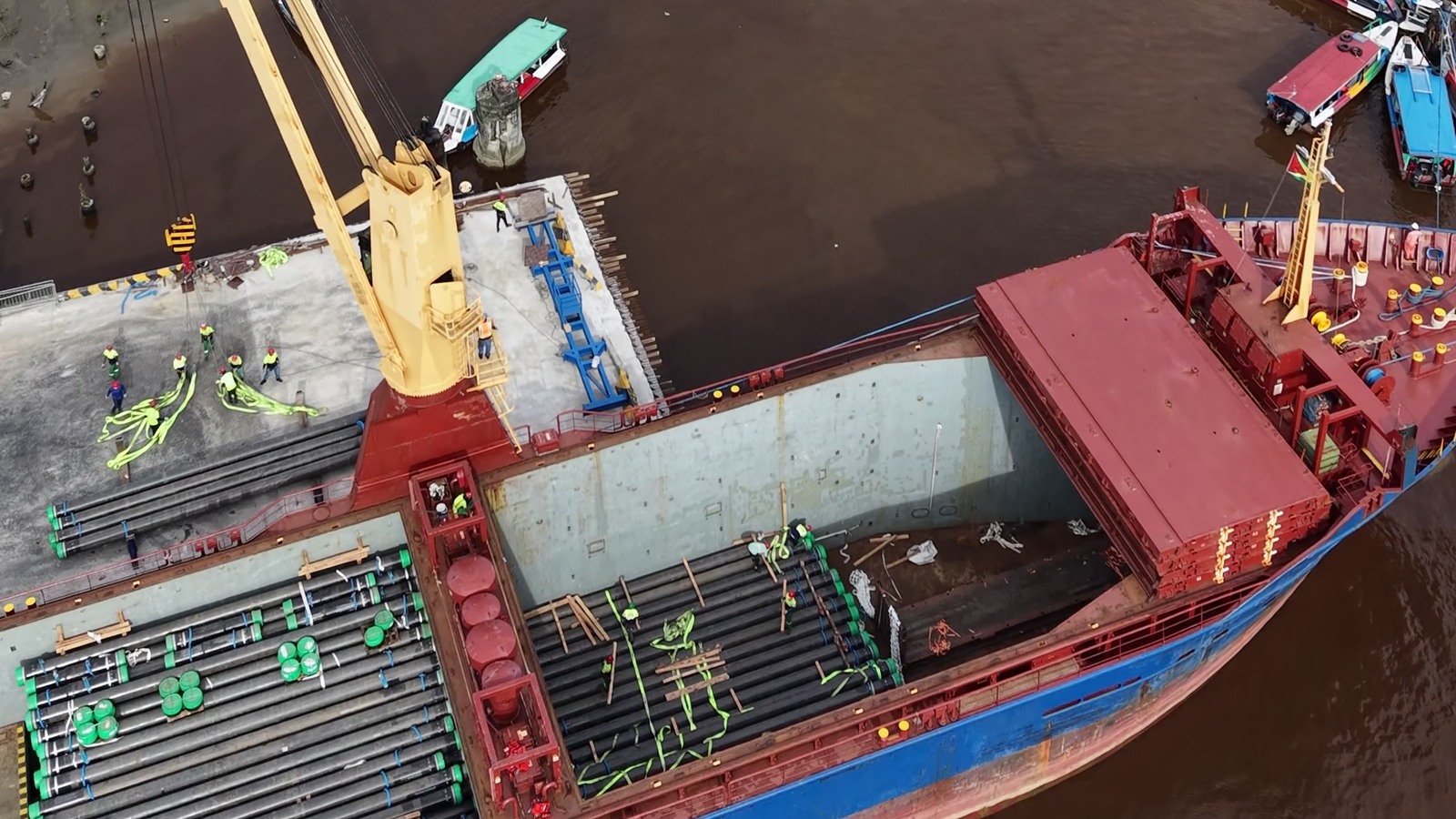
File image: Cargo handling on Georgetown’s waterfront; the Hammerhead vessel is not pictured.
Singapore-based Seatrium will fit the production equipment onto the vessel that will serve Hammerhead, Guyana’s seventh approved offshore oil development. Seatrium disclosed the contract on 16 November, identifying Japan’s MODEC as the company that awarded the work. The announcement puts a contractor on a major piece of vessel construction, but gives no contract value or new date for production.
The vessel, named Essequibo 1899, will process, store and offload crude from the Hammerhead field in the Stabroek Block. Seatrium’s job is to bring together the processing modules that sit above the hull, make the flare tower and crane pedestal, and support the checks and testing that prepare the equipment for service. MODEC remains responsible for delivering the vessel to ExxonMobil Guyana; this award covers part of that work, not the entire ship or field.
MODEC lists the vessel as under construction, with an initial design capacity of about 150,000 barrels of oil a day and storage for about 1.6 million barrels. Neither figure is current production. ExxonMobil’s 12 November update again put Hammerhead’s start in 2029, after Whiptail, which it expects in 2027. Seatrium’s announcement did not bring either date forward.
The contract sits inside a much bigger project
ExxonMobil put the whole Hammerhead development at US$6.8 billion when it took the final investment decision in September 2025. That figure covers a field development with 18 production and injection wells, not just the vessel and certainly not Monday’s integration contract. The new disclosure does not identify any Guyanese subcontractors or put a value on work to be done in Guyana.
Seatrium has done this kind of work for MODEC on another Guyana vessel. The company integrated the topside equipment for Errea Wittu, which MODEC said arrived in Guyana in August for the separate Uaru development. The vessel still had offshore preparations and commissioning ahead after it reached Guyana. That sequence is a useful guide to the stages ahead at Hammerhead, not a timetable for them.
Some components for the vessel have already been fabricated in Guyana. In a separate piece of work earlier this year, Blue Water Shipping said it moved about 100 tonnes of Guyana-fabricated steel handrails from Georgetown to the shipyard in Tianjin, China. And under a different contract announced in 2025, Saipem said it would manage logistics for its Hammerhead subsea work through the Vreed-en-Hoop shore base. Neither is an award flowing from Monday’s announcement.
Monday’s award identifies who will integrate the production equipment. For a Guyanese supplier deciding whether to commit shop space, hire or bring in stock, it does not yet provide the next three things they would need: who is buying locally, what they need and when they need it.