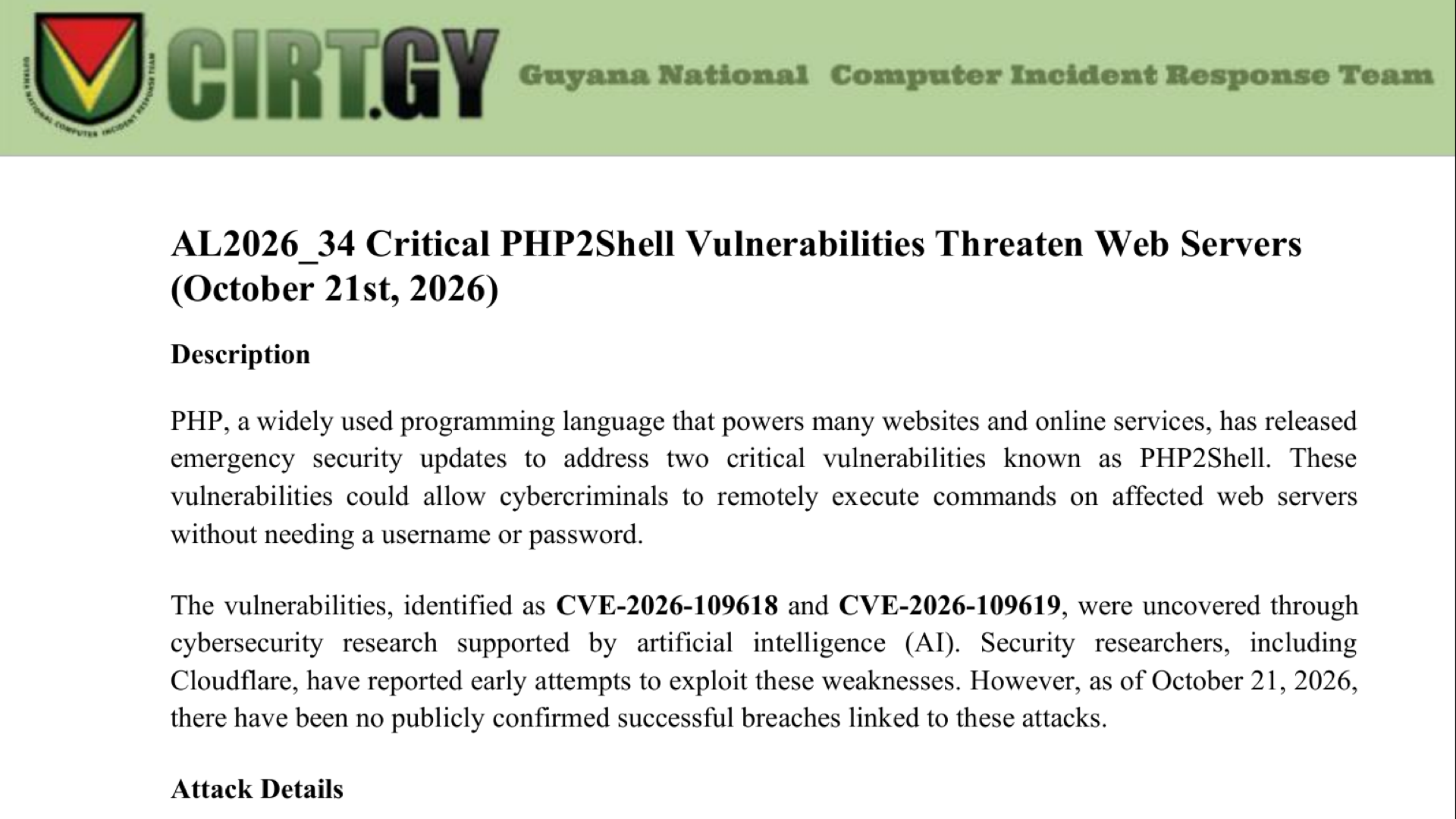
Graphic: Guyana National Computer Incident Response Team.
Guyana’s National Data Management Authority has completed security updates for PHP-based government websites hosted on its platform after two critical flaws exposed internet-facing servers to possible unauthenticated remote-code execution. The response protects the government systems identified by NDMA, but it does not establish that every Guyanese website or privately hosted server has been updated.
NDMA said its monitoring systems had detected no attempts to exploit the flaws and that applications on its platform which do not use PHP were unaffected. The authority also issued public guidance through Guyana’s National Computer Incident Response Team and encouraged website owners and administrators using PHP to apply the relevant security updates promptly.
The assurance has a defined scope. It relates to what NDMA’s monitoring detected and to government websites hosted on the authority’s platform. It should not be interpreted as evidence that there were no attempts against other servers in Guyana, or that privately managed websites are safe without checking their own environments.
Why the vulnerabilities require urgent attention
PHP is a widely used server-side programming language underpinning websites, portals and online applications. The two flaws—CVE-2026-109618 and CVE-2026-109619—were assigned critical 9.2 scores under CVSS version 4.0, according to the Guyana National CIRT alert.
The PHP development team said the vulnerabilities could allow unauthenticated remote-code execution. In practical terms, an attacker may be able to make a vulnerable server execute commands without first supplying a valid username and password.
The exposure is not confined to one content-management system. PHP’s official notice identifies installations serving web requests through PHP-FPM, Apache with mod_php, php-cgi, FrankenPHP and LiteSpeed. Guyana CIRT also warns that containerised PHP applications and common web-server configurations may be affected.
This matters for businesses because updating a website’s visible software is not necessarily enough. A WordPress, Drupal, Laravel or other application update does not independently repair a vulnerability in the underlying PHP runtime. The hosting environment itself must contain the relevant PHP fix or an officially supported vendor backport.
The fixed releases
PHP issued emergency security releases on October 21. The fixed versions are PHP 8.5.12, 8.4.27, 8.3.36 and 8.2.35.
PHP 8.1 and earlier branches no longer receive normal updates from the PHP project. Some Linux distributions and long-term-support vendors may apply security fixes to older-looking package versions through backports. Businesses should therefore ask their hosting or technical provider to confirm the installed package and patch status rather than relying only on the version number displayed in a website dashboard.
On October 23, the PHP team issued an additional informational advisory concerning an uncommon session-upload-progress configuration associated with CVE-2026-109619. It recommended temporarily setting session.upload_progress.enabled=0 until the next regular bug-fix release, while noting that the further issue requires an unusual combination of application behaviour and configuration.
That precaution is technical and should be implemented by a competent administrator. It is not a replacement for installing the security release.
What “no exploitation attempts detected” means
NDMA’s finding is reassuring for the monitored government environment, but it has limits.
Monitoring can report what a particular system observed. It cannot prove the absence of hostile activity across servers outside that visibility, and an attempted attack is different from a successful compromise. Guyana CIRT reported that security researchers had observed attempts against internet-facing PHP installations internationally, while noting that no successful breach of a specific server had been publicly confirmed at the time of its October 21 alert.
Businesses should therefore avoid two opposite errors: assuming that every PHP website has been compromised, or assuming that the absence of a public Guyanese breach means patching can wait.
The appropriate response is evidence-based: identify affected systems, confirm the patch, restart services where required, review relevant logs and maintain recoverable backups.
The business exposure extends beyond a public website
A compromised web server can affect more than a company’s homepage. Depending on how the system is configured, it may process customer enquiries, online orders, employee information, authentication sessions, uploaded documents, payment-related data or connections to other internal services.
Guyana CIRT says successful exploitation could expose information held in process memory, including passwords, authentication tokens or API keys, and could permit code execution with the privileges assigned to the PHP worker. The exact business impact would vary by server permissions, network design and the data handled by the application.
For an investor or board, the relevant issue is operational continuity. Website downtime, unauthorised access, data exposure and emergency restoration can interrupt customer service and create legal, financial and reputational consequences. Cyber maintenance is therefore part of business resilience, not simply a task for the web designer.
A practical verification checklist
Organisations using an internal IT team, developer or hosting provider should request written confirmation of several points:
- the PHP version or vendor package running on each internet-facing server;
- whether the package contains fixes for CVE-2026-109618 and CVE-2026-109619;
- whether services and workers were restarted after the update;
- whether the October 23 session-upload-progress precaution applies;
- whether logs were reviewed for abnormal requests, errors or other indicators;
- whether current website files and databases have tested, recoverable backups; and
- how suspected compromise would be isolated, investigated and reported.
Shared-hosting customers may not control the PHP runtime directly. They should contact the hosting provider rather than attempting server-level changes through a content-management dashboard. Organisations using cloud or self-managed servers should follow their operating-system or support vendor’s security instructions where patches are backported.
Guyana CIRT advises users to report indications of unauthorised access or compromise for investigation. NDMA’s public help desk is designed for government ministries, agencies and departments; private operators should use their provider or technical team and the national incident-reporting route where appropriate.
The wider lesson for Guyana’s digital economy
Guyana is expanding online public services, digital payments and technology-enabled business. That growth increases the value of reliable hosting, supported software, monitoring and incident response.
NDMA’s rapid update of the government sites under its control is the immediate news. The wider commercial test is whether organisations know which software supports their websites, who is responsible for patching it and how quickly they can verify a critical update.
Cyber risk cannot be eliminated by one emergency patch. It can be reduced through clear ownership, supported systems, timely updates, backups, access controls, network separation and practiced response procedures.
For Guyanese businesses running PHP, the present requirement is straightforward: do not assume an application update or a provider’s silence means the server is protected. Obtain confirmation that the underlying runtime has been patched and that the environment has been checked.