Photo: Invest Guyana
Consider an illustrative proposal for a logistics facility in Guyana. A local operator will contribute access to a site and its customer network. An international equipment company will provide cash, systems and technical capability. Yet the evidence behind the proposed 50–50 venture is scattered: the land document is incomplete, the customer list has no contract status, and the equipment valuation came from the contributor.
The immediate task is not to draft a shareholder agreement. It is to establish what each party owns, can legally contribute, is authorised to promise and is expected to deliver. A joint-venture due-diligence file makes that investigation traceable before commitment.
This Guide provides a preparation method, not an official checklist or legal opinion. The correct scope depends on the partners, sector, site, transaction structure and risk. Use Guyanese legal, tax, accounting, technical and environmental advisers to verify the final file.
1. Define the decision before collecting documents
Write a one-page scope note stating the proposed business, parties, intended ownership, location, expected contributions, funding plan and decision date. Then identify what the review must decide. Is the question whether to sign a term sheet, incorporate the venture, contribute an asset, release funding or execute definitive agreements?
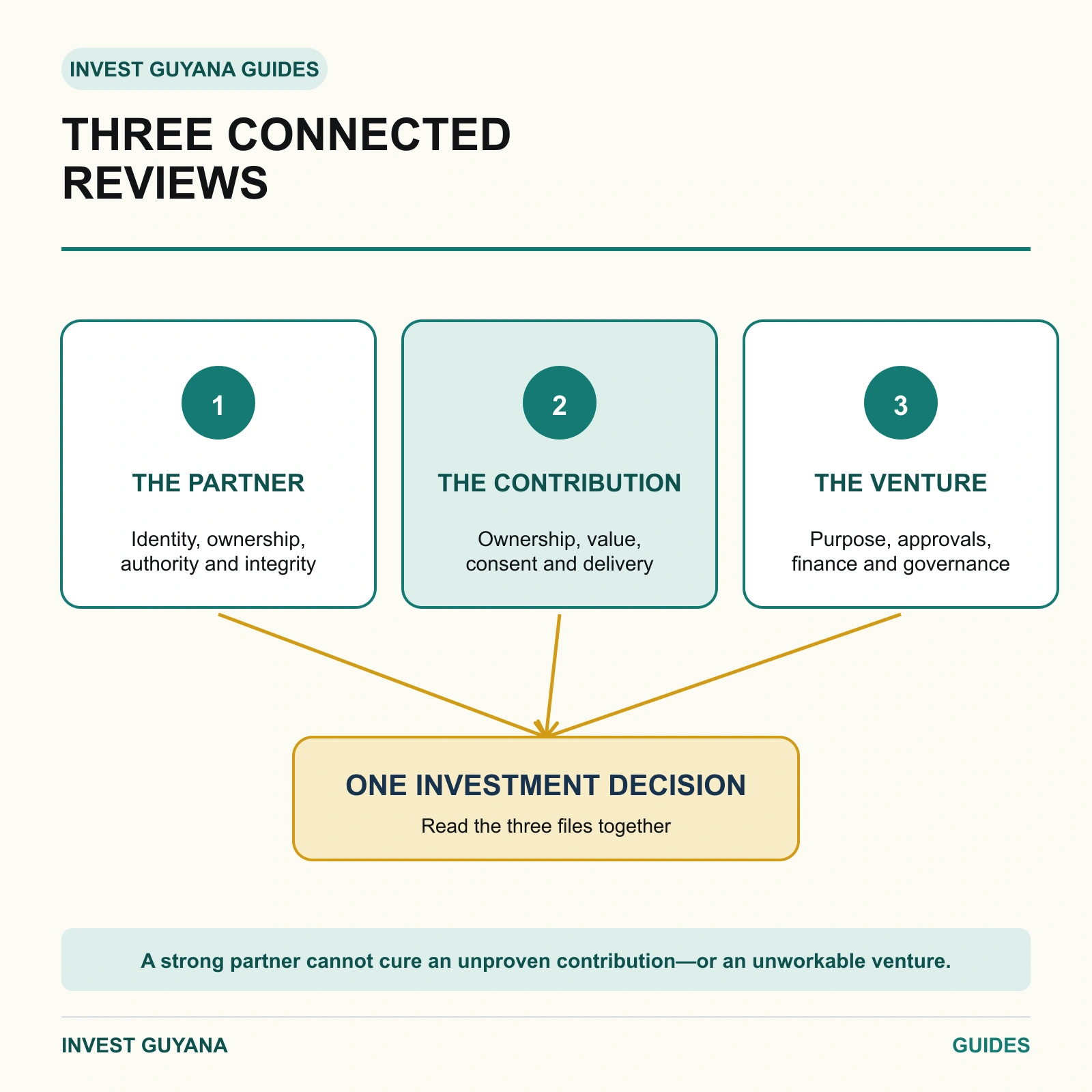
The scope should distinguish three subjects that are often mixed together:
- the prospective partner — identity, ownership, authority, capability, financial condition, integrity and obligations;
- the proposed contribution — cash, land rights, equipment, intellectual property, staff, licences, contracts or services; and
- the proposed venture — structure, approvals, economics, governance, operating plan and exit assumptions.
A strong partner does not cure a defective site right, and an attractive asset does not prove authority to contribute it. Keep the three reviews connected but separate.
2. Build one controlled evidence index
Create a data room with an index before accepting files by email. The World Bank’s joint-venture checklist covers structure, governance, funding, transfers, exit, liabilities and intellectual property. Use it as an institutional prompt, not as Guyanese law or a transaction-specific request list.
| Ref. | Evidence requested | Source and date | Status | Reviewer | Finding or gap | Next action |
|---|---|---|---|---|---|---|
| C-01 | Certificate, articles and by-laws | Deeds and Commercial Registries Authority (DCRA)/partner, illustrative date | Received; registry confirmation pending | Legal | Entity name differs on one draft contract | Obtain current registry evidence and reconcile names |
| O-03 | Ownership and beneficial-owner chart | Partner, illustrative date | Incomplete | Compliance | One intermediate company lacks supporting records | Obtain certified records and natural-person ownership chain |
| A-04 | Site right and survey | Partner, illustrative date | Conditional | Property counsel | Proposed contributor is not the registered owner | Identify owner, authority and required consent |
| F-06 | Equipment list and valuation | Partner, illustrative date | Received; unverified | Technical/finance | Valuation is contributor-prepared | Obtain specifications, title and independent valuation basis |
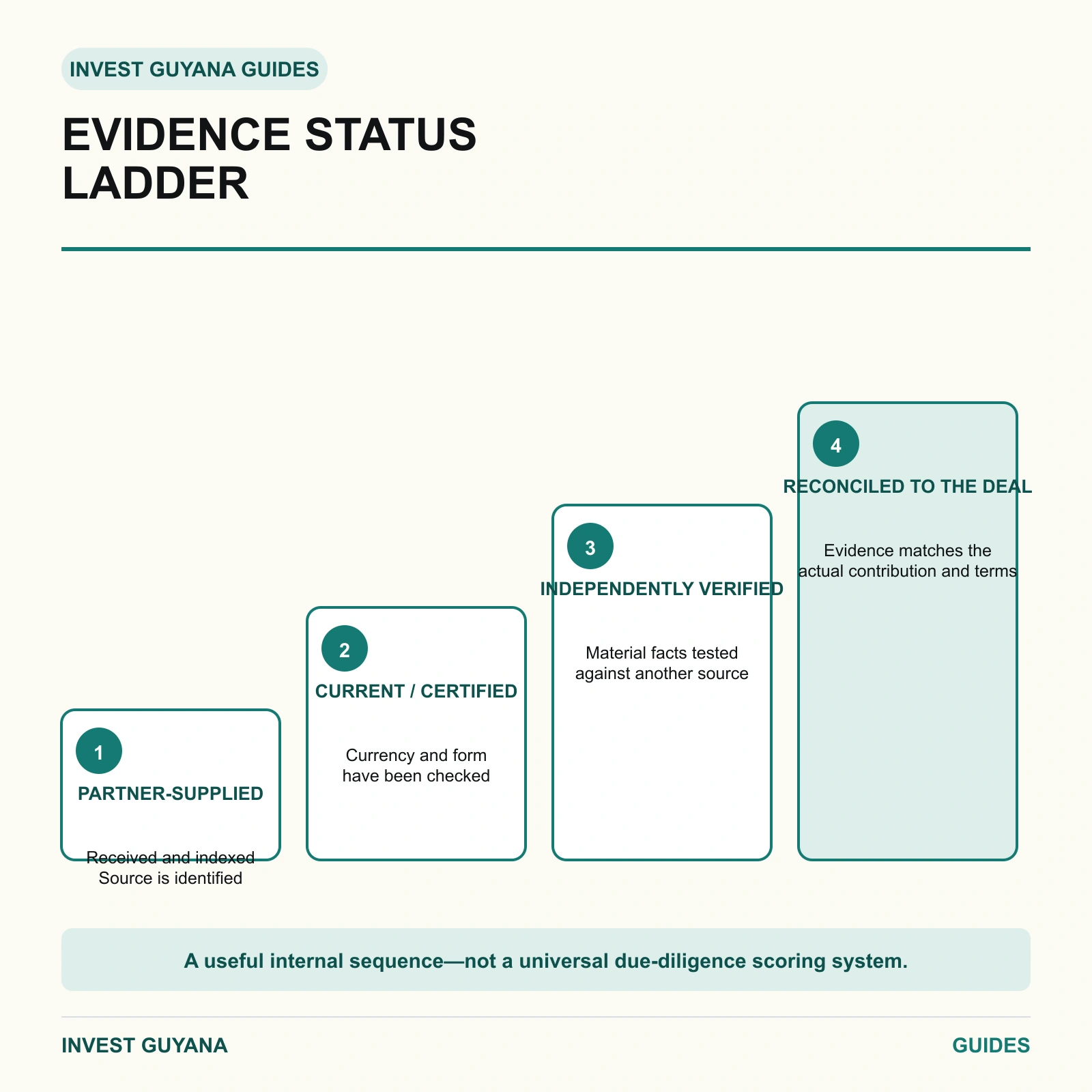
All reference numbers, dates, roles and deadlines in this Guide are illustrative. Mark each record as current, superseded, draft, certified, independently verified or partner-supplied. Preserve superseded versions but prevent them from being mistaken for the current evidence.
3. Verify identity, ownership and authority
Start with the legal name and registration number of every proposed party and intermediate owner. Obtain current incorporation records, articles, by-laws, registered office, directors, secretary, share register and later amendments. The Government’s company-incorporation service identifies continuing obligations including annual returns, financial statements, beneficial-ownership declarations and notices of specified changes. Incorporation alone does not establish that those later obligations are current.
Reconstruct ownership to the natural persons who ultimately own or control the partner. Guyana’s beneficial-ownership service explains the current registry declaration and change process. Reconcile that filing with the share register, group chart, financial statements and proposed transaction. Record unexplained nominees, trusts, options, shareholder loans or control rights for adviser review.
Then test authority. The person presenting the opportunity may not have power to bind the company, contribute its assets or approve a guarantee. Obtain the applicable board and shareholder approvals, signatory authorities and any parent-company consent. If the partner is state-owned, regulated, financed or subject to another agreement, identify additional approvals and restrictions rather than assuming ordinary corporate authority is enough.
| Authority question | Evidence |
|---|---|
| Who owns and controls the proposed partner? | Registry evidence, share register, beneficial-owner filing and group chart |
| Who can negotiate and sign? | Board resolutions, powers of attorney and signatory schedule |
| Can the asset or right be contributed? | Title, contract, licence, consent and encumbrance search |
| Can the partner fund its commitment? | Approved funding plan, financial evidence and any parent support |
4. Prove each proposed contribution
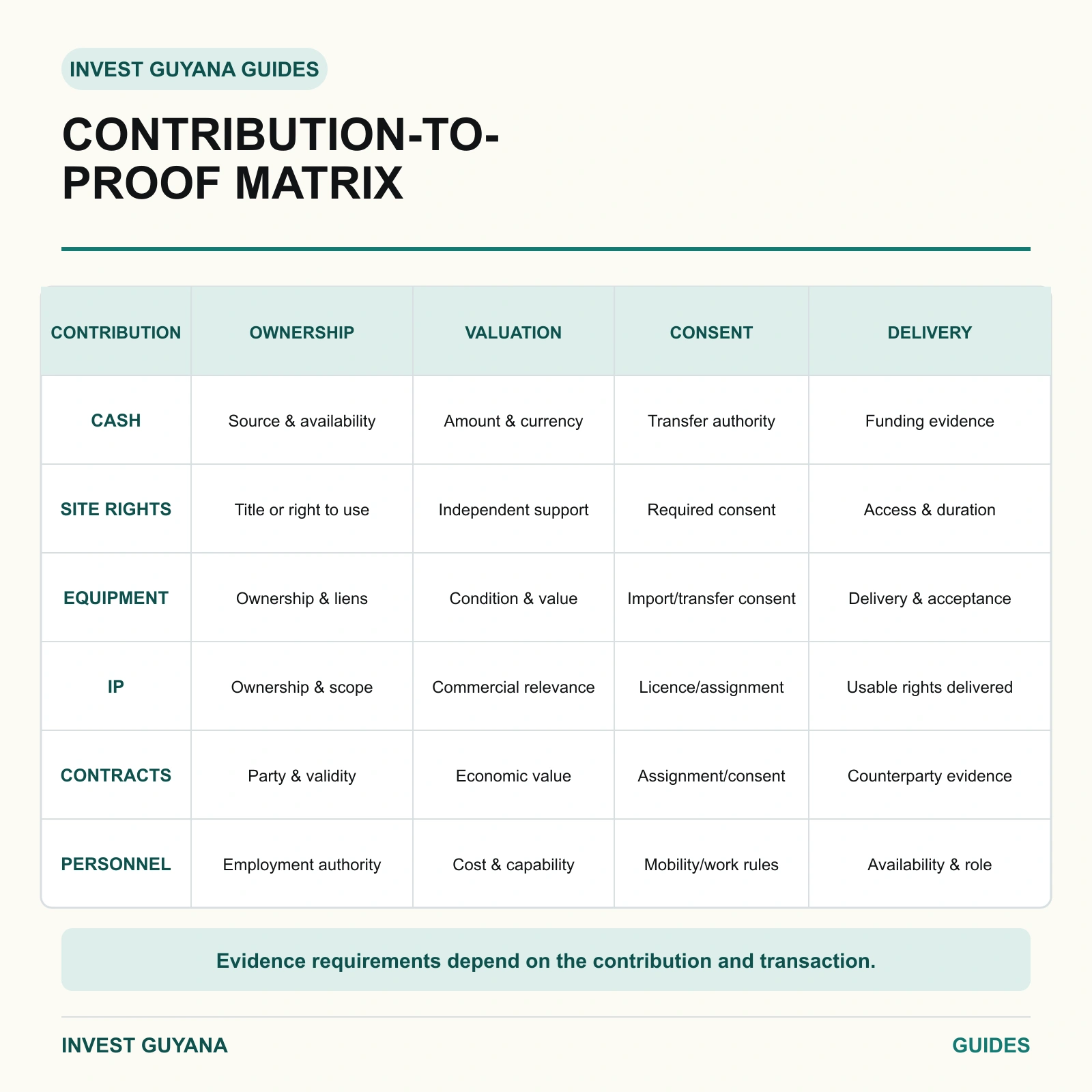
Create a contribution schedule that translates every promise into evidence, valuation, transfer steps and conditions.
| Proposed contribution | Questions to answer | Evidence to obtain |
|---|---|---|
| Cash | Amount, currency, source, timing and conditions? | Funding approval, source evidence and payment schedule |
| Land or lease rights | Who owns it, what use is permitted, and can it be transferred, leased or secured? | Transport/title/lease, survey, searches, valuation, consents and planning position |
| Equipment | Who owns it, what condition and capacity, and is it encumbered? | Invoices/title, specifications, inspection, warranty, valuation and security search |
| Intellectual property or systems | Who owns it, what territory and term, and may the venture modify or sublicense it? | Registration where applicable, licence, maintenance and termination terms |
| Customers or contracts | Are volumes and prices binding, conditional or forecast? | Executed contracts, amendments, termination rights and customer consents |
| Staff and know-how | Who employs the people and bears cost, liability and replacement risk? | Employment/secondment terms, qualifications, payroll and transition plan |
Do not use the agreed share percentage as proof of value. If one party receives 50% for a site right, the file should show what that right is, how it was valued, when it becomes available and what happens if a consent is refused. The financial model, contribution schedule and proposed capitalisation table must reconcile.
5. Reconcile the financial and compliance position
Obtain historical financial statements, recent management accounts, budgets, bank debt, shareholder loans, guarantees, tax filings, receivables, payables and contingent obligations. Reconcile related-party balances and transactions rather than treating them as ordinary trade items. Test whether claimed revenue belongs to the prospective partner, an affiliate or an individual owner.
Check tax and employment compliance through official records and adviser confirmation. The Government portal identifies the Guyana Revenue Authority’s (GRA) Optimal eServices as the channel for tax accounts and returns. The National Insurance Scheme (NIS) employer compliance service addresses registration, contributions and records. A dated certificate does not identify every historic or transaction-specific liability.
The file should also record existing security interests, mortgages, liens, litigation, claims, insurance gaps and commitments outside the balance sheet. Where a conclusion depends on a search, state the search date, jurisdiction, name used and limitation. “No issue found” is useful only when the reader can see what was checked.
6. Run a risk-based integrity review
The International Finance Corporation (IFC) describes integrity due diligence as a process for understanding clients and business partners, including ownership, reputation, tax and corruption risks. A World Bank integrity-compliance publication notes that joint ventures can require more intensive due diligence and that identified misconduct should be cured or addressed by a time-bound plan before signing. These are institutional risk principles, not automatic Guyanese filing requirements.
Identify beneficial owners, directors, senior managers, government or state links, related parties and intermediaries who may act for the venture. Check official sanctions and debarment sources relevant to the parties, countries and financiers; court and regulatory records; declared conflicts; procurement history where relevant; and the partner’s anti-bribery, whistleblowing and approval controls. If an allegation cannot be verified, record it as unresolved rather than converting it into a fact.
The review should be proportionate. A small operating partner and a multi-layered international group do not require identical procedures, but both need a documented ownership and authority conclusion. Escalate unexplained ownership, pressure to use an undisclosed intermediary, requests for off-book payments, inconsistent records or refusal to provide standard evidence.
7. Verify the operating and regulatory route
Map the project’s activities before listing approvals. A logistics facility may require different land, planning, environmental, utility, fire, employment, customs or sector permissions depending on its site, storage activities, fuel, refrigeration, traffic and wastewater. Record the competent authority, application holder, status, conditions, expiry and dependency on the construction programme.
Separate four states: not assessed, application in preparation, application submitted and decision issued. A partner’s experience with another site is not approval for the new venture. If a permit belongs to the prospective partner, determine whether it can be used, varied or transferred and whether a change of ownership or control triggers notice or consent.
Employment records should identify actual employer, contracts, accrued liabilities, disputes, NIS status, health-and-safety controls and any personnel expected to transfer or be seconded. If foreign workers or specialist licences are part of the plan, record the required route and timing without assuming approval.
8. Test governance readiness against the evidence
Due diligence should inform negotiation. It should not secretly become the shareholder agreement. Convert findings into a governance issues matrix:
| Finding | Investment consequence | Matter to resolve |
|---|---|---|
| One partner controls the site through a related company | Venture depends on a non-party | Direct lease, owner consent, security and related-party approval |
| Customer demand is non-binding | Revenue case is less certain | Downside model and conditions before full capital release |
| Technical system is licensed, not owned | Operations depend on licence continuity | Scope, term, support, termination and transition rights |
| Partner cannot fund its full commitment at signing | Ownership and project schedule may change | Staged funding, evidence dates and consequence of shortfall |
Then compare the findings with the proposed articles, business plan, capitalisation table and draft agreement. A due-diligence conclusion that the partner owns valuable technology is not enough if the draft gives the venture no durable right to use it.
9. Maintain a red-flag and conditions register
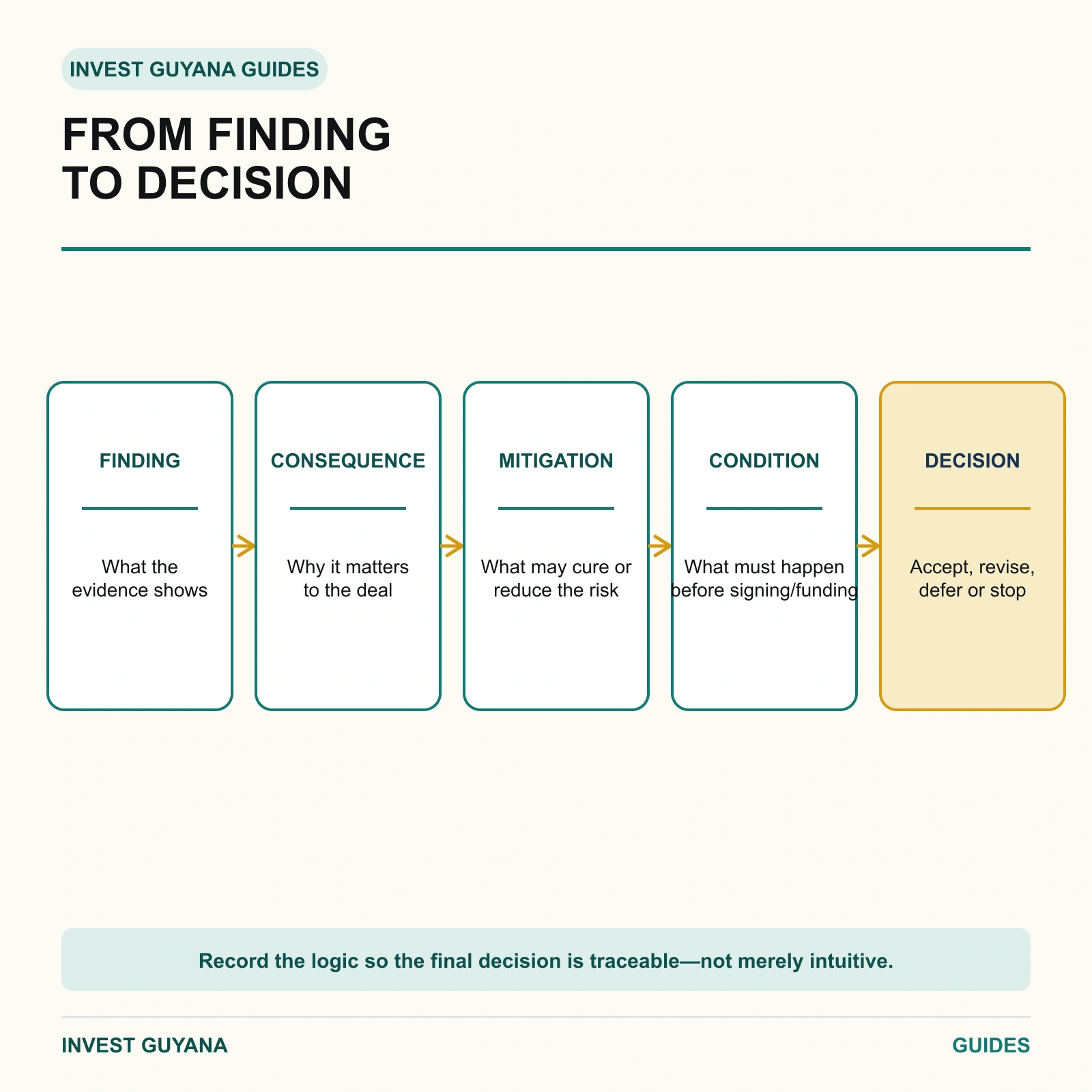
Classify each finding as cleared, accepted, mitigated, a condition before signing, a condition before funding, or a reason not to proceed. Give it an owner, deadline, evidence requirement and decision authority. Avoid a traffic-light colour without an explanation.
Some gaps can be cured with a certified record, consent, revised model, indemnity, licence or operational control. Others may change the price, ownership, governance or transaction structure. A serious integrity, authority or title problem may justify stopping. The register should show who made that decision and on what evidence.
Pre-signing file check
- ☐ Every party’s legal identity, ownership, beneficial owners and authority are reconciled.
- ☐ Annual returns, financial statements and relevant change filings have been checked.
- ☐ Each cash, land, equipment, contract, IP and personnel contribution is evidenced and valued.
- ☐ Existing debt, security, guarantees, claims and related-party balances are disclosed.
- ☐ Tax and NIS evidence is current and its scope is understood.
- ☐ Integrity, sanctions, conflicts and intermediary risks have documented conclusions.
- ☐ Project approvals are mapped to the correct applicant, site, activity and programme.
- ☐ The business plan and financial model reflect verified rather than assumed contributions.
- ☐ Open findings have owners, deadlines and a clear signing or funding consequence.
- ☐ The final legal documents are checked against the due-diligence conclusions.
A due-diligence file does not eliminate joint-venture risk. It makes the parties’ assumptions visible before capital, assets and reputation become difficult to separate. The goal is not to collect the most documents; it is to know which claims are verified, which remain conditional and which should change the deal.
The companion Invest Guyana Explainer, Shareholder Agreements Explained: How Control, Dilution and Exit Rights Shape an Investment, explains how the eventual governance and exit system affects investors after the evidence is assembled.
Editorial note: This Guide provides general preparation information, not legal, tax, accounting, valuation, integrity, environmental or investment advice. The review scope and evidence required depend on the parties, sector, site and transaction.