
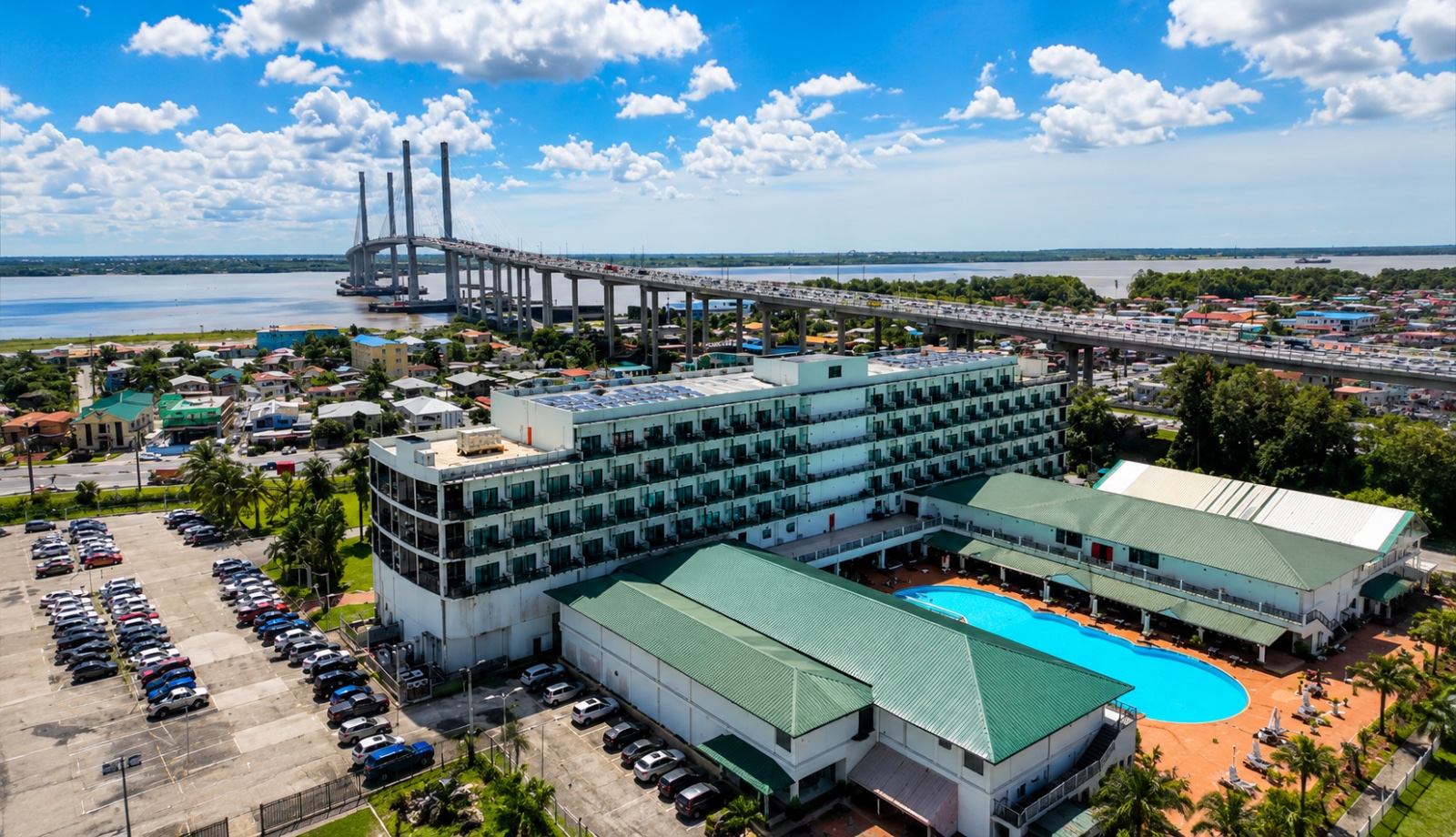
Major highways, improved airport connectivity, expanding communities and growing private investment are transforming the East Bank of Demerara into one of Guyana’s most important commercial corridors. Here’s why the area is becoming increasingly attractive to businesses and what it could mean for investors, entrepreneurs and the country’s long-term economic development.
More Than a Road to the Airport
For decades, the East Bank of Demerara was known primarily as the main route connecting Georgetown with the Cheddi Jagan International Airport and communities further south.
Today, that role is changing.
Warehouses, commercial centres, residential developments, industrial facilities and logistics operations are becoming increasingly common throughout the corridor. While Georgetown remains Guyana’s commercial capital, the East Bank is rapidly establishing itself as one of the country’s fastest-growing locations for commercial expansion.
This transformation is not happening by accident. It reflects major infrastructure investment, expanding residential communities, improved transportation links and growing private sector confidence.
As Guyana’s economy continues to expand, the East Bank is increasingly being viewed not simply as a transportation route, but as one of the country’s emerging commercial corridors.
Infrastructure Is Changing Business Decisions
When businesses decide where to locate, accessibility is often one of the most important considerations.
Companies depend on efficient transportation for employees, customers and the movement of goods. Over the past several years, Government has invested heavily in road infrastructure designed to improve connectivity across the Greater Georgetown area.
Projects including the Mandela-to-Eccles Highway, the Ogle-to-Eccles Highway and continued improvements to the East Bank corridor have significantly strengthened transportation links between Georgetown, the East Coast, surrounding communities and key commercial areas.
These investments do more than reduce travel times.
They improve logistics, increase accessibility and make surrounding land increasingly attractive for commercial development.
For many businesses, improved infrastructure reduces operating costs while creating opportunities to expand into areas that were previously less accessible.
Two International Airports. One Connected Commercial Corridor.
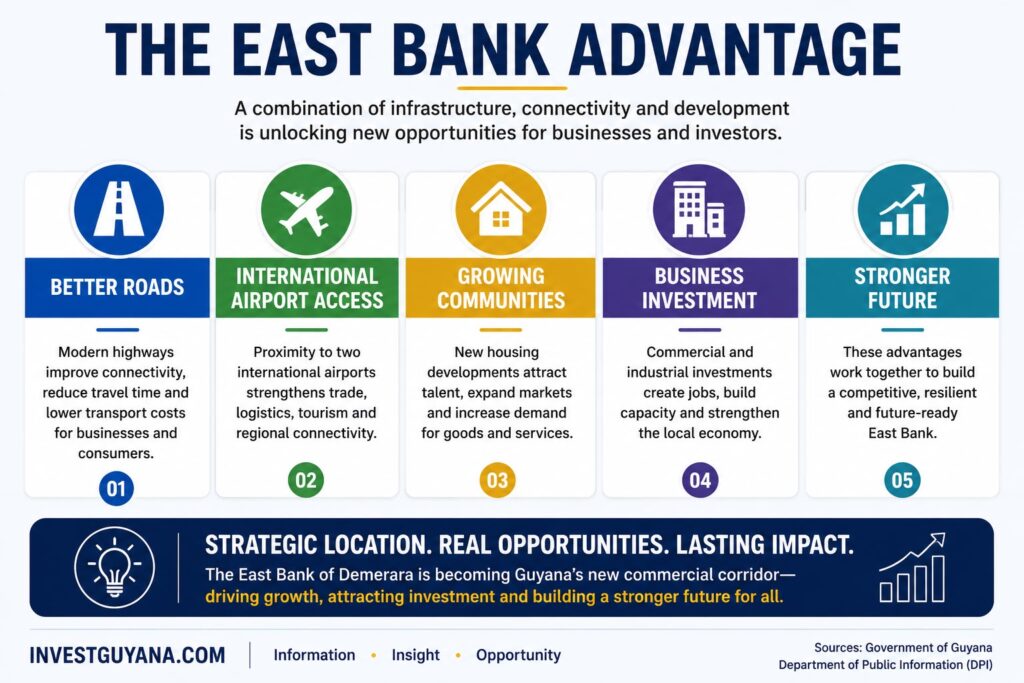
One of the East Bank’s strategic advantages is its connection to Guyana’s two international airports.
The Cheddi Jagan International Airport serves as Guyana’s primary international gateway for long-haul passenger travel, international cargo and global connectivity.
The Eugene F. Correia International Airport (Ogle) complements that role by serving domestic aviation, regional international flights, offshore energy operations, business aviation and regional commercial travel.
The completion of the Ogle-to-Eccles Highway has significantly improved connections between the East Coast and East Bank, creating more efficient movement between Ogle Airport, the Cheddi Jagan International Airport corridor, Georgetown and rapidly expanding commercial and residential communities.
For logistics companies, aviation operators, tourism businesses, distributors and professional service firms, this improved connectivity provides practical operational advantages while reinforcing the East Bank’s role as one of Guyana’s emerging commercial corridors.
Rather than viewing these transport assets independently, businesses increasingly benefit from an expanding network connecting highways, airports, ports and commercial districts.
Housing Growth Is Creating New Markets
Commercial development often follows residential growth.
Thousands of house lots have been allocated across the East Bank in recent years, while private residential developments continue to expand throughout the corridor.
As communities grow, demand naturally increases for:
- Supermarkets
- Pharmacies
- Restaurants
- Schools
- Healthcare facilities
- Banking services
- Hardware stores
- Automotive services
- Professional offices
- Everyday retail businesses
This expanding customer base provides strong incentives for private investment.
Businesses are responding to growing demand created by expanding communities, helping transform the corridor into a more complete economic ecosystem.
Private Investment Is Following Public Investment
Roads alone do not create commercial corridors.
They create the conditions that encourage private investment.
As transportation improves and residential communities expand, businesses begin identifying opportunities to establish warehouses, offices, retail centres, hospitality projects, industrial facilities and professional service businesses.
This relationship between public infrastructure and private investment is one of the defining characteristics of rapidly developing economies.
The East Bank increasingly reflects this pattern.
Commercial developments continue to emerge as confidence in the corridor grows, supported by improved accessibility and expanding nearby communities.
More Than Roads
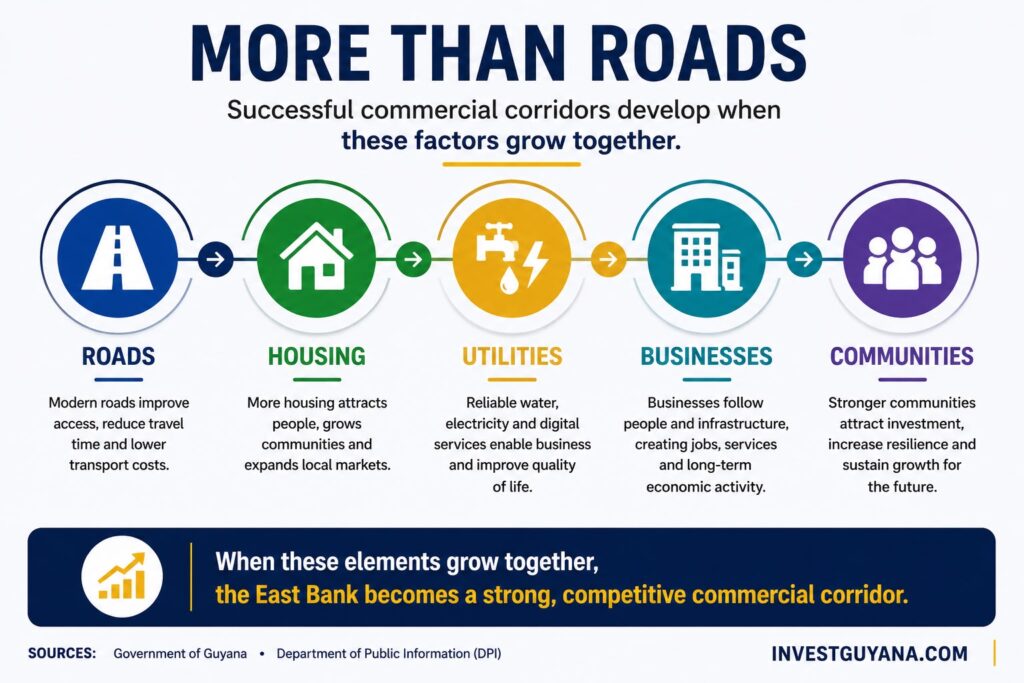
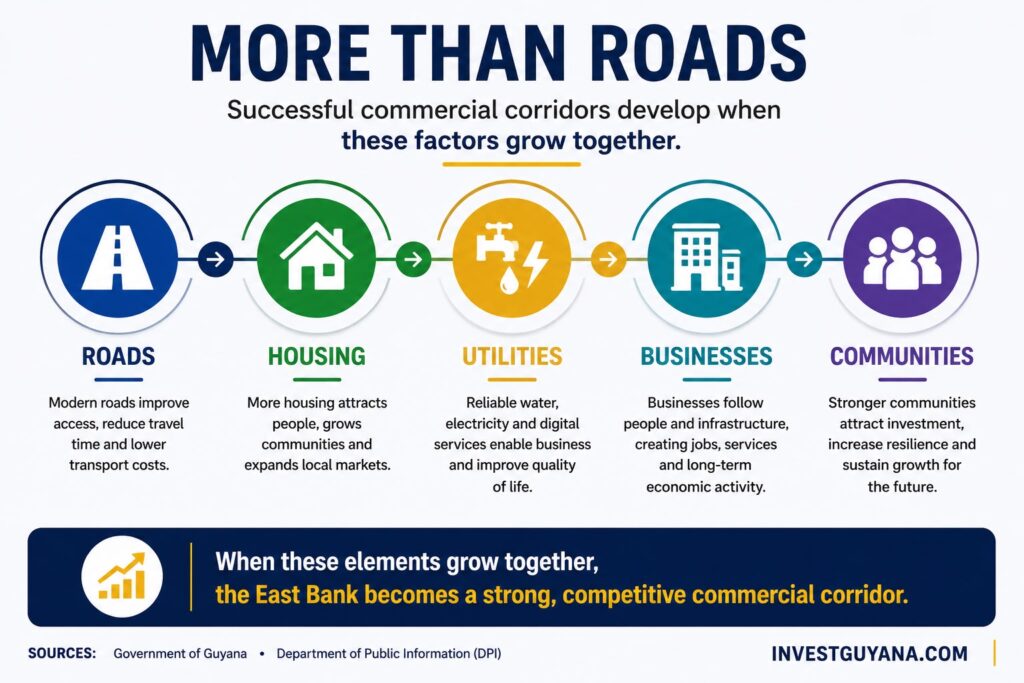
Infrastructure is only one part of the story.
Businesses also consider:
- Access to customers
- Available workforce
- Utilities
- Telecommunications
- Commercial land
- Supporting services
- Future growth potential
The East Bank increasingly combines many of these advantages within a single geographic corridor.
This makes the area attractive not only for logistics and industrial operations, but also for retail businesses, healthcare providers, professional services, hospitality, commercial offices and mixed-use developments.
The corridor’s evolution demonstrates how infrastructure investment can influence private sector decision-making, changing not only how people travel, but also where businesses choose to invest.
Challenges Remain
Rapid growth also creates new demands.
Continued investment in drainage, utilities, public services and supporting community infrastructure will remain important as development accelerates.
Balancing residential, commercial and industrial expansion will also require careful planning to ensure the corridor remains accessible, efficient and sustainable over the long term.
Successful commercial corridors depend not only on new buildings, but on creating communities that support businesses, employees and residents alike.
Invest Guyana Insight
Successful commercial corridors rarely emerge because of a single infrastructure project.
They develop when transportation, housing, utilities, businesses and population growth reinforce one another over time.
The East Bank of Demerara increasingly demonstrates many of these characteristics, suggesting that its transformation reflects a broader shift in Guyana’s economic geography rather than the success of any individual project.
Investor Takeaway
The East Bank of Demerara is evolving from a transportation corridor into one of Guyana’s emerging commercial hubs.
Improved highways, stronger airport connectivity, expanding residential communities and growing private investment are together creating conditions that support continued business expansion.
For entrepreneurs, developers and investors, the opportunity extends well beyond today’s projects.
The longer-term story is how infrastructure investment is reshaping where businesses locate, where communities expand and where future commercial activity is likely to concentrate.
As Guyana’s economy continues to grow, the East Bank appears increasingly well positioned to play a central role in the country’s next phase of commercial development.