
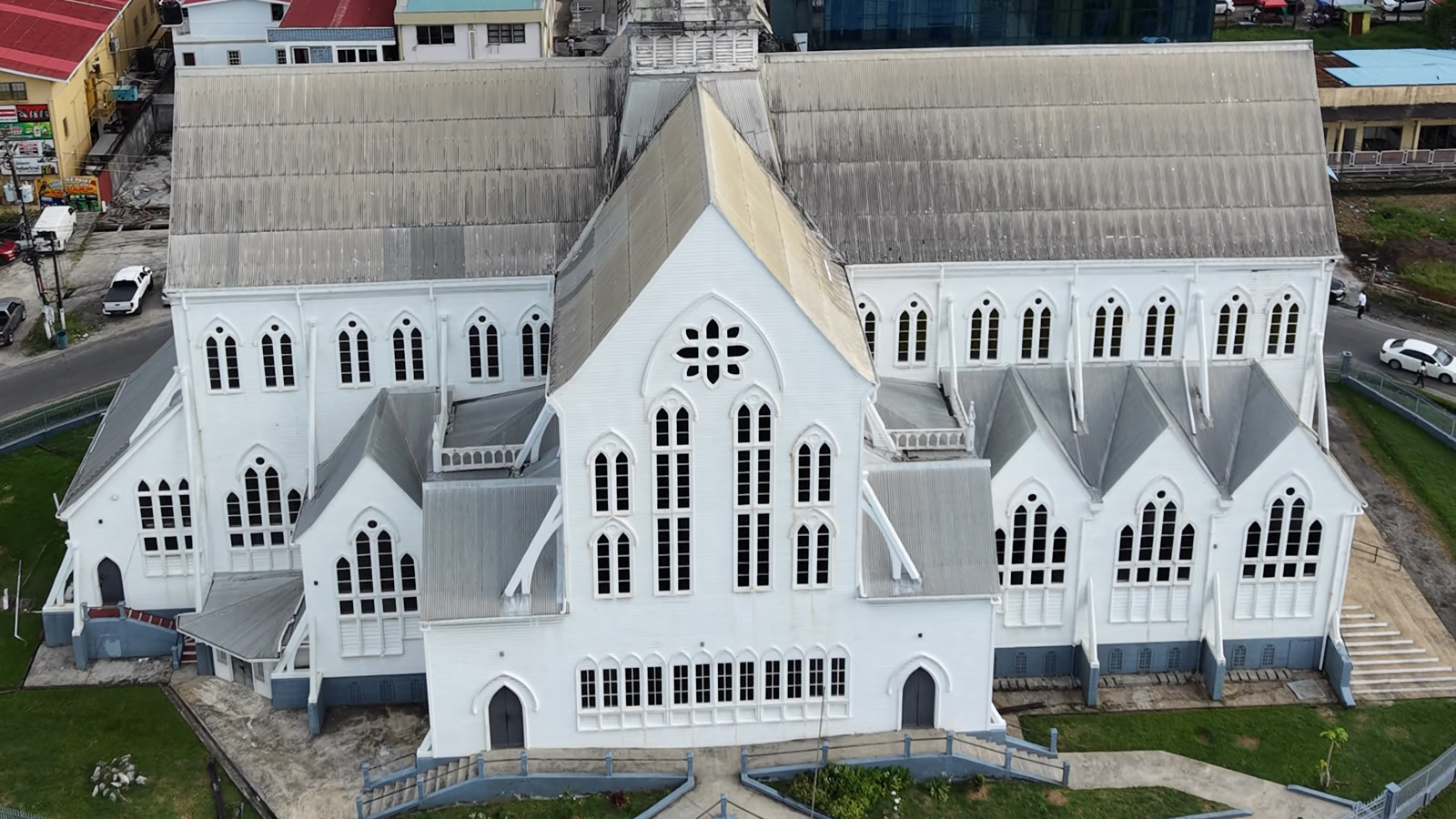
File image: St George’s Cathedral, Georgetown.
Guyana’s National Assembly passed the National Heritage Preservation Bill on 18 November, advancing a proposed overhaul of how historic properties are protected. The 19 November government report says the framework would replace the National Trust Act of 1972 and establish a National Heritage Preservation Council, with responsibility extending beyond monuments to districts, archaeological assets and underwater heritage.
For someone considering an older Georgetown property for offices, accommodation or another commercial use, the relevant question is not simply whether the building can be bought. It is whether the proposed alterations can be approved, what must be conserved and who will carry that cost. A purchase price and a contractor’s estimate do not, on their own, answer those questions.
The Gazette’s 10 November publication is the original Bill No. 16, not an assented Act. The final amended text and evidence of assent had not been recovered as of 20 November. The proposals examined here should therefore not be treated as new rules already confirmed in force.
Private ownership and heritage protection
In his explanation during the debate, Culture, Youth and Sport Minister Charles Ramson Jr said the approach would allow heritage protection without automatically transferring a privately owned property to the National Trust. He also described a national heritage register, published annually in the Gazette and accessible on the council’s website, so prospective purchasers could identify protected property.
A register would make a property’s heritage status easier to investigate, but it would not replace a title search or establish that a proposed use is permissible. A buyer would still need to connect the correct property description to any designation, conservation conditions and approvals. The building’s appearance, or a seller’s assurance that it is not a monument, would be a poor substitute for that evidence.
The published bill’s clauses 67 and 71 propose maintenance duties, recovery of reasonably incurred council repair costs after notice, and an application for a council planning permit for works. Construction, significant renovation and demolition are included. Permissions independently required under other laws would remain necessary.
For a renovation project, that would mean allowing for conservation requirements before settling the design and construction programme. An estimate that assumes unrestricted demolition or replacement could describe a different project from the one ultimately permitted. The owner, architect and contractor would need to price the same scope, rather than leave preservation work as an undefined extra after financing has been arranged.
Conservation costs belong in the investment decision
Continued private ownership would not remove acquisition powers. Clause 69 would permit compulsory acquisition in specified circumstances, including neglect or an inability reasonably to secure protection otherwise, subject to a council report, ministerial findings, a Gazette order and compensation. It preserves access to the High Court for acquisition disputes. This is not a proposal to acquire every historic building.
For lenders and prospective partners, the practical issue is whether a conservation project has an affordable maintenance plan as well as a purchase budget. Where a building will earn income only after renovation, delayed approvals or a revised scope could affect when that income begins. Those are project assumptions to test, not losses or delays established by the passage of this bill.
Nor should owners assume existing protections disappear during the transition. Clause 100 contains savings for existing operative exemptions, directions, orders and registers. Its final enacted wording would need checking before relying on any change in a particular property’s treatment.
The next useful records are the text passed by the Assembly, evidence of assent and the resulting legal and administrative arrangements. Until those are confirmed, a buyer can prepare the property file and investigate current restrictions, but should not treat this week’s vote as a permit to build, a new listing of the property or a guarantee of conservation funding.