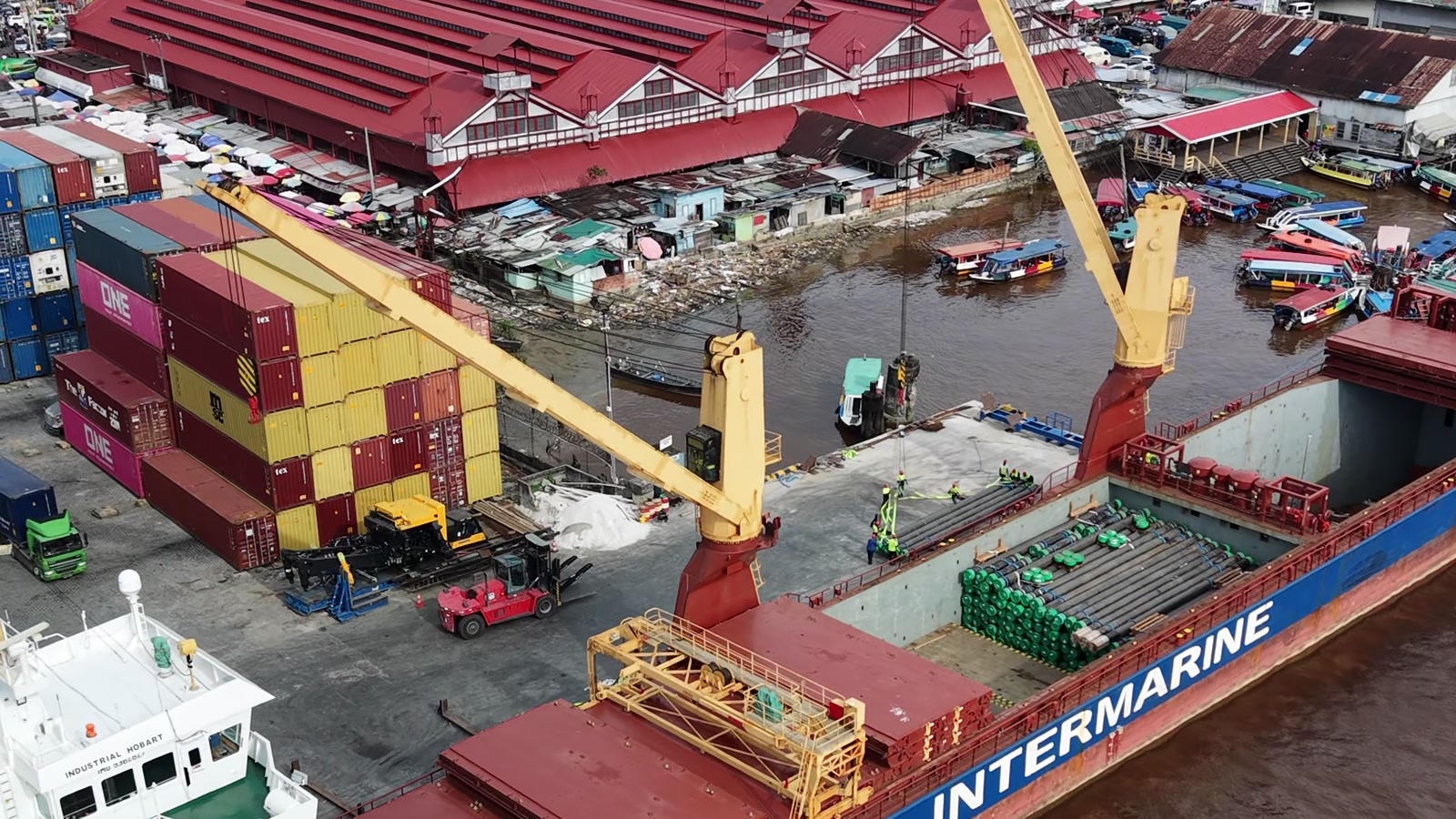
File image: cargo handling on Georgetown’s riverfront.
CARICOM trade ministers began a two-day meeting in Georgetown on Thursday, 26 November, with import costs and regional production among the issues before them. Guyana’s Foreign Minister Hugh Todd chairs the Sixty-Third Regular Meeting of the Council for Trade and Economic Development, according to Secretary-General Carla Barnett’s opening address.
The agenda includes preparations for a Common External Tariff based on the Harmonised System 2028, CSME implementation and external trade relations. Barnett also called for support for assessment teams examining regional supplies of products including paints and varnishes, petroleum bitumen, glass bottles and hydraulic cement. The opening remarks announce no new duty rate or implementation date.
Those product groups connect the regional discussion to ordinary purchasing decisions here: paint for a building, bottles for a processor and bitumen for roadworks. A manufacturer wants reliable inputs at a workable price; a distributor needs to know what it will cost to land and clear stock. The eventual detail matters more to either business than a general promise of easier trade.
The product code is only part of the calculation
The Revised Treaty of Chaguaramas provides the underlying framework. Article 82 requires a common external tariff for goods that do not qualify for Community treatment, following COTED’s plans and schedules. The question is therefore not simply whether a consignment arrives from another CARICOM country, but whether the goods qualify for the treatment being claimed.
CARICOM’s published HS 2022 tariff reference brings together classification, rates, conditional exemptions and origin provisions. It is background to the present discussion, not evidence that an HS 2028 schedule has already taken effect in Guyana. No product-specific duty calculation can be made from the meeting’s opening agenda alone.
Article 84 of the Treaty addresses Community origin. Its framework covers goods wholly produced within the Community and goods made using outside or undetermined-origin materials that meet the relevant substantial-transformation conditions. Some products must satisfy the specific conditions in Schedule I. Buying an input from a regional supplier does not, by itself, resolve the origin of the finished product.
The records behind that claim are visible in GRA’s published application for a Certificate of Origin. It asks the exporter to explain the grounds for Common Market origin and provide supporting documents. Where outside materials are used, the form calls for information on those materials, their origin and the manufacturing process; value-added conditions require evidence that can substantiate the calculation.
For a Guyanese producer developing a regional customer, that puts the factory’s records alongside the sales quotation. The ingredients or components, their source and the work done here can all need explanation. A regional sale should not be priced on an assumed preference before the applicable origin condition and supporting evidence have been established.
At the import end, GRA’s customs guidance describes electronic declarations through ASYCUDA World with the accompanying documents relevant to the shipment, including invoices, transport documents, permits and a CARICOM origin certificate where applicable. A regional trading relationship does not remove the need to clear the goods through the national customs process.
Guyana sits on all four product teams
CARICOM’s preparations for external negotiations also extend beyond this week’s meeting. Its September account of trade-readiness consultations records more than 400 participants across the 12 Single Market countries, including Guyana. A preliminary update was planned for this COTED, with a final assessment intended for the first half of 2027. That timetable describes preparation for negotiations, not an agreement granting new access to a foreign market.
Guyana also has a direct role in the product assessments. CARICOM’s 9 October announcement lists Guyana on all four teams examining paints and varnishes, hydraulic cement, glass bottles and petroleum bitumen. The work was intended to compare regional supply with demand and examine competitiveness against outside imports, including tariffs, non-tariff barriers, logistics costs and origin rules. The reports were to inform future tariff treatment. The announcement does not establish that those reports are complete or their recommendations adopted.
For Guyana’s manufacturers and distributors, the immediate task is to keep that commercial information in order while following the meeting’s published decisions. Any change affecting a shipment will need to be read for its actual product coverage, conditions and implementation arrangements. Neither a different tariff heading nor a regional certificate is a substitute for establishing what applies to the goods being traded.