ExxonMobil has taken a final investment decision on Longtail, a planned US$12.5 billion development, after Guyana approved its development plan and issued a production licence. The company’s 12 November announcement targets first production in 2030. That decision moves the eighth Stabroek development beyond early engineering. It does not commit the partners to delivering gas to shore.
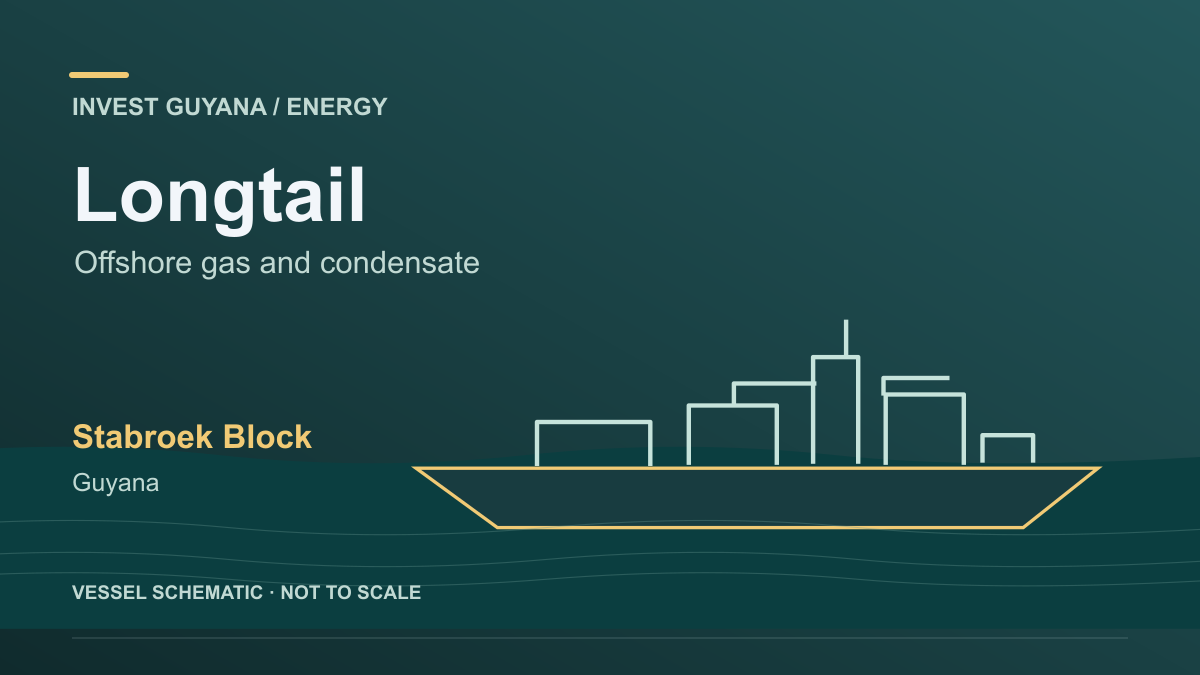
Longtail is Guyana’s first offshore development centred on non-associated gas, which is produced from gas-bearing reservoirs rather than as a by-product of crude oil production. The project also targets condensate, a light hydrocarbon liquid recovered from the gas stream. The Ministry of Natural Resources’ licensing announcement describes a development covering nine reservoirs, with 27 production wells and 18 gas injection wells.
What the offshore development includes
The project will use a floating production, storage and offloading vessel designed to process about 1.2 billion standard cubic feet of gas a day and produce up to 250,000 barrels of condensate a day. These are vessel design figures, not forecasts for actual daily output. In particular, the gas figure measures what the vessel can handle, not what would reach a power plant or industrial customer. ExxonMobil Guyana operates the Stabroek Block with a 45% interest; Hess Guyana Exploration holds 30% and CNOOC Petroleum Guyana holds 25%, the operator said.
What still has to happen for gas to reach shore
The licence requires a study of gas use and export, covering reservoir performance, production forecasts, potential export timing and markets. The vessel’s base design must provide for gas export, and the development will also have full gas reinjection capability. Export-ready equipment and an operating pipeline are different milestones: ExxonMobil says sending gas to shore depends on future investment decisions, market demand and the necessary infrastructure.
The ministry links Longtail to the government’s plans for a second offshore gas-to-energy pipeline and a natural-gas industrial site in Berbice. For companies assessing projects such as fertiliser manufacturing or mineral processing, the practical distinction is that the offshore decision does not establish when gas would be available, how much could be bought or at what price. Those are the milestones to watch before treating Longtail as a committed source of industrial feedstock.
What suppliers should watch
Early work was already underway before the investment decision. SBM Offshore’s March announcement covered front-end engineering and design for the vessel; further work was subject to approvals, the final investment decision and release of the second phase. Saipem’s April notice covered about US$150 million in preliminary engineering and procurement for the subsea system, not execution of the entire package. ExxonMobil’s announcement does not identify new bid packages, deadlines or awards. Suppliers should look for notices from the buyers before treating the project sanction as an open contracting opportunity. For context on how Longtail fits with other developments, see Invest Guyana’s major projects review, which recorded Longtail as under review before this decision.