

A new chapter in Guyana’s property market is unfolding. Here’s what the Condominium Act means for homebuyers, developers, investors and the future of real estate. A significant shift is underway in Guyana’s real estate market.
For generations, property ownership in Guyana has largely been associated with house lots, detached homes, transports, leases and Certificates of Title. Whether purchasing a family home, acquiring land or investing in commercial property, ownership has traditionally been tied to a specific parcel of land. That is beginning to change.
Recent discussions between government agencies, regulators and commercial banks have clarified the framework for financing condominium units under Guyana’s Condominium Act. While the development may appear technical, it could represent one of the most important changes to property ownership in modern Guyana.
The introduction of condominium ownership creates a new way to buy, finance, own, mortgage, inherit and sell property. For developers, banks, investors and homebuyers, it has the potential to reshape how real estate is developed and owned in the years ahead.
Why This Matters Now
The immediate catalyst is the government’s recent engagement with the banking sector regarding implementation of the Condominium Act.
According to official statements, stakeholders confirmed that legal and administrative issues surrounding the registration of condominium mortgages have been resolved, allowing commercial banks to move forward with financing condominium units under the existing legislative framework.
This clarification is significant because financing often determines whether a new form of property ownership becomes widely accessible or remains a niche product.
A condominium may be legally recognised, but if purchasers cannot obtain mortgage financing, the market cannot develop at scale.
The latest developments suggest Guyana’s condominium framework is moving beyond legislation and into practical implementation, creating new opportunities for residential development, homeownership and investment.
How Property Ownership Traditionally Worked in Guyana
To understand why condominiums matter, it helps to understand how property ownership has traditionally functioned in Guyana.
Historically, ownership has generally been tied to land. A buyer acquires a defined parcel and receives legal documentation reflecting ownership rights.
Depending on the property and location, ownership may be evidenced through a Transport, a Certificate of Title, a lease or another legally recognised instrument.
Many Guyanese are familiar with the term Transport. A Transport is a legal instrument recorded through the Deeds Registry system and serves as evidence of ownership and the lawful transfer of property.
Other properties fall within the Land Registry system, where ownership is reflected through a Certificate of Title.
Although the two systems operate differently, both establish legally recognised ownership rights.
The challenge is that these systems were originally designed around ownership of land and buildings situated on individual parcels. Modern condominium developments require ownership to be divided differently, allowing multiple owners to hold individual units within a single development while sharing ownership of common areas.
Transport vs Certificate of Title: What’s the Difference?
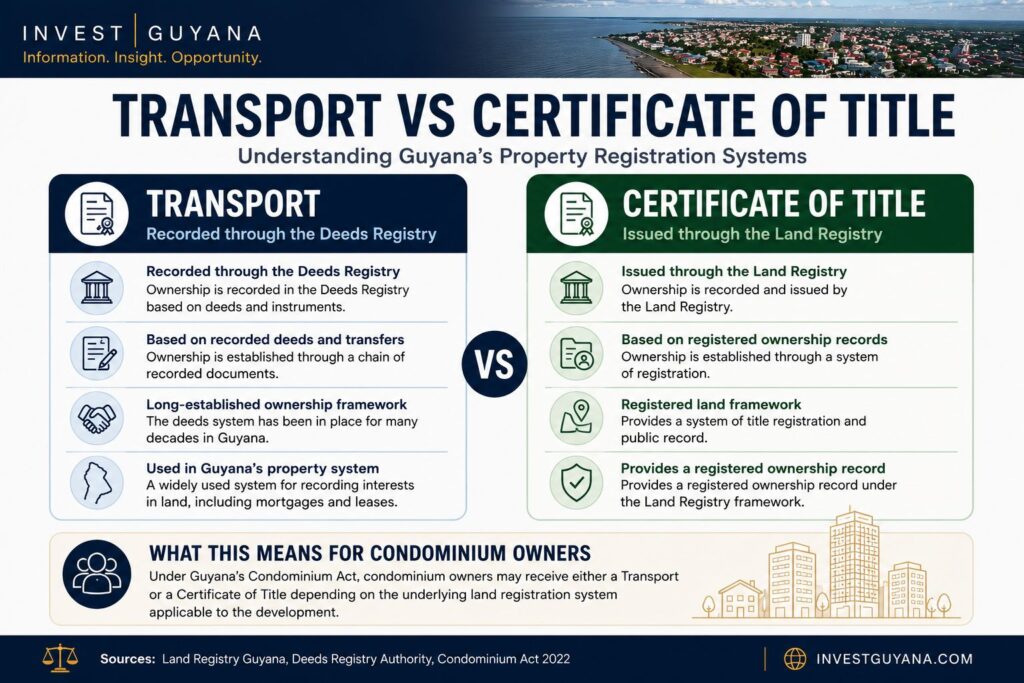
While both systems establish legal ownership, they operate through different registration frameworks.
Transport
A Transport is a legal ownership instrument recorded through the Deeds Registry system. Ownership is established through recorded deeds and documented transfers of property over time.
Certificate of Title
A Certificate of Title is issued through the Land Registry system. Ownership is reflected through a registered title maintained within the Land Registry framework.
Both Systems
While the processes differ, both systems establish legally recognised ownership rights.
Guyana’s Condominium Act has been designed to operate within the country’s existing property registration framework. Depending on the underlying land registration system applicable to a development, a condominium owner may ultimately receive either a Transport or a Certificate of Title for their unit.
Understanding this distinction is important because condominium ownership does not replace Guyana’s existing property registration systems. Instead, it provides a legal framework that allows individual ownership of units while working within the country’s established land registration structure.
How Government Agencies Work Together in a Condominium Development
Condominium ownership does not rely on a single government agency. Instead, several institutions perform different functions within Guyana’s property system, each playing an important role in the development, registration and ownership of condominium units.
The Guyana Lands and Surveys Commission (GLSC) oversees cadastral surveys, survey plan recording, public land administration and related land management functions. These surveys establish property boundaries and provide the physical framework upon which developments are planned and constructed.
The Central Housing and Planning Authority (CH&PA) plays a different but equally important role. Through its planning and housing functions, CH&PA oversees development applications, planning approvals and housing-related regulatory processes. Development proposals typically rely on supporting documents such as approved survey plans and proof of ownership as part of the approval process.
Once a condominium development is completed, ownership interests are recorded through either the Deeds Registry or the Land Registry, depending on the applicable land registration system.
Commercial banks then play a critical role by providing mortgage financing, allowing qualified purchasers to acquire condominium units.
Together, these institutions form the legal and administrative framework that supports modern property ownership in Guyana.
What the Condominium Act Changes
The Condominium Act establishes a legal framework that allows a single development to be divided into individually owned units while preserving shared ownership of common areas.
In practical terms, this means an individual can own a specific apartment, townhouse or condominium unit while sharing ownership of common property with other unit owners.
Common property may include:
- Hallways
- Elevators
- Parking facilities
- Recreational areas
- Security infrastructure
- Landscaping
- Shared utilities
- Other common facilities identified within the condominium scheme
Rather than owning an entire building or a standalone parcel of land, each owner acquires legal rights to an individual unit together with a proportional interest in the common property.
This model of ownership has been used successfully throughout North America, Europe and the Caribbean for decades.
Guyana is now establishing the legal framework to support similar forms of ownership.
Who Owns the Land Under a Condominium?
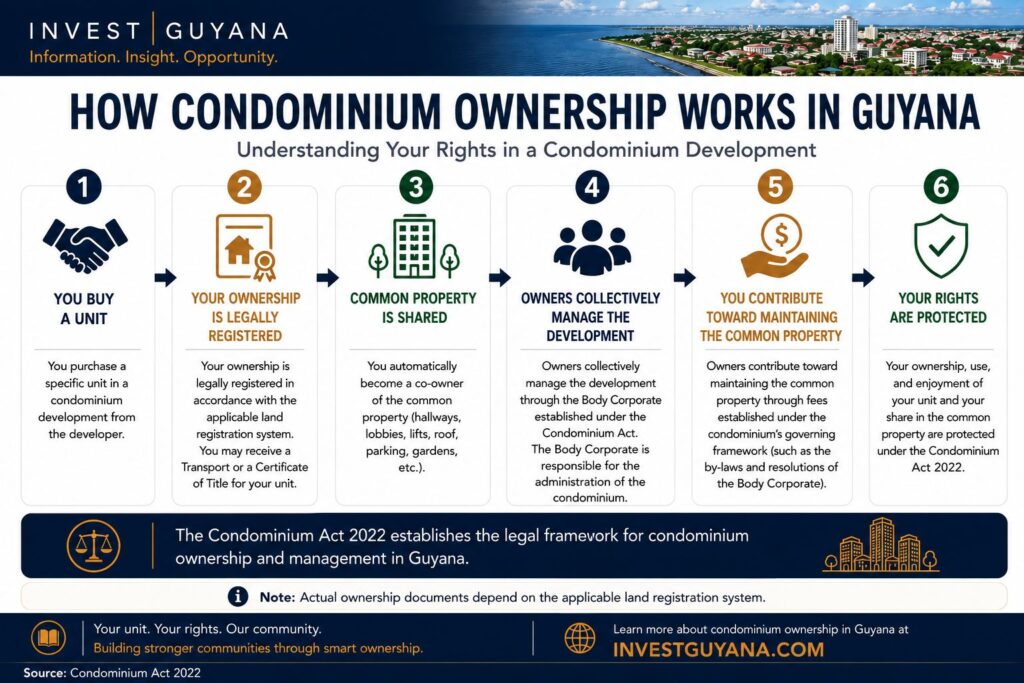
One of the most common questions surrounding condominium ownership is whether owners actually own the land beneath the building.
The answer is yes, but ownership works differently from traditional house-and-land ownership.
Rather than each owner holding an individual parcel of land, condominium owners generally own their individual unit together with a proportional interest in the common property of the development.
The exact legal structure depends on the condominium scheme and the applicable land registration system. However, ownership typically includes rights associated with the individual unit together with shared rights relating to common areas such as hallways, parking facilities, recreational spaces, landscaped areas and other shared amenities.
In other words, buyers are not simply purchasing the physical apartment. They are acquiring a legally recognised ownership interest within a larger property structure governed by the Condominium Act and the rules of the development.
For many Guyanese, this represents a different concept of ownership from the traditional house-and-lot model, but it is a well-established system used in many countries around the world.
Understanding this distinction is important because the value of a condominium depends not only on the individual unit itself, but also on the quality, maintenance and management of the shared property.
What Is a Body Corporate?
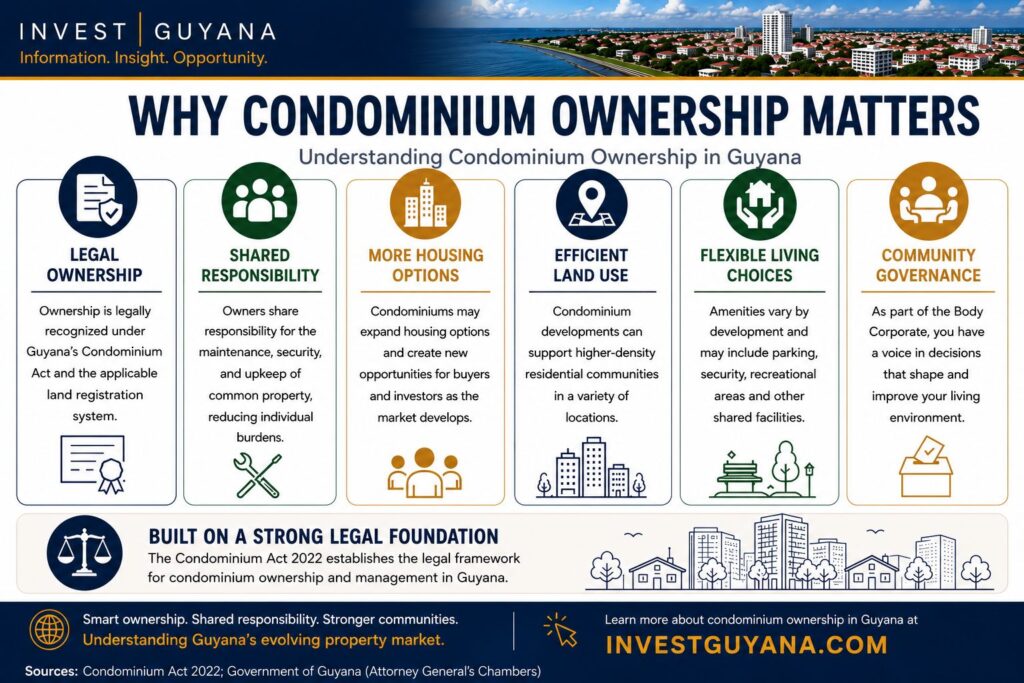
One of the most important concepts introduced by condominium ownership is the Body Corporate.
Once a condominium scheme is legally established, the owners of the individual units collectively form the Body Corporate in accordance with the Condominium Act.
The Body Corporate is responsible for managing the common property and ensuring that the development operates effectively for the benefit of all owners.
Its responsibilities commonly include:
- Maintaining common property
- Collecting contributions from owners
- Arranging insurance for common areas
- Contracting service providers
- Managing repairs and maintenance
- Enforcing the condominium by-laws
- Managing the financial affairs of the development
For first-time condominium buyers, understanding the role of the Body Corporate is just as important as understanding the unit itself.
Effective governance and professional management can have a significant influence on the long-term quality, desirability and value of a condominium development.
Why Mortgage Financing Matters
A successful condominium market requires more than legislation. It requires access to financing.
Most homebuyers do not purchase property entirely with cash. Mortgage financing allows a much larger pool of buyers to participate in the housing market.
The recent clarification involving government agencies and commercial banks removes an important barrier to financing condominium developments under Guyana’s existing legal framework.
As financial institutions become more comfortable financing condominium units, developers may gain access to a broader market while purchasers benefit from additional housing choices.
This could encourage future residential development in areas where higher-density housing is appropriate and where infrastructure can support sustainable urban growth.
For developers, improved financing options may increase the viability of condominium projects.
For buyers, they create an additional pathway to homeownership.
For the wider economy, they represent another step in the continued evolution of Guyana’s real estate sector.
What Guyana Can Learn from Barbados and Trinidad & Tobago
Condominium ownership is not new in the Caribbean. Countries such as Barbados and Trinidad & Tobago have operated condominium markets for decades, providing useful examples of how this form of ownership can support housing development, urban growth and private investment.
In both jurisdictions, condominiums have contributed to higher-density residential communities, mixed-use developments, tourism accommodation and urban redevelopment projects.
Their experience demonstrates that the long-term success of condominium developments depends on more than construction quality alone.
Strong governance, professional property management, adequate insurance, reserve funding, transparent financial management and clear by-laws all contribute to maintaining property values and protecting owners’ investments.
As Guyana’s condominium market develops, these regional experiences provide valuable lessons for developers, policymakers, financial institutions and buyers alike.
What Buyers Need to Understand
Purchasing a condominium differs from buying a traditional house and lot. While owners acquire legal ownership of their individual unit, they also become part of a shared ownership structure with responsibilities relating to the common property.
Before purchasing a condominium, buyers should understand:
- The rules governing the development.
- Their financial contributions toward maintaining common property.
- The responsibilities of the Body Corporate.
- Insurance arrangements.
- Voting rights within the development.
- The condominium by-laws.
- Long-term maintenance and reserve funding.
A condominium is more than an individual apartment. It is participation in a professionally managed community where owners share both rights and responsibilities.
Understanding these obligations before purchasing helps buyers make informed decisions and contributes to the long-term success of the development.
What Investors Should Watch
The introduction of condominium ownership creates several areas of interest for investors and developers.
These include:
- Expansion of residential housing options.
- Increased demand for mortgage financing.
- Higher-density urban development.
- Mixed-use residential and commercial projects.
- Opportunities for professional property management services.
- Growing interest from the Guyanese diaspora.
- Potential participation by regional and international investors.
The pace at which the market develops will depend on several factors, including implementation of the legislative framework, financing availability, buyer confidence, infrastructure development and the quality of projects brought to market.
As with any emerging market segment, investors should conduct appropriate due diligence before making investment decisions.
Investor Takeaway
Guyana is not simply introducing a new type of housing. It is introducing a new model of property ownership.
For decades, the country’s real estate market has been centred primarily on individual ownership of land and detached housing. The Condominium Act establishes a legal framework that allows ownership to be divided vertically, enabling individuals to own separate units within a single development while sharing ownership of common property.
The recent clarification surrounding condominium financing represents another important milestone in implementing that framework.
As developers begin bringing condominium projects to market and financial institutions expand mortgage financing options, buyers will have greater flexibility in how they purchase property, while developers gain another model for meeting future housing demand.
Countries such as Barbados and Trinidad & Tobago demonstrate that condominium ownership can support modern urban development when accompanied by effective governance, sound regulation and responsible property management. Guyana is now laying the foundation for a similar evolution.
Whether condominiums become a major segment of the housing market will depend on continued collaboration between government, regulators, financial institutions, developers and buyers.
What is already clear, however, is that condominium ownership represents an important evolution in Guyana’s property market.
For investors, developers and prospective homeowners alike, understanding this framework today may provide valuable insight into how Guyana’s real estate sector develops tomorrow.
⸻
Sources
This article was researched and prepared using information from the following official legislation and government sources:
- Condominium Act No. 6 of 2022
- Attorney General’s Chambers and Ministry of Legal Affairs
- Department of Public Information (Government of Guyana)
- Guyana Lands and Surveys Commission (GLSC)
- Deeds Registry Authority
- Land Registry Guyana
- Central Housing and Planning Authority (CH&PA)
- Barbados Condominium Act (Cap. 224A)
- Trinidad and Tobago Condominium Act