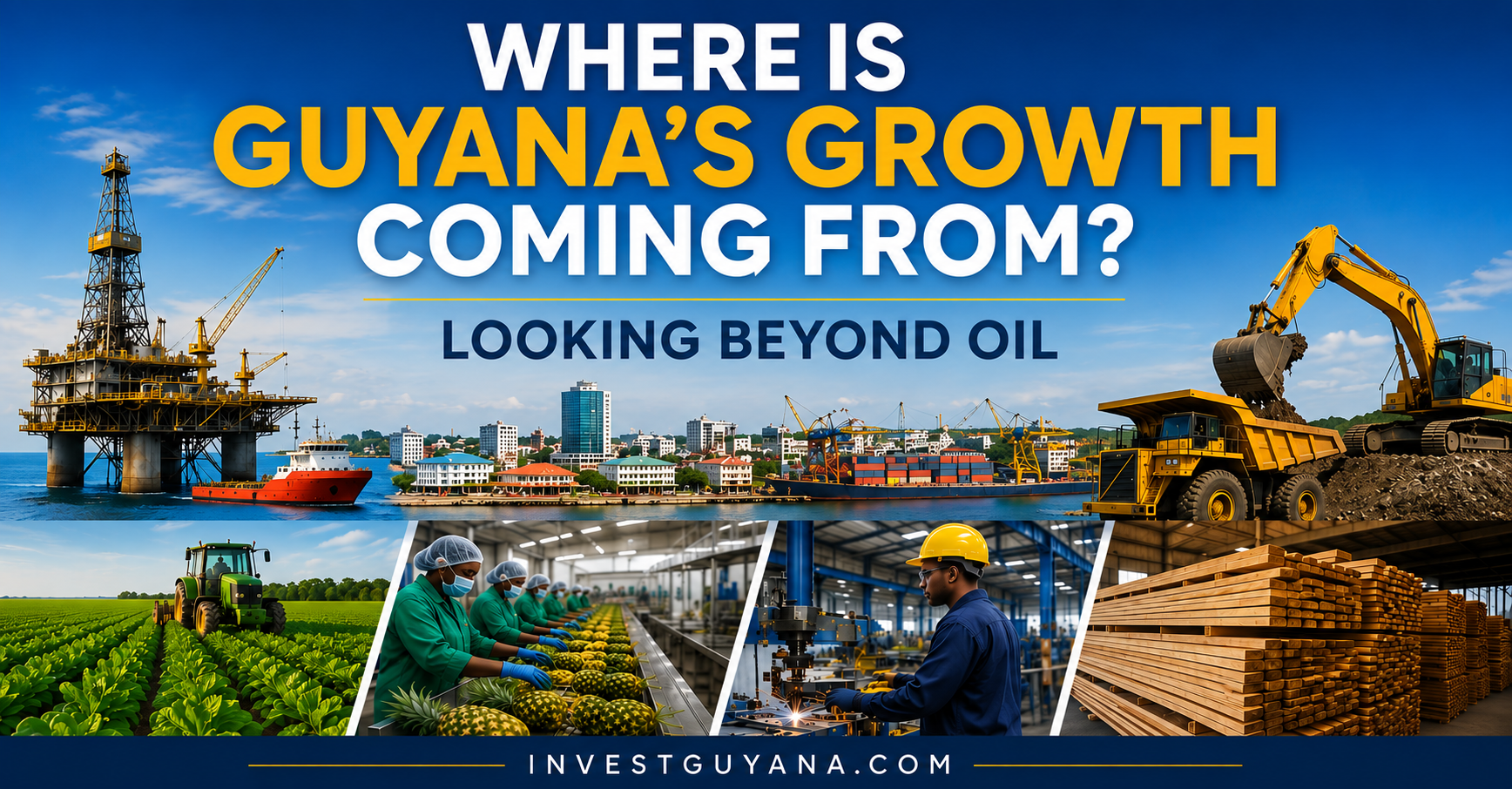
For much of the past decade, Guyana’s economic story has been told through a single lens: oil.
The country’s emergence as one of the world’s fastest-growing economies has attracted global attention, international investment and intense interest from policymakers, investors and businesses.
Yet an important question remains.
Is Guyana’s growth coming exclusively from oil, or are other sectors beginning to benefit from the country’s economic transformation?
The answer matters because long-term economic resilience depends not only on growth, but on the breadth of that growth.
Economies that rely heavily on a single sector often face greater vulnerability to commodity cycles, external shocks and investment slowdowns.
For investors, the key question is whether Guyana is building additional engines of growth alongside petroleum.
The latest economic data suggests that while oil remains the dominant driver of expansion, a broader growth story is gradually emerging beneath the surface.
OIL STILL DRIVES THE HEADLINE NUMBERS
There is little doubt that oil remains the primary driver of Guyana’s economic performance.
According to the International Monetary Fund (IMF), Guyana’s economy expanded by 43.6 percent in 2024, making it one of the fastest-growing economies in the world.
Oil production continues to generate extraordinary levels of output growth, government revenue and foreign investment.
Without the petroleum sector, Guyana’s economic trajectory would look very different.
However, headline GDP growth tells only part of the story.
A closer examination of the data reveals that growth is occurring across multiple sectors of the economy, not solely within petroleum production.
This distinction is important because investors often focus on whether economic gains are spreading beyond the oil industry into the broader domestic economy.
THE NON-OIL ECONOMY IS GROWING AT AN EXCEPTIONAL PACE
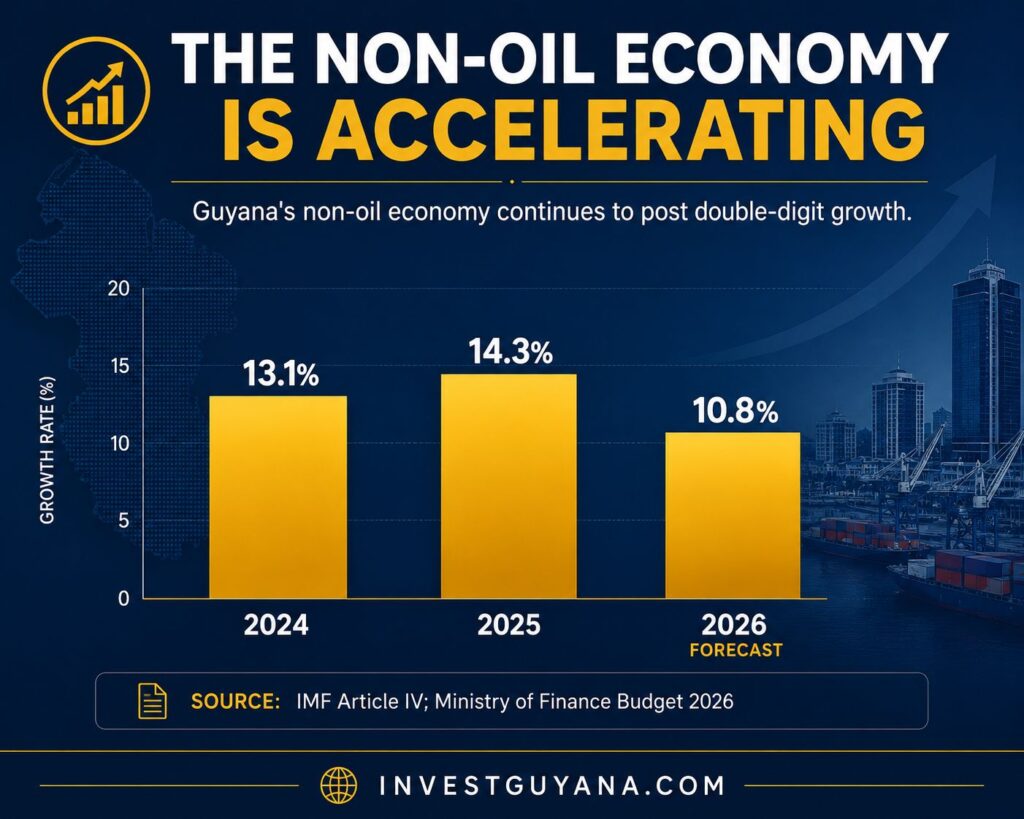
One of the strongest indicators of diversification is the performance of Guyana’s non-oil economy.
According to IMF projections and government data, non-oil GDP expanded by approximately 13.1 percent in 2024 and is projected to grow by approximately 14.3 percent in 2025.
These growth rates would be considered exceptional in most emerging markets.
Resource-rich economies often struggle to build competitive industries beyond the dominant commodity sector.
The fact that Guyana’s non-oil economy continues to post double-digit growth suggests economic activity is beginning to spread more broadly throughout the economy.
This does not mean Guyana has diversified away from oil.
It does suggest that oil-driven investment and spending are creating opportunities in other sectors.
AGRICULTURE IS QUIETLY RE-EMERGING
Agriculture rarely receives the same attention as oil, yet it remains one of Guyana’s most strategically important industries.
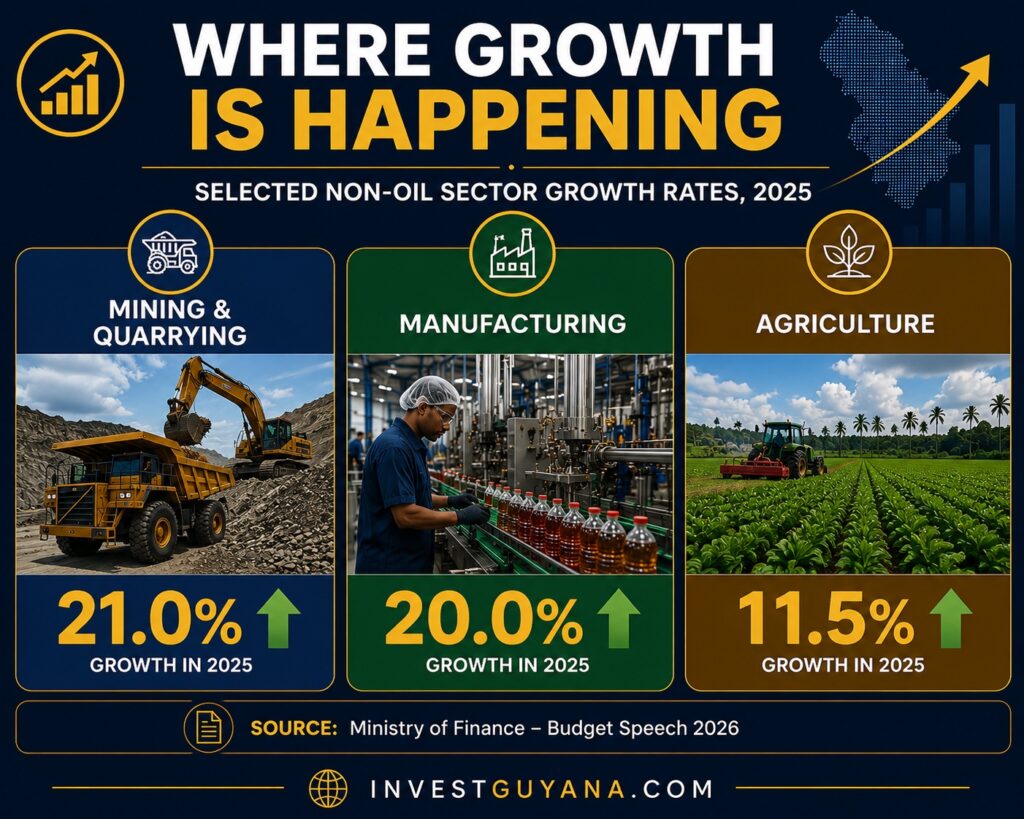
According to the 2026 Budget Speech, the sector expanded by approximately 11.5 percent in 2025.
Agriculture continues to play an important role in employment, exports, food security and rural economic development.
The sector also provides potential opportunities in value-added processing, logistics, packaging and regional food exports.
For investors, agriculture’s significance extends beyond farming itself.
As incomes rise and infrastructure improves, opportunities often emerge across supply chains, storage, transportation and processing.
While agriculture is unlikely to rival oil in economic scale, its continued expansion contributes to a broader and more resilient economic base.
MINING REMAINS A MAJOR CONTRIBUTOR
Another important sector is mining and quarrying.
According to official data, the sector expanded by approximately 21 percent in 2025.
Gold remains particularly important, supporting exports, employment and investment activity.
This is significant because it demonstrates that Guyana’s resource story is not limited to petroleum.
Mining continues to attract capital and generate economic activity independent of the offshore oil industry.
For investors, this creates opportunities in support services, equipment, logistics, transportation and related industries.
The coexistence of multiple resource sectors may ultimately strengthen Guyana’s economic resilience.
MANUFACTURING MAY BE THE MOST UNDERRATED STORY
One of the most interesting developments in recent years has been the performance of manufacturing.
According to the 2026 Budget Speech, manufacturing expanded by approximately 20 percent in 2025.
This matters because manufacturing is often viewed as one of the clearest indicators of economic diversification.
Growing manufacturing activity suggests businesses are increasingly positioning themselves to serve a larger domestic economy.
Demand for building materials, consumer products, industrial supplies and value-added goods often increases as economies develop.
While the sector remains relatively small compared to petroleum, its growth rate suggests it deserves closer attention from investors.
CONSTRUCTION AND REAL ESTATE ARE IMPORTANT SIGNALS
Construction and real estate provide another window into how economic growth is spreading through the economy.
Government housing investment remains substantial, with GY$159.1 billion (approximately US$760 million) allocated to housing initiatives in the 2026 national budget.
Mortgage lending and housing development have also expanded significantly in recent years.
While authoritative national property price data remains limited, growth in housing investment, construction activity and related lending suggests the sector is benefiting from broader economic expansion.
Importantly, construction has multiplier effects throughout the economy.
Every new housing development creates demand for contractors, engineers, building materials, transportation, utilities and financial services.
As a result, the sector serves as a useful indicator of how economic growth is reaching households and businesses.
CAPITAL IS FOLLOWING GROWTH
Credit growth provides another valuable signal.
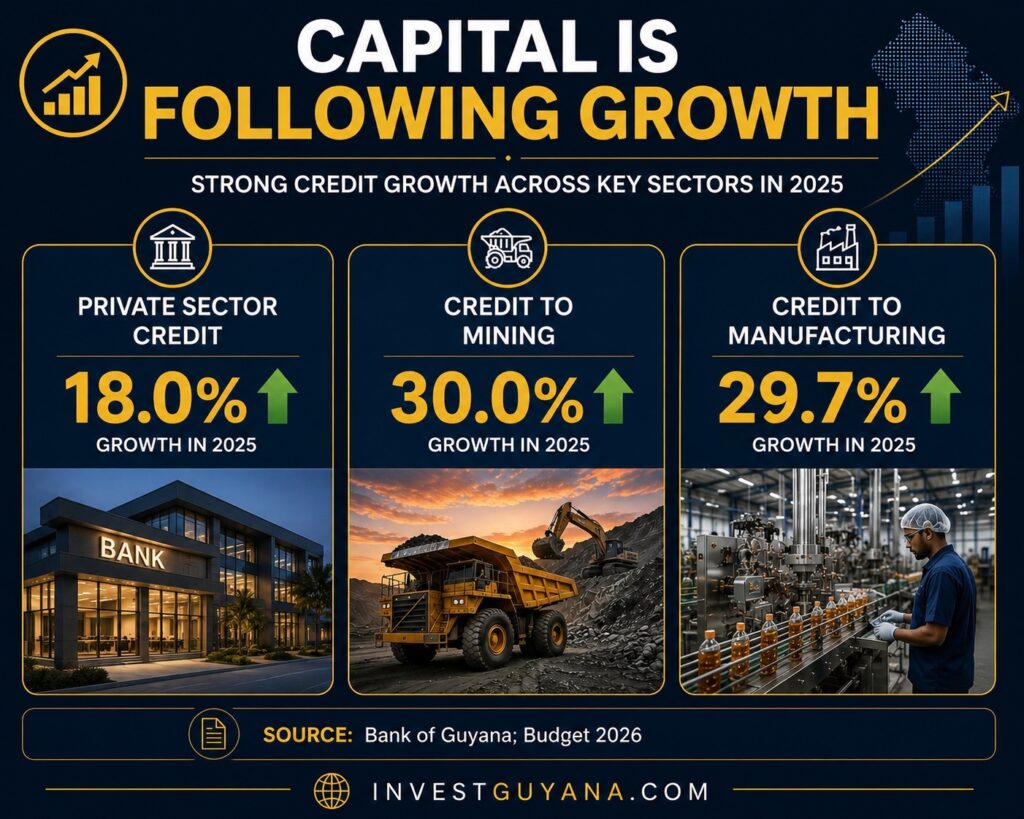
According to official banking data, private sector credit expanded by approximately 18 percent in 2025.
Lending to mining increased by approximately 30 percent, while lending to manufacturing expanded by approximately 29.7 percent.
These figures suggest that private capital is increasingly flowing toward productive sectors of the economy.
Investors often pay close attention to credit trends because lending decisions reflect expectations about future business activity.
Rising credit growth can indicate confidence in economic prospects and expanding investment opportunities.
IS DIVERSIFICATION ACTUALLY HAPPENING?
The answer depends on how diversification is defined.
If diversification means reducing dependence on oil in the near term, the answer is likely no.Petroleum remains overwhelmingly important to Guyana’s economic performance.
However, if diversification means building additional growth engines alongside oil, the evidence is more encouraging.
Agriculture, mining, manufacturing, construction and other non-oil sectors are all expanding at rates that would be impressive in their own right.
These sectors are not replacing oil. They are growing around it.
That distinction may prove critical to Guyana’s long-term development.
WHAT WE ARE WATCHING?
Several indicators will be important to monitor over the coming years.
These include:
- Non-oil GDP growth
- Manufacturing output
- Agricultural productivity
- Mining investment
- Private sector credit growth
- Construction activity
- Housing development
- Commercial real estate investment
These metrics will help determine whether today’s growth broadens into a more diversified economic structure or remains heavily concentrated in petroleum.
INVESTOR TAKEAWAY
The conventional view of Guyana as simply an oil story is becoming increasingly incomplete.
Oil remains the foundation of the country’s economic expansion, but the latest data suggests that growth is spreading across multiple sectors of the economy.
Agriculture is expanding.
Mining remains strong.
Manufacturing is growing rapidly.
Construction and housing investment continue to accelerate.
Credit growth indicates private capital is following these opportunities.
These figures do not suggest that Guyana has achieved diversification.
They do suggest that diversification may be beginning.
For investors, the most compelling opportunities over the next decade may increasingly emerge in the industries growing around the oil sector rather than the oil sector itself.