
Photo: Communicatiedienst Suriname, via GOV.SR.
A grower and a buyer can agree on what to plant long before either knows whether the eventual crop will reach an export market. Between that agreement and a completed sale sit questions about quality, land use and who carries the cost when something goes wrong. Suriname’s latest agricultural reform discussion brings those commercial details into focus.
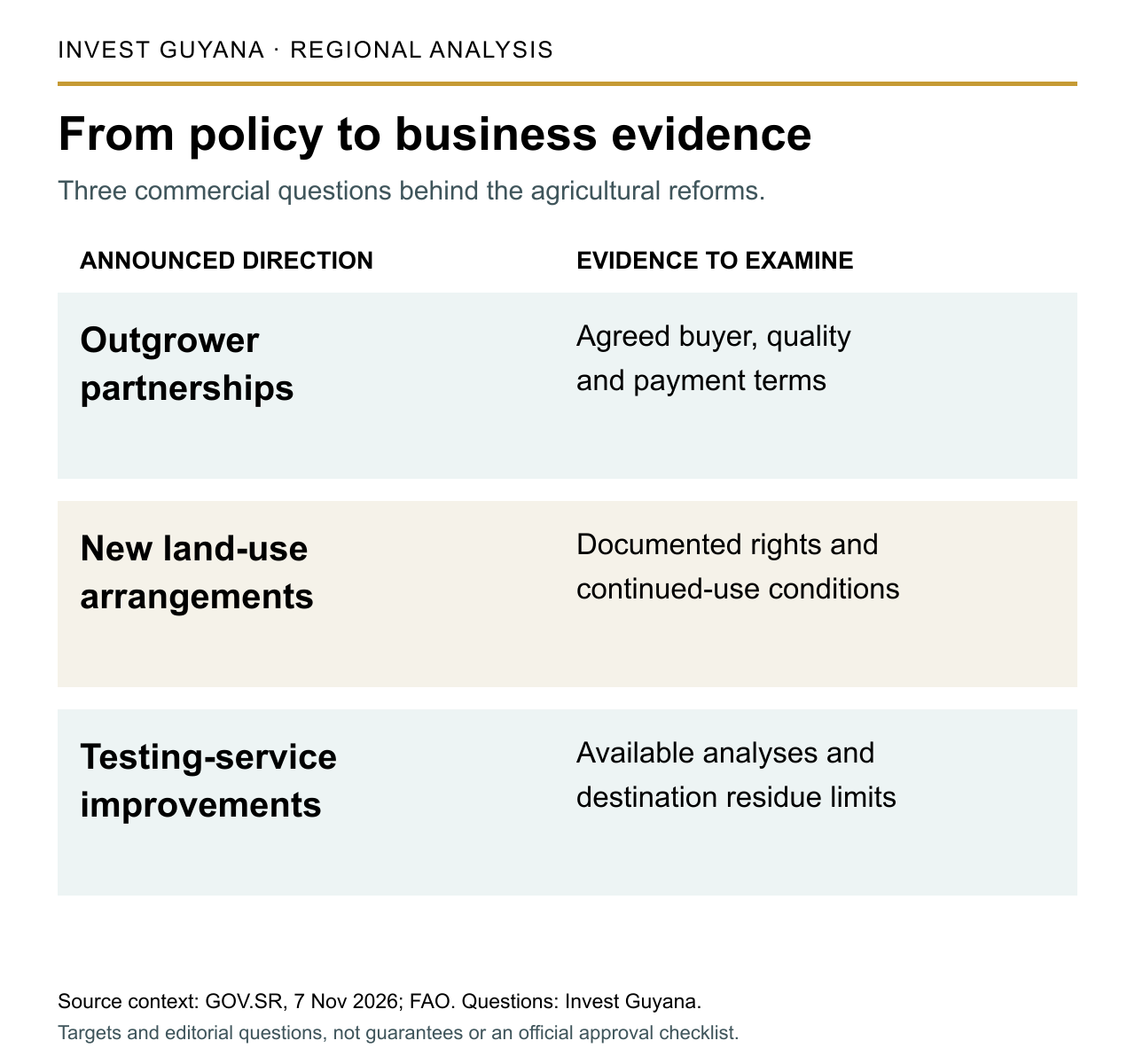
President Jennifer Simons wants foreign investment linked to local farmers through an outgrower model, according to the government’s account of her November 7 remarks. The announcement describes a policy direction, not a signed investment project or contract award.
She also outlined new agricultural land-use contracts under development, with land returning to the state if farming stops. These are proposed arrangements, not an invitation identifying available parcels or completed legal terms.
The production relationship matters
The broad commercial idea is to connect farmers with a business that buys, processes or markets their output. The Food and Agriculture Organization’s explanation of contract farming centres on agreements made before production and sale. Such agreements can define volumes, quality, delivery and payment, and may include inputs or technical support. Those are possible features of the model, not terms announced for Suriname’s proposed arrangements.
This can give a farmer a clearer route to market and a buyer a more organised supply base. But the relationship needs more than confidence that both parties want production to increase. The FAO’s contract-farming training material identifies risks on both sides: farmers can become dependent on a purchaser or indebted, while buyers face unreliable deliveries, side-selling and the cost of coordinating many producers.
For a small grower, the difference between a useful partnership and an unfavourable obligation may lie in how a price is calculated, when payment arrives and whether deductions are understandable. For a processor, the important question may be whether enough suitable produce arrives when the facility needs it. Neither issue is resolved simply by calling an arrangement an outgrower scheme.
The FAO’s contract-analysis checklist makes those operating details explicit, including responsibility for inputs, collection, quality assessment and payment. It also addresses how the parties handle failed performance. These are useful questions for evaluating a future proposal, rather than a substitute for its actual terms or the applicable law.
Export testing needs people as well as equipment
Simons identified overseas rejection of vegetables over pesticide residues as a constraint. She said the residue laboratory has new equipment but insufficient specialist staff, with a solution targeted for 2027.
That distinction matters because an equipment purchase and a dependable testing service are different business milestones. An exporter needs a result it can use within a shipment timetable; a grower needs to understand the quality expected before the crop is ready for collection. Laboratory capacity connects production decisions with the evidence a buyer may require.
The FAO’s pesticide toolkit explains maximum residue limits as permitted concentrations for pesticide residues in food or feed. It also notes that European Union limits do not always match international Codex limits. A general statement that produce has been tested therefore cannot, by itself, answer every question about suitability for a particular destination.
For businesses following the proposed laboratory improvements, the relevant signals include which analyses become available and how reliably the service operates. Those practical capabilities would be more informative than a statement that equipment has arrived. The November announcement does not establish that an expanded service is already available to exporters.
Rice research has a separate timetable
The president also set a 2027 target for reactivating ADRON, the Anne van Dijk rice research centre in Nickerie, to address problems including seed quality.
That target should not be confused with newly delivered research capacity. A separate government report dated November 2 describes twelve ADRON employees participating in refrigeration and construction training. It establishes existing staff activity, not completion of the wider rice-research revival.
For growers and agricultural suppliers, the useful follow-through would be identifiable research or seed services and a dependable connection between that work and farm operations. Staff training, institutional reorganisation and usable outputs measure different stages of progress.
What regional businesses should watch
Simons said removing administrative bottlenecks would be a priority over the following two months. For agriculture, delays can affect a production season rather than merely an office timetable.
Our assessment is that the investment significance lies in whether these strands become a workable system: clear production agreements, land arrangements that parties can evaluate, usable testing and research services, and decisions delivered in time for farming. Guyanese businesses considering regional relationships should assess specific counterparties and transactions against those capabilities. The announcement is a development to monitor, not evidence of guaranteed access, orders or returns.