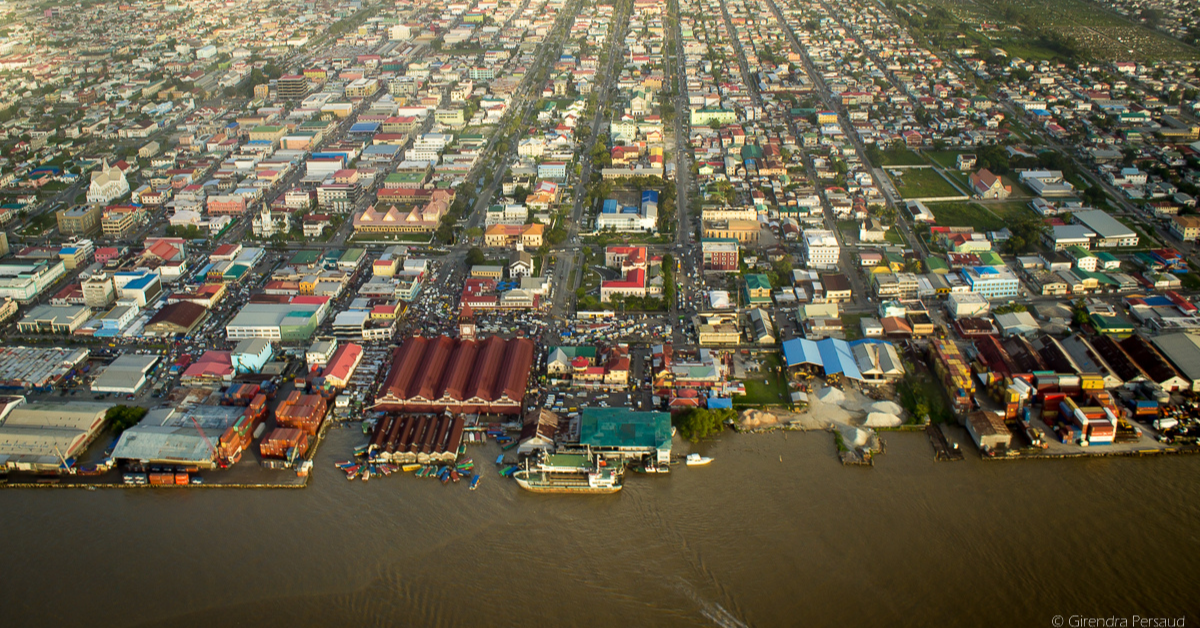

Photo: Invest Guyana.
Two figures are central to Guyana’s latest export story: 19.1% and 77%.
They do not measure the same thing.
The first is a regional figure. The Inter-American Development Bank says goods exports from the Caribbean grew 19.1% year-on-year during the first half of 2026, with that growth concentrated in Guyana and Suriname.
The second comes from Guyana’s Bureau of Statistics. It shows that the value of Guyana’s domestic exports through the end of June 2026 reached US$16.13 billion, representing a 77% increase over the corresponding period in 2025.
Together, the figures confirm the scale of Guyana’s expanding role in Caribbean trade. They also highlight the central question facing investors and policymakers: how much of today’s export momentum can be converted into a broader, more diversified investment economy?
What the IDB’s 19.1% figure means
The IDB’s Trade and Integration Monitor 2026 found that goods exports from Latin America and the Caribbean increased 19.5% year-on-year in the first half of 2026, exceeding the 14.5% increase recorded in world trade.
Within that regional performance, Caribbean exports grew 19.1%.
The IDB said the Caribbean increase was concentrated in Guyana and Suriname and was driven by higher prices for mining and energy products, particularly oil.
The IDB release does not assign a separate 19.1% growth rate to Guyana. That number applies to the Caribbean grouping covered by the report. Guyana’s national result must therefore be assessed using the country’s own official trade statistics.
This distinction matters. Regional and national growth rates describe different geographic groupings and should not be used interchangeably.
Prices and volumes tell different stories
The IDB's regional headline also needs to be separated into price and volume effects.
Across Latin America and the Caribbean as a whole, the report says higher export volumes were the main contributor to growth, with rising prices adding support. The Caribbean and South American results were different: higher prices for mining and energy products, particularly oil, were the principal drivers highlighted by the IDB.
That distinction affects how an investor interprets momentum. Growth created by a larger physical volume can point to additional production, handling and logistics demand. Growth created mainly by higher commodity prices can increase export value without requiring an equivalent expansion in the number of tonnes or barrels moved.
Both effects can improve national income and commercial activity, but they carry different risks. Price-led gains may reverse when global commodity markets weaken. Volume-led gains may be constrained by production capacity, infrastructure or demand. The regional percentage alone does not disclose which businesses gained, how much capacity was added or whether higher export earnings were retained in the domestic economy.
For Guyana, the Bureau of Statistics values show the scale of the result but do not provide, in the one-page release, a complete price-versus-volume decomposition for every product. Investors should therefore avoid converting the 77% value increase into an assumed 77% increase in physical output.
Guyana’s official export picture
Guyana’s Bureau of Statistics reported domestic exports of US$16.13 billion through the end of the second quarter of 2026, up 77% from the corresponding period of 2025.
Crude-oil exports accounted for US$15.05 billion, or 93.3% of all domestic exports.
Gold remained the next major export category. Gold exports reached US$826.2 million, an increase of 48.5% from US$556.3 million in the comparable 2025 period.
When re-exports of US$64.8 million are included, overall exports reached US$16.20 billion. Guyana recorded a goods-trade surplus of US$11.62 billion during the first half of the year.
All 2026 figures published by the Bureau are provisional and remain subject to revision.
Scale has arrived before diversification
Guyana’s export expansion is significant by any measure. It increases the country’s presence in global commodity markets, expands foreign-exchange earnings and supports demand across shipping, aviation, engineering, business services, construction, insurance and professional services.
But the composition of those exports is equally important.
With crude oil accounting for more than nine-tenths of domestic export value, Guyana’s export performance remains highly concentrated in one commodity. A large export total therefore does not, on its own, indicate that the country has achieved a diversified export economy.
For investors, that distinction changes the questions that need to be asked.
The immediate opportunity is not limited to oil production. It extends to the supporting infrastructure, services and supply chains surrounding the sector. The longer-term test is whether the revenues, infrastructure and capabilities created during the petroleum expansion help other sectors compete internationally.
Agriculture, agro-processing, forestry products, tourism, manufacturing and technology-enabled services will require their own market access, quality standards, transport systems, financing and commercial relationships.
Where Guyana’s exports are going
The Bureau of Statistics identified the Netherlands, Panama and the United Kingdom as Guyana’s three largest reported export destinations during January–June 2026.
Exports to the Netherlands totalled US$2.48 billion, while Panama received US$1.93 billion and exports to the United Kingdom reached US$1.04 billion.
The broader destination table also includes China, Türkiye, Italy, Spain, Germany, the United States and Croatia among Guyana’s principal reported export markets.
This geographic spread gives Guyana exposure to markets in Europe, the Americas and Asia. However, the value of destination diversity should still be assessed alongside product diversity. A country can ship one dominant commodity to several markets and remain commercially concentrated.
Most regional growth came from outside the region
The IDB report says Latin America and the Caribbean's exports to destinations outside the region increased 21.4%, while intraregional exports rose 7.8%. The intraregional share of total exports stood at 12.2%, down 1.3 percentage points.
This does not mean regional trade is unimportant. Nearby markets can be especially relevant to smaller manufacturers, food producers and service companies that cannot immediately absorb the cost and complexity of entering distant markets. It does show, however, that the first-half acceleration was led more strongly by demand beyond the region.
For Guyanese non-oil exporters, a regional market can still be a practical first step—but only if products meet the importing market's standards, supply is reliable, logistics are workable and prices remain competitive after freight and compliance costs. The aggregate export surge does not remove those firm-level requirements.
Invest Guyana’s importing and customs explainer and product standards and compliance explainer provide the procedural context businesses need when assessing those requirements.
From trade resilience to investment
The IDB argues that the region’s export resilience creates an opportunity to attract more foreign direct investment.
That opportunity is not automatic.
Despite the region’s recent trade performance, the IDB found that Latin America and the Caribbean received 4.5% less foreign investment during 2023–2025 than during 2012–2014. The region’s share of the global stock of foreign direct investment also fell from 7.1% to 6%.
The report places average annual FDI inflows at approximately US$178.5 billion during 2023–2025. Measured against the size of the economy, the region's 2.6% FDI-to-GDP ratio remained comparatively high. Those figures can coexist: investment may be material relative to regional output while the region still loses share in global capital allocation.
Within the IDB's regional FDI comparison, the Caribbean's gain in share was driven by Guyana. That is commercially important, but it also reinforces the concentration question. A large petroleum project can lift national and regional investment totals without proving that capital is spreading across a wide range of export industries.
The report therefore places particular emphasis on regulatory architecture.
According to the IDB, double-taxation treaties, bilateral investment treaties and trade agreements containing investment provisions are associated with a greater likelihood of investment relationships between countries. Domestic regulatory certainty and public goods that reduce the cost of operating internationally are also important.
For Guyana, this places the quality of the investment environment alongside the volume of exports.
Investors will examine the reliability of electricity and transport, the availability of skilled workers, customs efficiency, contractual certainty, tax administration, access to serviced land and the predictability of sector regulation. These factors influence whether export-led growth produces a wider range of productive investments.
What conversion into productive capacity would look like
The strongest outcome would not simply be another increase in the value of crude exports. It would be evidence that the export boom is creating capabilities that remain useful across sectors.
That could include more reliable port and cold-chain capacity, lower-cost energy, laboratories and certification systems, export finance, skilled technical and commercial personnel, stronger local suppliers and firms able to sell value-added goods or services into several markets.
The evidence should be measured rather than assumed. Useful signals would include sustained growth in non-oil export value and volume, repeat orders in new markets, greater processing before export, a wider base of exporting companies and private investment in productive facilities rather than only short-term trade activity.
This is why diversification is not a slogan attached to a high export total. It is a change in what the country sells, who can sell it, how much value is added domestically and whether the supporting systems allow those sales to continue through a commodity-price cycle.
What investors should watch
Five indicators will help determine how the export story develops:
- the share of crude oil in total domestic exports;
- growth in non-oil exports, particularly value-added products and services;
- changes in Guyana’s principal export markets;
- investment in logistics, energy, standards and workforce capability; and
- the regulatory reforms and international agreements affecting investment certainty.
Guyana’s export acceleration is real, and its contribution to Caribbean trade is increasingly visible.
The next stage is more demanding. It involves transforming exceptional commodity-export scale into an economy capable of supporting a wider range of internationally competitive businesses.
The 19.1% Caribbean growth rate captures the momentum. Guyana’s 93.3% oil share explains why diversification remains the larger investment question.
Editor’s note: Guyana’s January–June 2026 trade figures are provisional and subject to revision. The IDB’s 19.1% rate applies to Caribbean exports as a regional grouping; it is not a Guyana-specific growth rate.