
Photo: Invest Guyana
Consider an illustrative international equipment company evaluating Guyana. Its commercial team sees demand, its finance team wants a local subsidiary, its head office prefers a branch and a potential distributor proposes a joint venture. Each team has an opinion, but no one has assembled the evidence needed for a decision.
A market-entry brief turns that debate into one controlled document. It should explain what the business intends to do, which facts are verified, which assumptions remain open, what each structure would have to support and what must happen before capital is committed.
This is an internal decision tool, not an application to a government agency and not a substitute for legal or tax advice.
1. State the decision before collecting documents
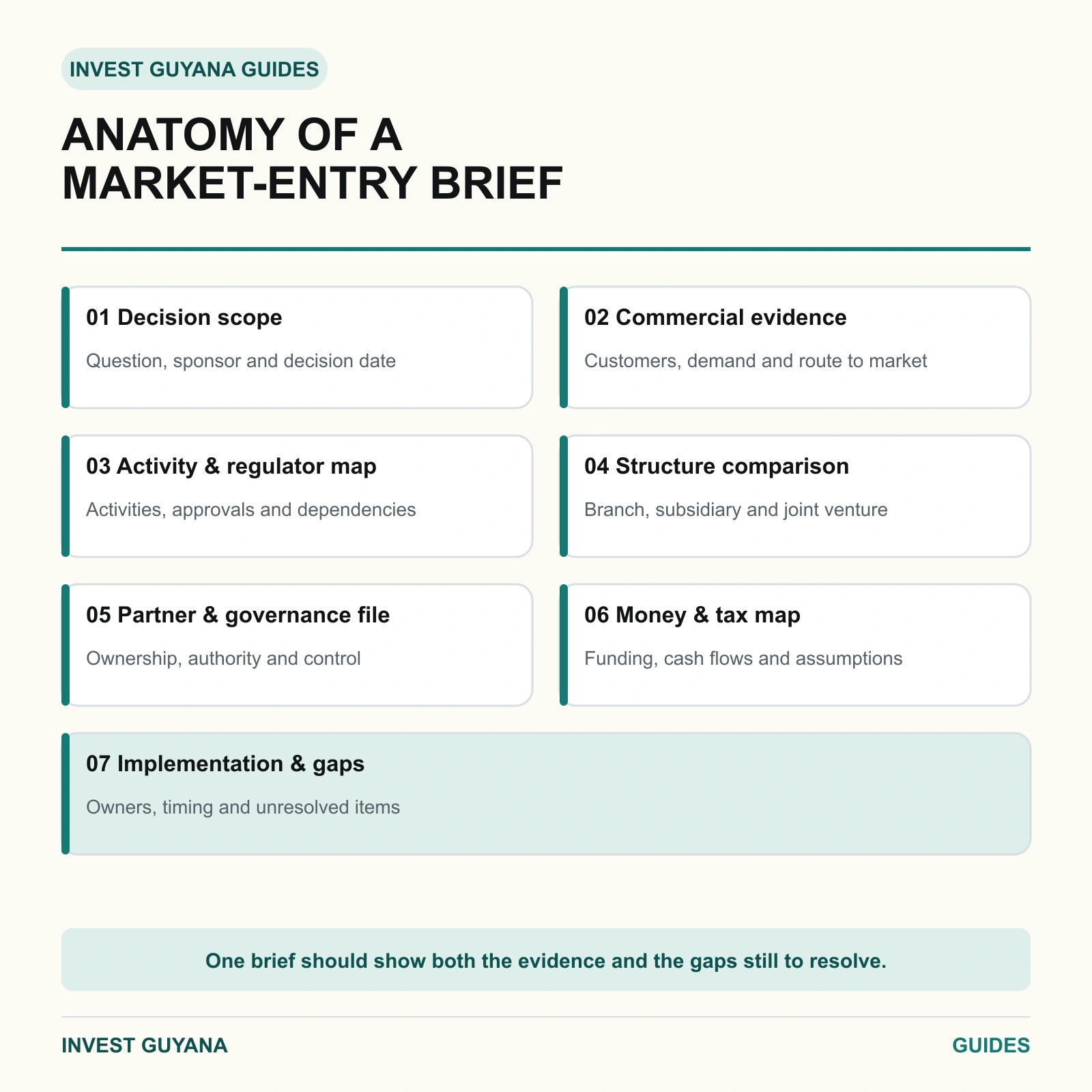
Begin with one decision statement:
Decide how the proposed Guyana operation should be owned, controlled, funded and implemented for its first defined phase.
Then record the scope. Identify the products or services, target customers, intended location, proposed launch date, capital range and planned activities. State what is outside the current decision.
A company evaluating sales and maintenance should not quietly assume that warehousing, importing, installation or construction will be added later. Those activities may change the contracts, licences, people, facilities and structure required.
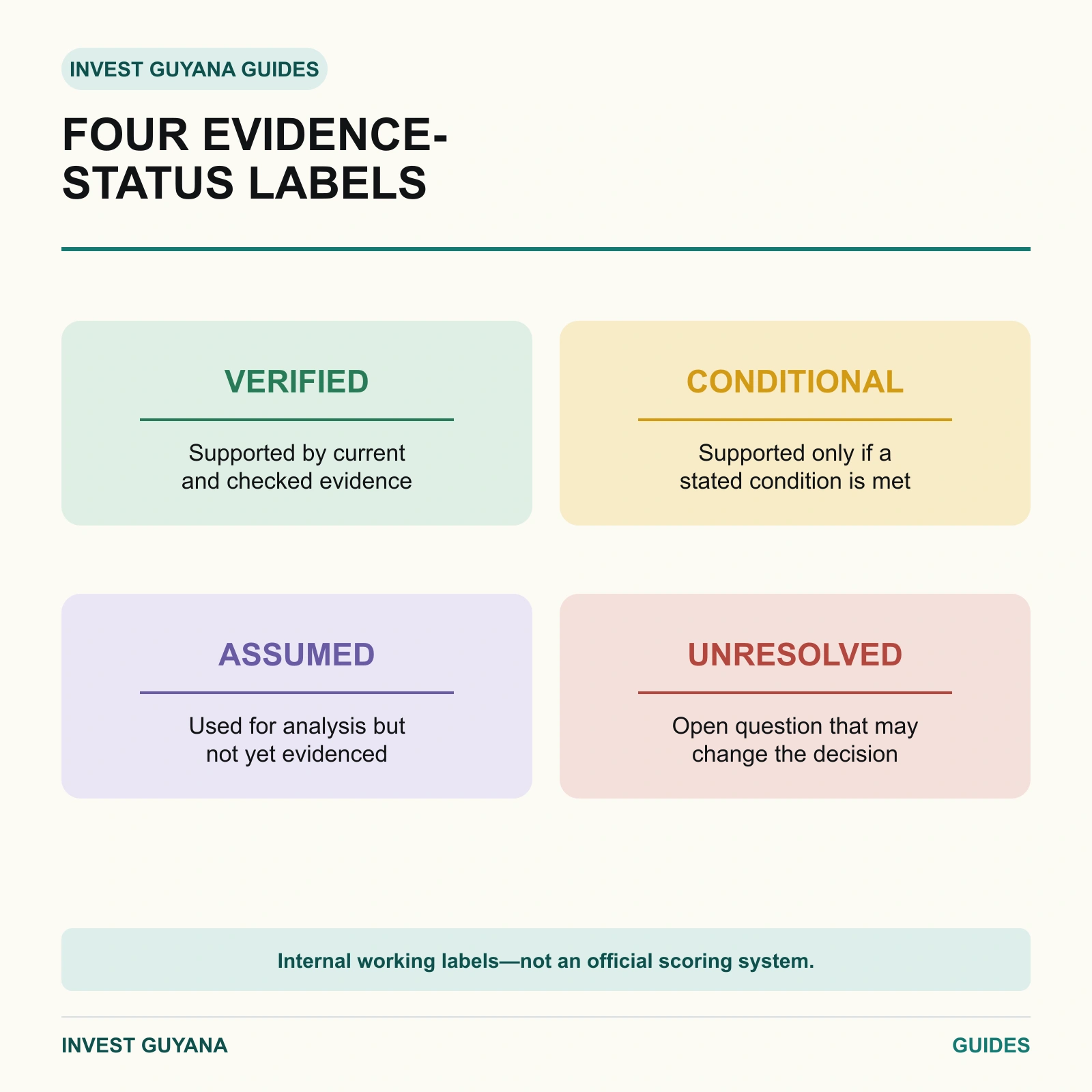
Use a fact-status key throughout the brief:
| Status | Meaning |
|---|---|
| Verified | Supported by a current primary document or authoritative confirmation |
| Conditional | Supported, but dependent on a stated event, approval or contract condition |
| Assumed | Used for analysis but not yet supported |
| Unresolved | A material question remains open and has an owner and deadline |
These are internal evidence labels, not a government or lender scoring system.
2. Build the commercial evidence file
The brief should explain why the market entry exists before discussing the legal form.
| Question | Evidence to include | Gap to expose |
|---|---|---|
| Who is the customer? | Customer interviews, tender documents, signed contracts, conditional agreements or non-binding letters, clearly labelled | Whether demand is contracted, conditional or forecast |
| What is being sold? | Product and service description, technical requirements, warranty and after-sales obligations | Whether local installation, maintenance or certification is required |
| How will it reach the customer? | Import, distribution, direct sales, agent or local-partner model | Who holds inventory and who signs customer contracts |
| What makes the offer competitive? | Price basis, delivery time, service capability and competitor evidence | Which advantages depend on an unverified partner or approval |
| What scale is planned? | Base, downside and expansion cases | Which assets and staff belong to phase one rather than a later ambition |
Link each major commercial statement to an indexed document. A market estimate should not be presented as a signed order, and an introductory conversation should not be presented as a partnership.
3. Map activities before comparing entities
Create an activity-and-regulator matrix. Do not begin with “register company” and assume everything else follows.
| Planned activity | Operating evidence | Official route to confirm | Structure question |
|---|---|---|---|
| Sign local customer contracts | Draft contract, warranty and governing-law position | Commercial and sector requirements | Which entity accepts performance and payment risk? |
| Import equipment or parts | Product list, tariff classification, volumes and importer role | Guyana Revenue Authority (GRA) and any controlled-goods regulator | Which entity is importer of record and funds duties and value-added tax (VAT)? |
| Employ staff | Organisation chart, job descriptions, payroll and immigration needs | GRA, National Insurance Scheme (NIS), labour and immigration routes | Which entity is employer and supervises staff? |
| Lease or acquire premises | Site requirement, term, access, utilities and permitted use | Landlord/title evidence, planning and local authority routes | Which entity signs the lease and funds fit-out? |
| Store, install or maintain equipment | Facility, safety, environmental and technical requirements | Relevant municipal, standards, safety, environmental and sector agencies | Which entity holds the approval and operating responsibility? |
| Bid for public or sector work | Tender and qualification requirements | Procurement, local-content or sector route where applicable | Does the bidder satisfy ownership, registration and capability rules? |
The official Government Services directory and GO-Invest advisory service can help identify routes. They do not replace written confirmation from the competent authority.
4. Prepare the structure options matrix
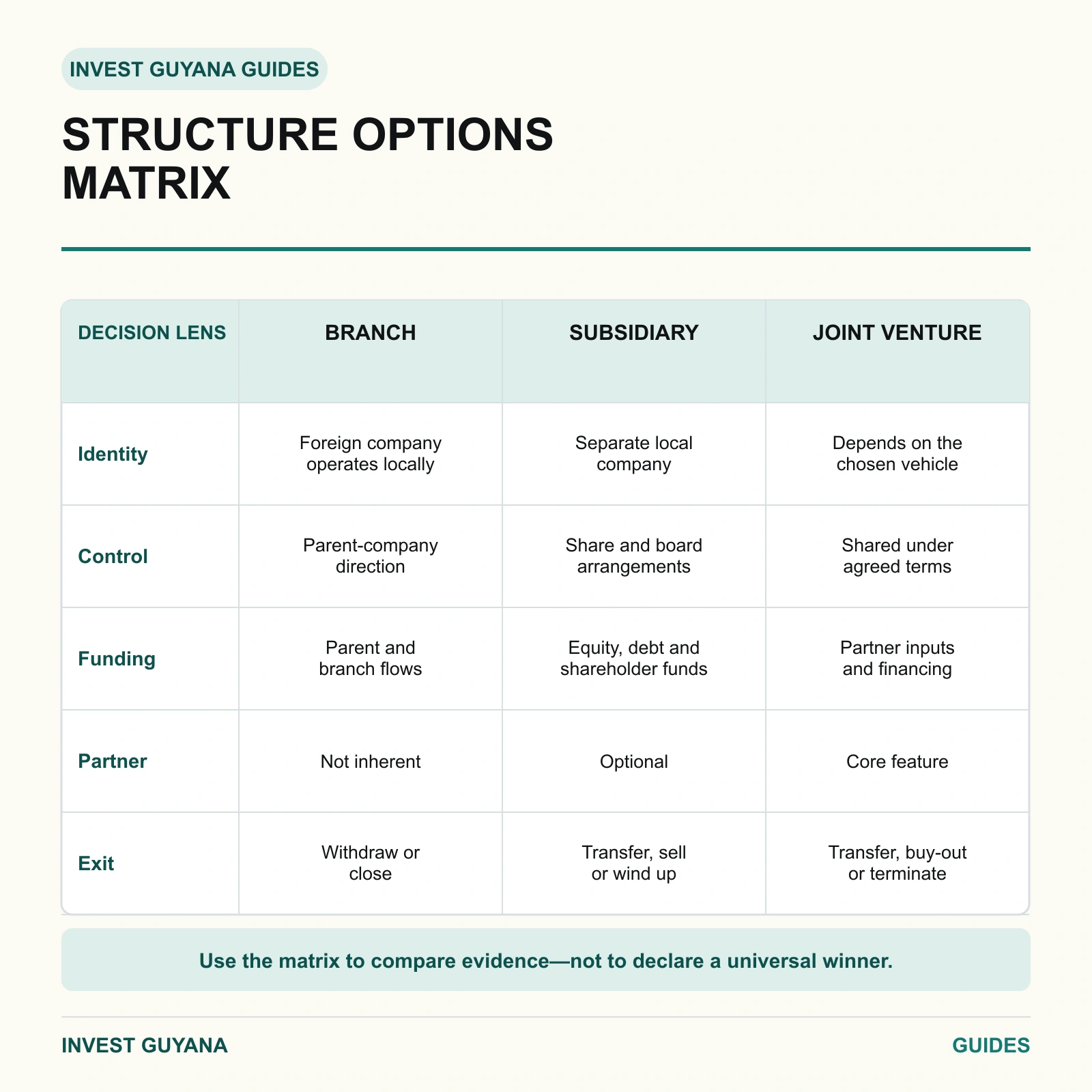
Compare at least the branch/external-company, local-subsidiary and joint-venture routes against the same facts.
| Decision area | Branch / external company | Local subsidiary | Joint venture |
|---|---|---|---|
| Legal identity | Foreign enterprise remains the operating legal person | Guyana company is a separate legal body | Depends on the chosen vehicle and venture documents |
| Ownership and control | Central parent control | Parent controls through shares, board and reserved matters | Negotiated between the venture parties |
| Liability relationship | Operating obligations are those of the external company | Liabilities ordinarily sit in the local company, subject to guarantees and law | Depends on the vehicle, guarantees and contractual allocation |
| Funding | Parent funds the Guyana operation directly | Equity, shareholder debt and third-party finance can be recorded locally | Contributions and future capital calls must be agreed |
| Partner contribution | No equity partner is required | A partner may subscribe for shares later | Contribution, valuation and delivery must be defined at entry |
| Exit route | Cessation of external-company registration and contract wind-down | Share sale, asset sale, dissolution or other corporate route | Transfer, buyout, deadlock and termination mechanisms must be negotiated |
| Evidence required | Foreign corporate instruments, authority and local registration evidence | Incorporation, ownership, governance and funding records | Partner diligence plus vehicle and venture documents |
The Investment Act permits wholly owned and joint-venture investment enterprises and does not impose a general domestic-share requirement. Record any sector-specific exception or commercial reason for local participation separately.
Do not select the option only by counting registration documents. Compare the structure’s ability to hold the required contracts, approvals, people, assets and funding throughout the planned phase.
5. Test any proposed partner
If the proposed route includes a local or international partner, open a separate due-diligence workstream.
Record:
- legal identity, registration status, ownership and beneficial owners;
- directors, authorised representatives and decision authority;
- relevant experience, staff, facilities and customer relationships;
- financial statements, liabilities and ability to fund;
- litigation, regulatory, tax and reputation checks within lawful sources;
- the assets, rights or services the partner promises to contribute;
- whether those contributions are owned, transferable and independently valued; and
- conflicts involving customers, suppliers, government contracts or competing ventures.
GO-Invest promotes and coordinates joint-venture connections, but its official profile states that it does not negotiate private deals. A facilitated introduction is not due diligence and is not evidence that a partner can deliver the proposed contribution.
Add a contribution schedule:
| Contribution | Party | Evidence | Delivery date or condition | Consequence if not delivered |
|---|---|---|---|---|
| Cash equity | Investor | Funding evidence and approval | Before first capital commitment | Funding plan and ownership must be reconsidered |
| Distribution network | Partner | Customer/supplier agreements and operating records | Before launch | Forecast route to market remains unverified |
| Premises | Partner | Title or lease and permitted-use evidence | Before fit-out | Site and programme remain conditional |
| Technical staff | Either party | Employment, qualifications and availability | Before commissioning | Service capacity cannot be treated as ready |
All entries are illustrative; the actual schedule should be built from the proposed transaction.
6. Map ownership, control and economics
Attach an ownership chart for each option. Show the natural persons who ultimately own or control the entities, not only the immediate shareholder names. The Commercial Registry gathers beneficial-ownership information for local and external companies and also handles annual returns and financial statements.
For a subsidiary or incorporated joint venture, identify:
- initial and fully diluted ownership;
- board composition and appointment rights;
- ordinary voting thresholds;
- decisions requiring special consent;
- management authority and banking mandates;
- new-share, transfer and pre-emption rules;
- capital-call and default consequences; and
- deadlock and exit routes.
For every option, map the money:
- initial capital;
- working capital;
- intercompany or shareholder funding;
- customer receipts;
- operating costs;
- fees, interest or distributions;
- taxes and withholding; and
- reinvestment or repatriation.
The GRA’s current Tax Laws index should be used to identify the legislation and amendments relevant to the actual facts. The brief should flag questions for tax advice rather than inserting a headline rate as if it decides the structure.
7. Build the implementation dependency plan
Create one implementation table that links the structure decision to the work needed for launch.
| Dependency | Owner | Evidence needed | Decision or completion gate | Effect if delayed |
|---|---|---|---|---|
| Structure and ownership approval | Sponsor board | Approved decision paper and authority | Before registration or partner commitment | Corporate work cannot proceed safely |
| Registry route | Legal lead | Current incorporation or external-company requirements | Certificate and required supporting records | Entity cannot be treated as operational |
| Tax registration | Finance lead | TIN and applicable tax-account evidence | Before required transactions and filings | Banking, contracting or compliance may be affected |
| Banking and funding | Finance lead | Account, mandates, source of funds and draw schedule | Before commitments are made | Launch funding remains unavailable |
| Licences and permits | Regulatory lead | Activity-specific applications and decisions | Before the regulated activity begins | Operations or revenue start may be delayed |
| Premises and utilities | Project lead | Site rights, permitted use and connection evidence | Before fit-out or commissioning | Cost and launch date remain conditional |
| People and immigration | HR lead | Employment, NIS, pay-as-you-earn (PAYE) and immigration plan | Before staff begin work | Operating capacity remains incomplete |
| Contracts and insurance | Commercial lead | Approved customer, supplier, partner and insurance documents | Before exposure is accepted | Risk may sit with the wrong entity |
The registration certificate is one gate in this plan, not the entire market entry.
8. Finish with the decision and gap register
The completed brief should end with:
- the recommended structure and why it fits the defined first phase;
- alternatives considered and the reason each was not selected;
- material assumptions and unresolved issues;
- conditions that must be satisfied before commitment;
- named owners and deadlines;
- the circumstances that would require the decision to be reopened; and
- the advisers or authorities from whom confirmation is still required.
A useful recommendation is conditional when the evidence is conditional. For example:
Use a local subsidiary for the first operating phase, subject to confirmation of the tax model, site route, relevant licences and parent funding approval. Do not proceed with the proposed joint venture unless the partner’s distribution rights, contribution and governance terms are verified.
That wording is stronger than pretending that every issue is already settled.
Pre-circulation check
Before the brief goes to the board or investment committee, confirm that:
- ☐ the commercial opportunity and first operating phase are defined;
- ☐ every planned activity appears in the regulator and dependency map;
- ☐ branch, subsidiary and joint-venture options were compared against the same facts;
- ☐ the proposed partner and promised contributions were independently checked;
- ☐ ownership, beneficial ownership, control and authority are visible;
- ☐ funding, tax, cash movement and exit have been modelled;
- ☐ applications, approvals and assumptions are labelled separately;
- ☐ each material claim points to current evidence;
- ☐ unresolved issues have owners and deadlines; and
- ☐ the recommendation states the conditions under which it remains valid.
The value of the brief is not that it predicts every issue. It lets decision-makers see what is known, what remains conditional and why the proposed structure fits the actual business.
The companion Invest Guyana Explainer, Market-Entry Structures Explained: Branch, Subsidiary or Joint Venture?, explains the legal and economic relationships behind the comparison.
Editorial note: This Guide provides general preparation information, not legal, tax, accounting, immigration, regulatory or investment advice. Requirements depend on the investor, activity, sector, location and laws in force at the relevant time.