Photo: Department of Public Information, Guyana.
Guyana is calling for Caribbean governments, shipping companies and development institutions to move beyond diagnosing the region’s transport problems and begin constructing a coordinated financing model for port modernisation.
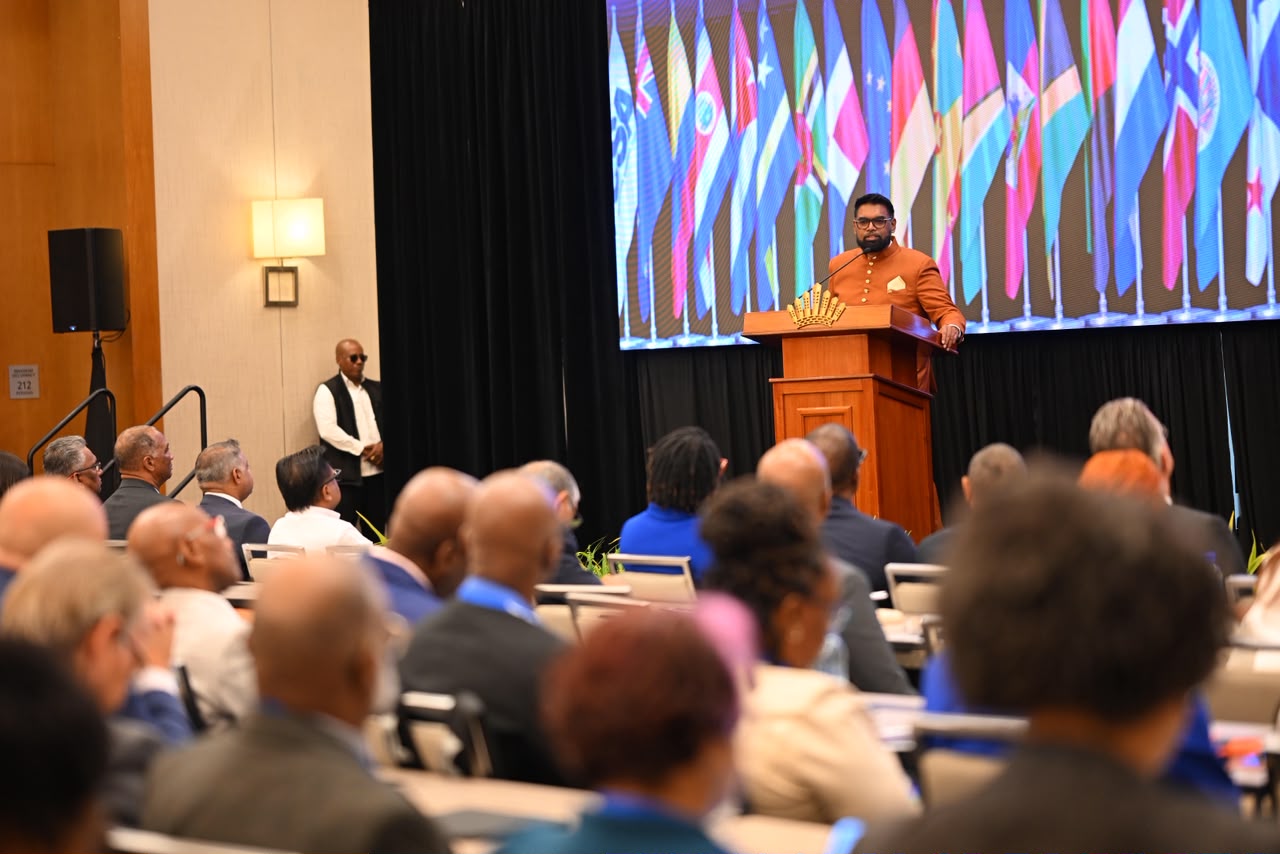
Speaking at the Caribbean Shipping Association’s 56th Annual General Meeting and Conference in Georgetown, President Dr Mohamed Irfaan Ali proposed the preparation of an urgent regional policy document setting out the fiscal incentives, banking arrangements and public-private partnership structures needed to mobilise investment.
The proposal identifies the Caribbean Development Bank, Inter-American Development Bank and IDB Invest as potential institutional partners. However, no regional financing facility, investment commitment or approved project pipeline has yet been announced.
That distinction matters. The initiative is currently a policy proposal intended to bring governments, financiers and maritime businesses around a common investment framework—not a funded programme ready for implementation.
Why Port Investment Matters
Ports sit at the centre of the Caribbean economy.
Food, construction materials, machinery, vehicles, fuel and most manufactured goods move through maritime supply chains. When port infrastructure is outdated, shipping connections are limited or cargo must pass through multiple hubs, the resulting costs affect businesses and consumers across the region.
A May 2026 International Monetary Fund working paper found that every CARICOM country except Jamaica faced shipping costs above the global average in the data examined.
The paper also identified limited direct cargo connections, dependence on regional transshipment hubs and weaker maritime connectivity as continuing constraints on Caribbean trade.
For businesses, those constraints can mean:
- higher landed costs for imported equipment and materials;
- longer and less predictable delivery times;
- increased inventory and working-capital requirements;
- weaker competitiveness for regional exporters; and
- higher prices for consumers.
Port modernisation is therefore not simply a maritime-sector issue. It affects manufacturing, agriculture, construction, tourism, energy, retail and almost every enterprise that imports inputs or exports products.
The Proposed Investment Model
According to the official account of the Georgetown address, the proposed framework would bring private investment together with infrastructure that serves a wider public and economic purpose.
This could include privately financed terminals, storage facilities, cargo-handling equipment and logistics services operating alongside publicly supported channels, roads, customs systems and regulatory infrastructure.
The concept broadly reflects models already used across Latin America and the Caribbean. An IDB assessment of port public-private partnerships describes arrangements in which private operators invest in the construction, rehabilitation and maintenance of port infrastructure while being required to meet defined service standards.
Such partnerships are not a single financing formula. Their commercial viability depends on cargo volumes, tariff structures, land and maritime access, construction risk, environmental obligations and the division of responsibilities between governments and operators.
A regional framework could help participating countries establish common principles while still allowing individual projects to reflect local conditions.
Guyana’s Emerging Maritime Investment Base
Guyana is presenting its recent experience as evidence that significant private capital can be attracted into maritime and logistics infrastructure.
President Ali estimated that private investment in shore bases, laydown yards and port facilities along the Demerara River has approached or exceeded US$1 billion during the past four to five years.
That figure represents the president’s stated estimate and should not be interpreted as an independently audited aggregate. It nevertheless reflects the scale of maritime infrastructure developed to service offshore petroleum operations and the wider economy.
The government is also examining a proposed deepwater port in Berbice. Engineering firm Bechtel has been conducting studies while Guyana considers the project’s design and financing structure.
Interest has been signalled by prospective international partners, including the US Export-Import Bank and the Qatar Investment Authority. No final financing agreement, construction contract or completed investment structure for the deepwater port has been publicly announced.
The project therefore remains at the development and financing stage.
A Wider Logistics Opportunity
The Caribbean Shipping Association’s conference programme places port modernisation within a broader agenda that includes digital transformation, artificial intelligence, supply-chain resilience and Guyana’s emergence as a regional logistics and energy hub.
For investors and service providers, the opportunity is wider than constructing wharves.
Potential demand could emerge across terminal operations, dredging, marine engineering, bonded warehousing, cold-storage, customs technology, maritime insurance, vessel maintenance, lower-emission port equipment and workforce development.
The commercial case for each investment will still depend on throughput, customers and the wider transport network. New terminals cannot operate efficiently without reliable roads, customs processing, utilities, digital systems and links to productive sectors.
Connecting Infrastructure to Trade
A port-development strategy must also answer a basic question: what additional trade will the infrastructure serve?
Guyana’s expanding oil and gas industry has already created demand for shore bases and marine support services. Future port investment is also being connected to agriculture, mining, manufacturing, energy processing and trade with northern Brazil and the wider Caribbean.
At the regional level, port improvements would be most valuable if they strengthen direct shipping links, reduce unnecessary transshipment and make it easier for businesses to move goods between Caribbean markets.
Modern facilities alone will not resolve those constraints. Shipping volumes, customs procedures, competition, port charges and coordination among carriers will remain important.
What Investors Should Watch
The proposal becomes materially more important when it begins producing bankable projects and defined institutional commitments.
- publication of the proposed regional policy and investment framework;
- formal participation by development banks and export-credit agencies;
- identification of priority ports and projects;
- procurement and public-private partnership rules;
- tariff, concession and risk-sharing structures;
- environmental and climate-resilience requirements; and
- credible cargo and revenue forecasts.
Investors should also distinguish expressions of interest from financing approvals. Statements of support can help establish momentum, but they are not substitutes for due diligence, signed agreements or financial close.
From Conference Proposal to Investment Pipeline
The Georgetown proposal reflects growing recognition that weak maritime connectivity is not merely a transport inconvenience. It is a constraint on investment, trade and competitiveness.
Guyana’s recent maritime expansion gives it a useful position from which to lead the discussion. The next test will be whether Caribbean governments, industry operators and financial institutions can turn that discussion into a transparent regional framework and a credible pipeline of investable projects.
Until then, the proposal should be understood as a strong policy signal—important, commercially relevant, but still awaiting the institutions, financing and projects required for execution.