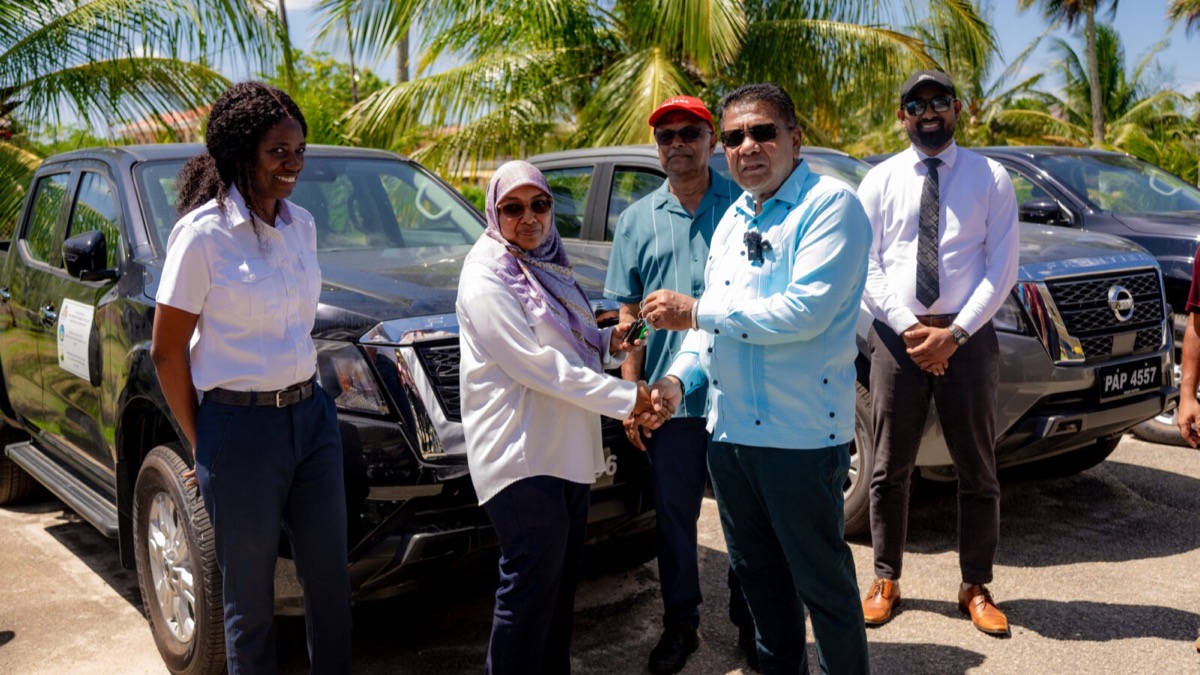
Guyana has equipped the National Agricultural Research and Extension Institute (NAREI) with a G$60 million vehicle fleet intended to expand field support for farmers and strengthen surveillance of the Carambola Fruit Fly, a pest that can restrict the movement and export of fresh produce.
Photo: Department of Public Information, Guyana.
The fleet—five pickup trucks, six all-terrain vehicles and 12 motorcycles—was procured under the Agricultural Infrastructure Development Programme (AIDP). The handover is a practical implementation milestone within a wider programme financed in part by the CARICOM Development Fund (CDF).
Field mobility for extension and pest surveillance
The Ministry of Agriculture’s official release says the vehicles will improve the mobility of NAREI’s technical and extension personnel, particularly in farming communities and difficult-access areas. The Department of Public Information published the same programme details.
Extension officers connect research and policy with day-to-day farm decisions. More reliable transport can increase the reach of farm visits, technical advice, farmer education and field responses, especially where distance and road conditions limit regular service.
The second purpose is more directly connected to trade risk. Government says the fleet will support regular trapping, monitoring and field inspections under the national Carambola Fruit Fly programme. Early detection and rapid intervention are important to limiting the establishment and spread of the pest in fruit-producing areas.
The vehicles improve operational capacity, but they do not by themselves establish pest-free status or guarantee access to any export market. Those outcomes depend on sustained surveillance, documented control results and the phytosanitary requirements of importing countries.
A milestone within an US$18 million programme
The CDF’s 2025 annual highlights say its board approved a US$15 million concessional loan in April 2025 to support Guyana’s US$18 million AIDP. The loan agreement was signed in June 2025 and a project start-up workshop was held the following month.
CDF describes the programme as a package of agriculture infrastructure and support measures expected to benefit 4,300 agripreneurs. Its components include facilities for Carambola Fruit Fly surveillance and control, processing capacity for several crops, training for farmers and extensionists, and technical assistance to agri-enterprises and sector associations.
The new vehicles therefore represent one visible delivery component rather than the whole programme. Investors and producers should watch whether the supporting infrastructure, training and technical-assistance elements advance on schedule and whether agencies publish measurable results.
Why this matters to agriculture investors
For commercial farms and agro-processors, dependable extension services can shorten the distance between a production problem and a technical response. Better field coverage may help producers adopt recommended practices, identify pests earlier and improve the consistency of supply entering processing and export channels.
Fruit-fly control has a wider market consequence. Pest surveillance and credible plant-health systems underpin confidence in Guyana’s ability to move fresh produce across borders. A stronger national network can support the evidence required for market-access discussions, although access decisions remain subject to formal regulatory processes in destination markets.
The fleet also signals continued implementation of a financed regional food-security programme. That matters to businesses assessing public investment around farms, processing, technical services and supply-chain reliability, but the commercial value will depend on deployment rather than procurement alone.
What to watch next
The most useful next disclosures would be the geographic deployment of the vehicles, the frequency and coverage of extension visits, the number of traps or surveillance points serviced, and response times when a pest signal is detected.
Programme reporting should also show progress on the planned fruit-fly facilities, farmer and extensionist training, processing infrastructure and support for agribusinesses. Those indicators will reveal whether the G$60 million fleet is being converted into wider service coverage and stronger trade safeguards.
For now, the verified development is a completed equipment handover under an active, externally financed agriculture programme. The investment case lies in what that mobility enables: more regular technical contact with producers, stronger pest monitoring and a more credible platform for agricultural expansion and export readiness.