
Drone photograph from Invest Guyana’s media archive; contextual image, not the hypothetical project described.
Imagine an entrepreneur presenting plans for a cold-storage business in Guyana. The site looks promising, suppliers have provided equipment quotations and several potential customers have expressed interest. The project has enough substance to feel real, and the founder is ready to describe it as viable.
A prospective investor asks a different question: what would need to be true for the business to cover its costs, meet its commitments and produce an acceptable return? The discussion moves from the attractiveness of the idea to the assumptions connecting demand, operations and finance.
That is the purpose of feasibility. It examines whether the proposed investment can work under a credible set of conditions. It is not a certificate guaranteeing success, and it is not established by accumulating unrelated signs of progress.
An opportunity needs a connected explanation
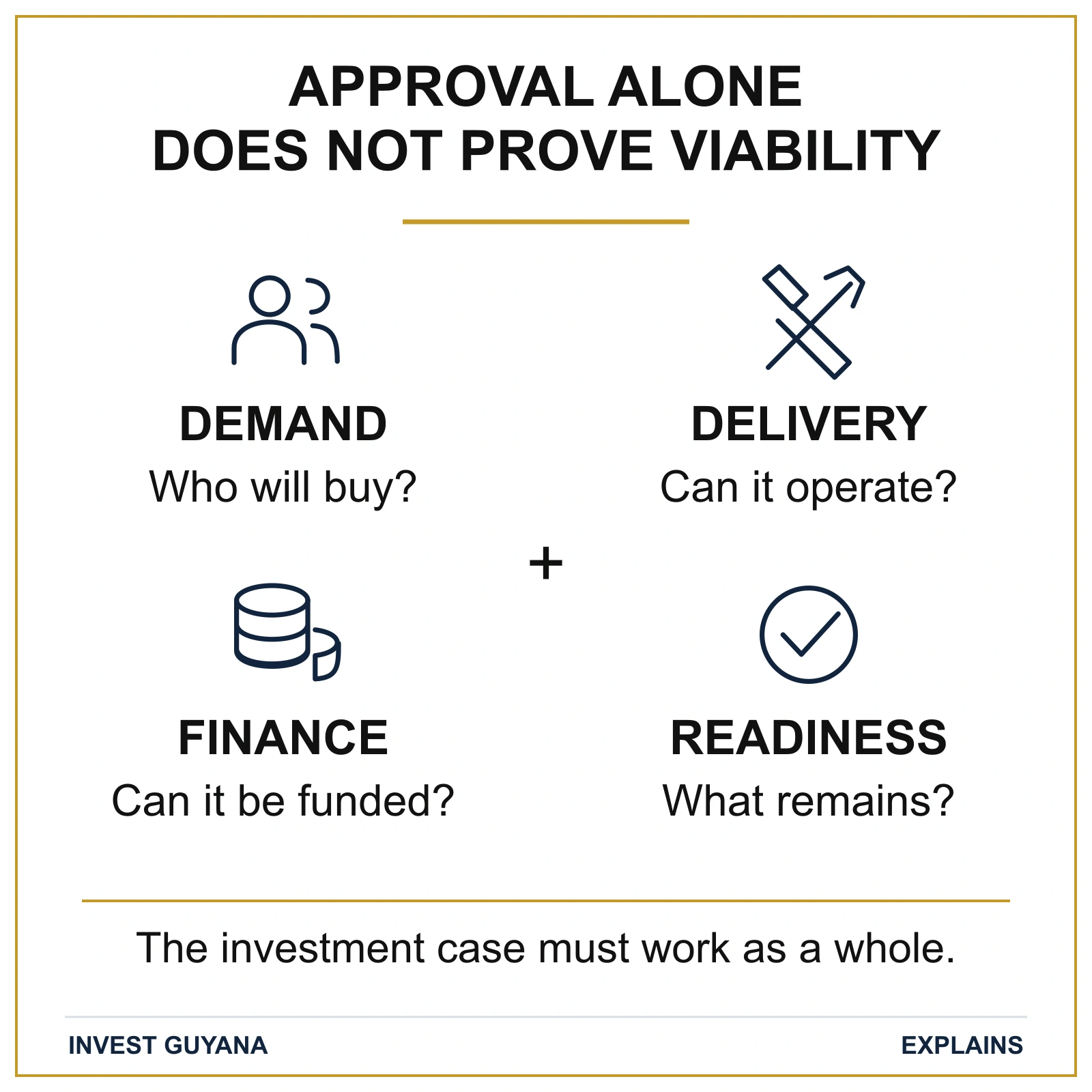
A project can have a suitable site without enough customers, customer interest without a workable delivery system or strong projected sales without adequate cash. Each positive feature matters, but feasibility concerns how the features fit together. A weakness in one essential connection can affect the whole investment.
The International Finance Corporation’s financing framework considers markets, technical arrangements and financing together. It illustrates the breadth of investment appraisal without making its application requirements a rule for every Guyanese enterprise. IFC financing framework.
For our cold-storage founder, the proposal needs to explain more than why refrigeration is useful. It needs a particular group of customers, a service they will buy and an operation capable of supplying it at a sustainable cost. The project becomes testable when those relationships are specific enough to examine.
This is where the preceding explainers become useful without needing to be repeated in full. Economic growth provides context, contracts define commitments, supply chains influence delivery and finance shapes cash obligations. Feasibility considers their combined effect on one decision.
Interest is different from demand at a price
A potential customer can genuinely like an idea without committing to buy the proposed service on the assumed terms. Conversations reveal useful information, but their evidential weight depends on what the customer has actually expressed. General enthusiasm should not silently become contracted revenue in the financial model.
Suppose several food businesses welcome the possibility of additional cold storage. Their actual demand may depend on location, reliability, temperature requirements, access arrangements and price. A project that satisfies only some of those conditions may capture less business than the founder expects.
The US Small Business Administration’s planning material treats market research and competition as separate subjects from startup costs. The general principle is useful: understanding what a service costs to supply does not establish that enough customers will buy it. US programme or tax details are not applicable guidance for Guyana. SBA business-planning concepts.
The founder therefore needs to distinguish a market’s existence from the share this particular project can plausibly serve. Competitors, customer alternatives and the pace of adoption all influence the connection between a national opportunity and the enterprise’s own revenue.
Capacity is valuable only when it can be used
A building and equipment create potential capacity. Operating that capacity requires inputs, people, systems and dependable supporting arrangements. The investment’s technical possibility should not be confused with its ability to deliver consistently under actual conditions.
For cold storage, the founder’s proposed service would depend on the functioning of equipment, suitable operating arrangements and the ability to handle goods as promised. A quotation for machinery addresses an important purchase, but it does not alone describe the full service customers will experience.
Imagine the facility offering more space than customers initially need. The unused capacity still has costs, even though it could support future growth. Alternatively, unexpectedly strong demand might expose a constraint in handling or access before the physical storage area is full.
These scenarios illustrate why capacity and utilisation belong in the same conversation. A project can be technically impressive while its practical operating pattern differs from the one assumed in the investment case.
Breaking even is one test, not the verdict
Break-even analysis asks when revenue covers specified costs under the assumptions used. It can clarify the relationship among price, volume and cost, but it does not verify those assumptions. Nor does a break-even result automatically demonstrate an attractive return on the capital committed.
Consider a simplified, original example. If a service has fixed monthly costs of G$1 million and each unit sold contributes G$2,000 after its associated variable cost, 500 units would cover those fixed costs. The calculation assumes that the units can actually be sold and delivered at those figures, and it excludes any costs not specified in the example.
If the founder cannot attract that volume at the assumed price, the arithmetic remains correct while the commercial conclusion changes. If an important expense was omitted, the apparent threshold may be misleading. The value of the calculation depends on the completeness and credibility of its inputs.
This is why a feasibility discussion asks where the numbers came from. A model is a structured account of assumptions, not independent proof that the future will behave accordingly.
The project must survive its timing
Even an investment expected to earn an acceptable return may require substantial money before customer receipts arrive. Construction, equipment and mobilisation can precede operating income. A project can therefore face a funding gap despite a positive longer-term projection.
The cash-flow explainer examined this timing distinction within ordinary business operations. At project level, the same issue extends across development and launch. The founder needs to understand the sequence of commitments, not merely whether projected total revenue eventually exceeds projected total cost.
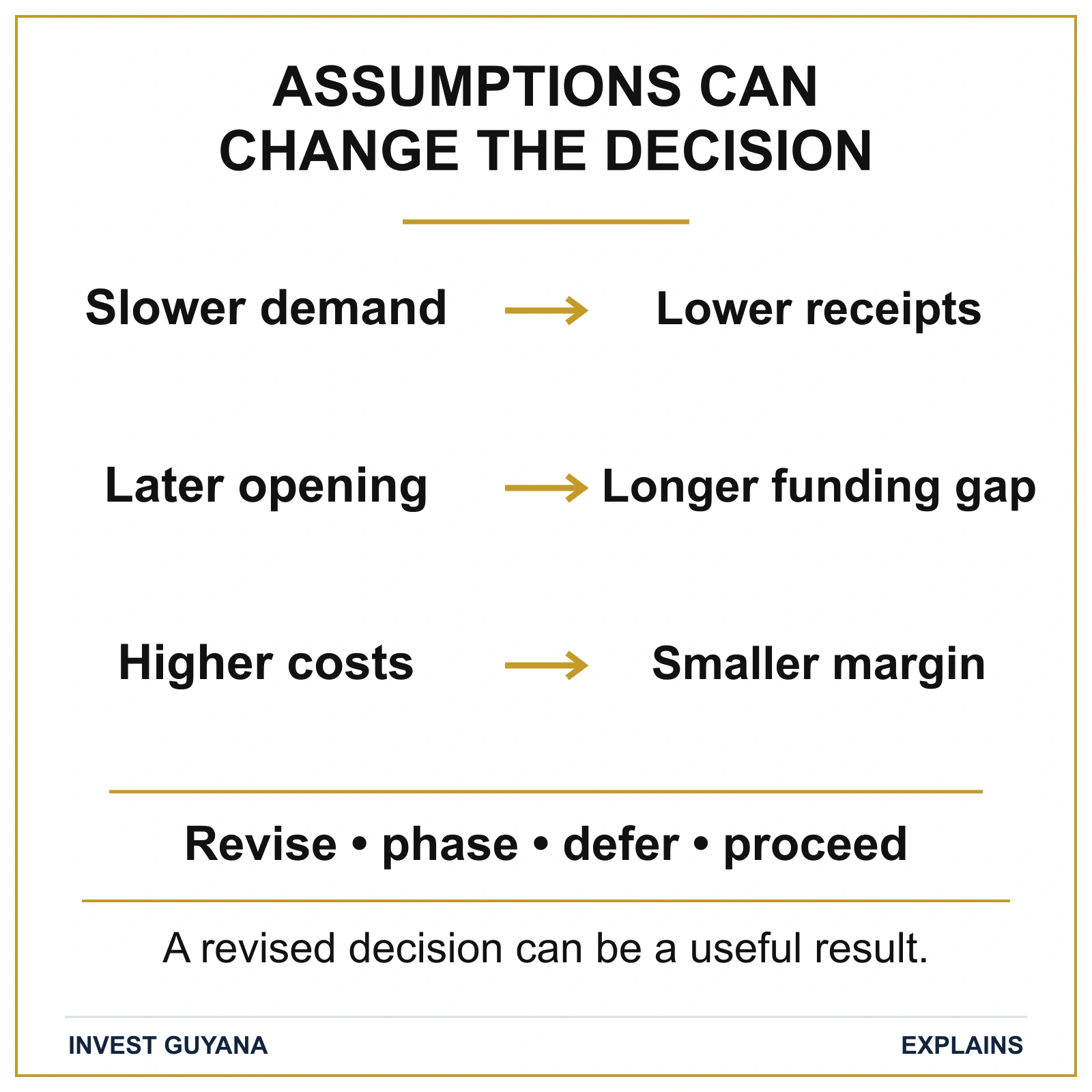
Suppose customer uptake is slower than the central forecast assumes. The facility may remain promising, but it could require more funding before reaching a stable operating level. If that funding is unavailable, the investment’s practical outcome can differ sharply from the return shown over a longer period.
Debt and equity arrangements also influence the result. Repayment dates, ownership rights and conditions attached to funding affect what room the project has to respond. Finance is part of feasibility, rather than a final administrative step after viability has supposedly been established.
Testing a change reveals the pressure points
A forecast usually rests on a central set of assumptions. Examining what happens when an important assumption changes can reveal which parts of the investment are most sensitive. This is useful even when nobody can predict the exact future value.
For our cold-storage proposal, a later opening, lower initial utilisation or a higher operating cost might affect the outcome differently. The point is not to invent a frightening scenario for every possible event. It is to understand which changes could materially alter the decision.
IFC’s project-cycle description treats appraisal as an examination of business potential, risk and financial, economic, environmental and social considerations. It also distinguishes appraisal, agreement and disbursement rather than presenting funding as one automatic event. IFC project cycle.
That example supports a wider lesson: the investor can revise, phase, defer or reject a proposal when the evidence changes. A feasibility exercise has not failed merely because it recommends a smaller project or exposes an assumption that cannot be supported.
Permission and commercial success remain distinct
Government authorisation concerns whether a project may proceed within the relevant legal framework. It does not promise that customers will arrive at the projected rate or that operating costs will match the forecast. Equally, an attractive commercial model does not remove the need for applicable permissions.
Our founder could therefore have a promising market case while a site or approval remains unresolved. Another project could be fully authorised yet struggle to earn a return. Both situations become clearer when regulatory readiness and commercial feasibility are reported separately.
This distinction preserves the series’ central editorial discipline: every document, measure and decision should be described according to what it actually establishes. Combining them can produce a stronger investment case, but none should quietly stand in for all the others.
The practical Guides can then support the specific tasks identified by the assessment, such as registration, land processes or development applications. Their successful completion supplies particular evidence, while the investment case remains responsible for explaining the overall commercial proposition.
Returning to the investment decision
The founder’s presentation can now become more useful. It identifies the customers and operating model, explains the assumptions behind costs and receipts, and shows where uncertainty could change the result. The investor is being offered an argument that can be examined rather than a collection of encouraging milestones.
Feasibility does not eliminate risk. It improves the quality of the decision by connecting the evidence to the commitments the project would require. Sometimes that supports proceeding, and sometimes it supports changing the scale, timing or design before more money is committed.
This completes the batch’s progression from understanding an opportunity to evaluating a workable investment. The companion Guides can take readers into specific applications, documents and practical tasks, while Invest Guyana Explains continues to clarify the concepts that make those tasks meaningful.