

Drone photograph from Invest Guyana’s media archive; contextual image, not the hypothetical project described.
Imagine a retailer preparing to launch a new range of electrical products. The shipment has arrived, the cartons look attractive and customers are already asking when sales will begin. The retailer assumes that an orderly import transaction means the products are ready for the shelf.
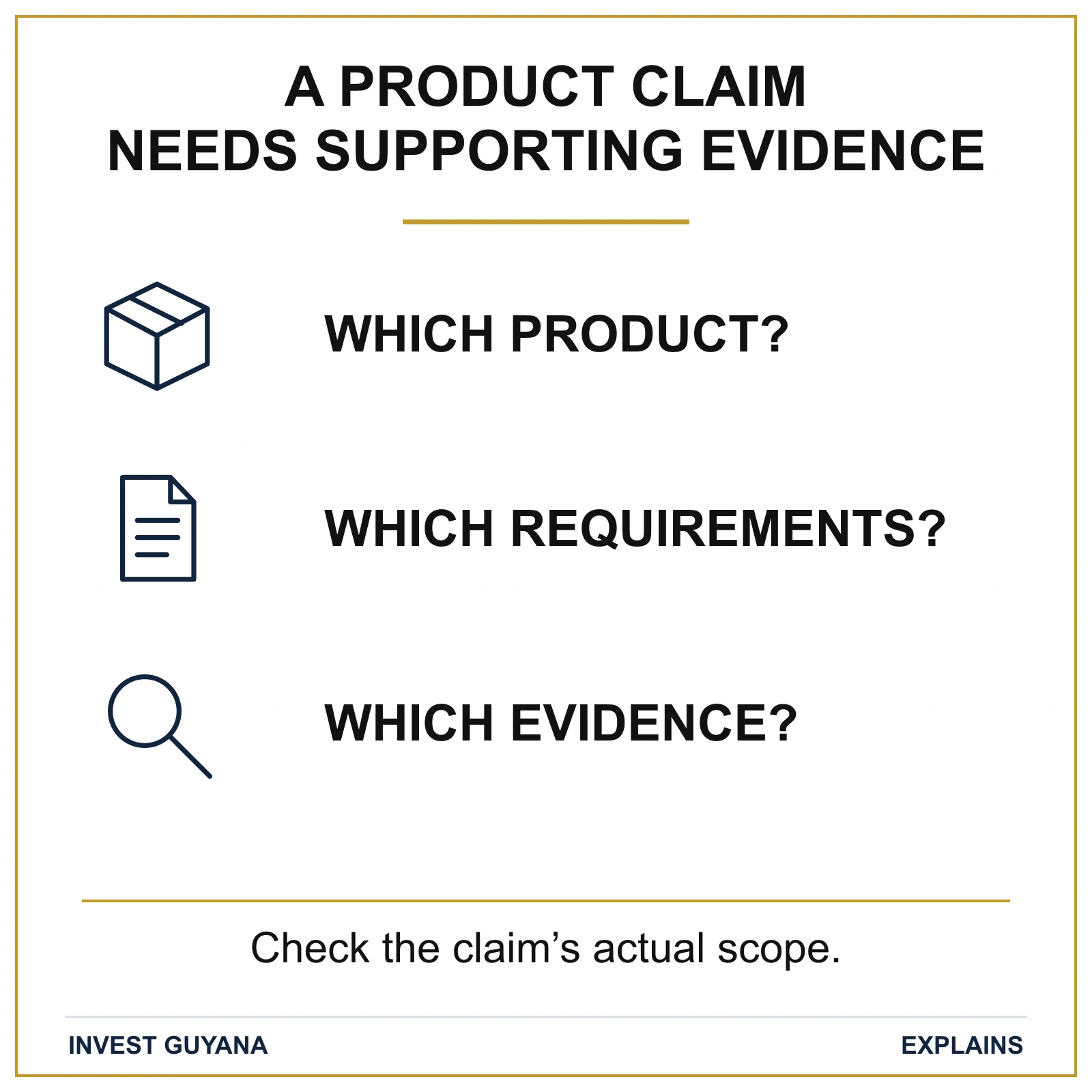
The remaining questions concern the goods themselves. Do the applicable standards cover these products? Is the required information present, and is any relevant evidence of conformity available? Arrival, customs processing and product compliance are related matters, but they do not establish exactly the same facts.
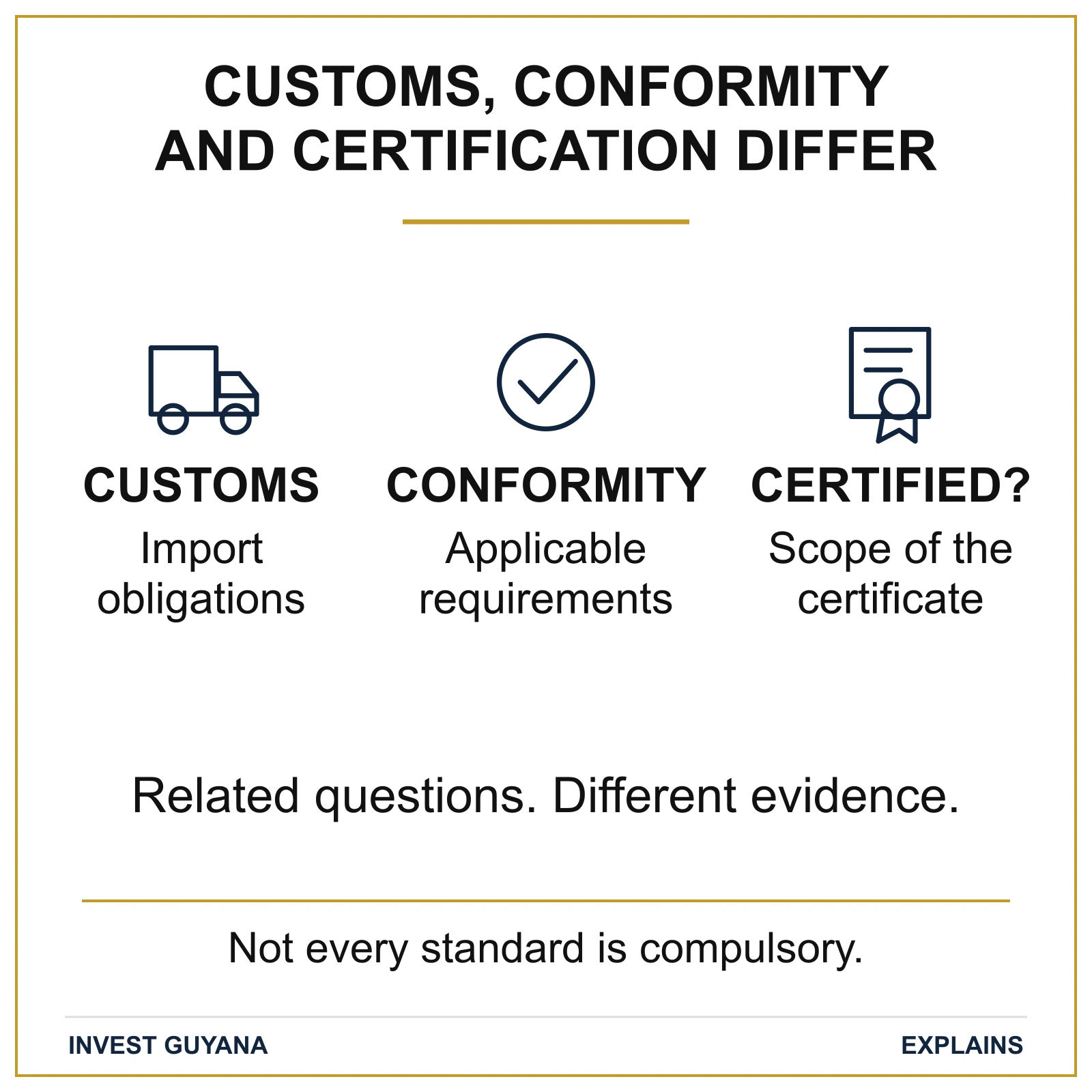
Understanding the distinction helps businesses avoid treating regulation as a single stamp of approval. A product can move through connected checks while different institutions remain responsible for different aspects of its entry, condition and sale.
Standards describe expected characteristics
A standard can describe characteristics, performance or other requirements relevant to a product or activity. It creates a reference against which conformity can be assessed. However, not every published national or international standard automatically has the same legal status in Guyana.
The Guyana National Bureau of Standards Act provides a process for declaring compulsory standards and establishes requirements relating to goods within that scope. The legal effect therefore depends on the applicable framework, not simply on whether a document is called a standard. GNBS Act, sections 20 and 22–24.
For our retailer, this means a supplier’s general claim that a product meets “international standards” is not the end of the inquiry. The relevant question is what requirements apply to the actual product in the market where it will be offered. Different claims can concern different tests, features or jurisdictions.
This distinction makes standards more useful rather than more mysterious. A meaningful reference identifies what is being assessed and against which requirements, instead of relying on an impressive but unspecified description of quality.
Product checks have a defined scope
GNBS monitors designated categories of imported and locally manufactured products. Its current product-inspection information describes checks at ports, warehouses and points of sale, with monitored imports identified through the customs system using product classifications. This is not a claim that every product in Guyana falls under identical GNBS arrangements. GNBS product inspection.
Other authorities have responsibilities for products outside that scope, including food, drugs and agricultural categories. A business therefore needs to identify the relevant product and function rather than assume that one institution approves everything sold to consumers.
For the electrical retailer, the product category creates the starting point for understanding the applicable checks. A business selling food would have a different regulatory conversation. Both are retail enterprises, but the nature of what they supply changes the relevant responsibilities.
This builds on the earlier article about regulators without becoming another agency directory. The central issue here is the product’s conformity and the evidence supporting it, not an exhaustive account of every institution’s powers.
Customs and conformity can be connected
It would be misleading to imagine a universal sequence in which customs always finishes before any product regulator becomes involved. Checks can be connected within the import process, and the exact relationship depends on the goods and applicable arrangements. The distinction is between the questions being answered, not necessarily two completely separate queues.
GRA’s description of the Guyana Trade Network explains its connection with participating agencies and ASYCUDA. A shared system can help coordinate applications and approvals without making the substantive responsibilities of each institution interchangeable. GRA explanation of the Guyana Trade Network.
Suppose our retailer has evidence that duties have been paid. That evidence addresses a particular financial obligation; it does not independently prove every safety, labelling or other applicable product requirement. Conversely, a product test does not settle every customs obligation associated with importing it.
The value of this distinction is practical clarity. A business can understand why different evidence appears in one transaction without concluding that every document is a repetition of the same approval.
Information on the product can matter
Compliance can concern more than whether an item appears to work when unpacked. Depending on the applicable requirements, labelling, instructions, safety information, certification evidence and physical condition may be relevant. The details need to be checked for the product concerned rather than inferred from a generic example.
GNBS’s account of product inspections describes attention to labelling and quality, including instructions and safety information. It also describes different responses to nonconformity, illustrating why an issue may require more than a verbal assurance from the supplier. GNBS explanation of registration and inspections.
Imagine a customer receiving a product without information needed to use it safely. Even if the item functions during a demonstration, the missing information can affect its use after purchase. This explains why appearance and immediate operation do not necessarily capture the full purpose of conformity requirements.
The same logic applies to a retailer’s purchasing decision. A carton photograph may show the commercial presentation while revealing little about the evidence or instructions accompanying the goods. Understanding the distinction helps the buyer know what a supplier’s assurance actually covers.
Certification and compulsory compliance differ
Certification can provide independent assurance that a product meets specified requirements within a defined programme. Its meaning depends on what has been certified and by whom. It should not be interpreted as a universal approval of every aspect of a business or every product it sells.
GNBS describes its product-certification programme as voluntary for covered locally manufactured products. That programme is conceptually different from complying with requirements that are compulsory for particular goods. One does not erase the need to understand the other. GNBS product certification.
For our retailer, a mark on packaging therefore invites a more precise question about its scope. It may relate to a product, a process or another defined matter. The existence of a mark is useful only when its meaning and relevance are understood.
This is also why generic graphics should not invent official seals or suggest certification where none has been established. Clear editorial explanations can use ordinary product icons, while actual claims about approval require authentic supporting evidence.
Compliance continues beyond arrival
Goods can be inspected at different points in their commercial journey. Their condition, storage and presentation remain relevant as they move towards the customer. Treating compliance as something that ends permanently when a shipment arrives can overlook what happens afterwards.
Suppose cartons are damaged in storage or products are separated from important instructions before sale. The retailer’s actual offering may no longer match the condition assumed when the goods were acquired. This hypothetical example shows why the commercial chain matters as well as the initial purchase.
Product identity also deserves attention when a supplier changes a model or specification. Evidence relating to one version should not automatically be assumed to cover every later variation. The relevant scope and requirements must remain connected to the goods actually being supplied.
The article does not provide an application checklist or list every mandatory standard. Those details belong in a current product-specific Guide. The enduring lesson is to keep the product, applicable requirement and supporting evidence aligned throughout the transaction.
Readers establishing a retail enterprise may already have used the business registration roadmap. The formal existence of the enterprise and the conformity of its products remain separate questions. A future product-specific compliance Guide should identify the current authority, applicable requirements and practical submission steps for a defined class of goods. It should link to this explanation rather than repeating a broad introduction to standards. That gives readers a coherent route from understanding the distinction to completing the particular task, while avoiding the misleading idea that every retailer needs one identical set of product approvals.
The commercial benefit is clearer communication throughout the supply relationship. A buyer can describe the evidence required, a supplier can identify the product it actually covers, and the retailer can avoid making broader claims to customers than that evidence supports. This discipline remains useful even when no immediate compliance problem has arisen.
Returning to the new product range
The retailer can now understand the launch as more than a successful shipment. The goods have a commercial description, an import history and a conformity position, each supported by different information. A complete picture requires those parts to agree.
This does not mean every product follows the same process or that customs and regulators work in isolation. It means that one completed obligation should not be asked to prove something outside its scope. The right authority and current requirements depend on the actual goods.
The final article in this batch brings these relationships together at the investment level. Project feasibility asks whether market demand, operating capability, permissions and finance form a workable proposition, rather than treating any single favourable signal as proof that an investment will succeed.