
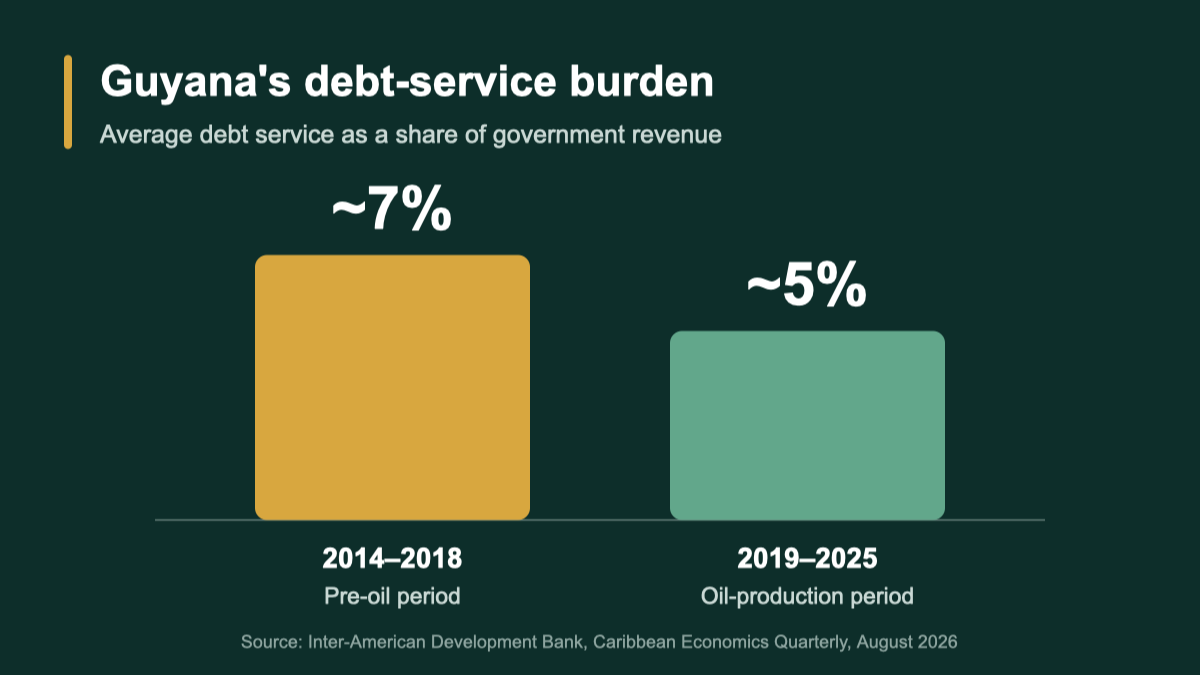
Guyana debt-service burden, 2014–2025. Source: Inter-American Development Bank, August 2026.
Guyana remains a low-debt outlier in the Caribbean even after its public-debt ratio increased in 2025, according to the Inter-American Development Bank’s latest regional economic assessment.
The distinction matters for investors and businesses assessing the country’s fiscal position. Guyana’s debt stock rose during the year, but its overall burden remained comparatively limited and much of its external borrowing continued to come from multilateral lenders on concessional terms.
The August 2026 edition of the IDB’s Caribbean Economics Quarterly reported that Guyana’s total public debt reached 28.6 per cent of gross domestic product in 2025, up from 24.3 per cent in 2024. The report attributed the increase to financing needed to close the fiscal gap.
That movement should not be read as evidence that Guyana’s debt level fell in 2025. Instead, the IDB’s assessment is that the country remains in a relatively strong position despite the increase, supported by rapid economic growth, oil revenues and a debt portfolio that is largely concessional.
Debt service remains comparatively contained
External obligations accounted for 56.3 per cent of Guyana’s public-debt portfolio in 2025. According to the IDB, multilateral creditors held 66.2 per cent of the country’s external public debt, which helped keep borrowing terms relatively favourable.
The report also found that Guyana’s average debt-service-to-revenue ratio declined from about 7 per cent during the 2014–2018 pre-oil period to approximately 5 per cent between 2019 and 2025.
This is an important distinction between the size of the debt stock and the cost of servicing it. A debt ratio can rise while the burden on government revenue remains manageable, particularly where financing is concessional and revenues are expanding.
For investors, the composition and servicing cost of public debt are therefore as relevant as the headline debt-to-GDP figure. They influence the government’s capacity to finance infrastructure and other public programmes without placing immediate pressure on the budget.
Fiscal deficit narrowed as oil withdrawals supported revenue
Guyana’s primary fiscal deficit narrowed to 5.0 per cent of GDP in 2025 from 6.9 per cent in 2024, the report said.
Public expenditure remained elevated, including spending associated with cash grants, but this was partly offset by higher revenues. The IDB reported that oil-profit withdrawals accounted for 85.1 per cent of non-tax revenue during the year.
Capital expenditure still represented just over half of total government spending, although its share declined. It fell from 53.8 per cent of expenditure in 2024 to 50.7 per cent in 2025. Measured against GDP, capital spending declined from 11.5 per cent to 10.2 per cent—the first such decrease since oil production began.
The figures point to the two-sided nature of Guyana’s fiscal position. Oil income creates room for major public investment, but it also increases the importance of project selection, procurement discipline, implementation capacity and transparent reporting on outcomes.
Growth remains exceptional, but concentration creates risk
The IDB estimated that Guyana’s economy expanded by 19.3 per cent in 2025, following growth of 43.8 per cent in 2024. Non-oil GDP grew by 15 per cent in 2025, up from 13 per cent one year earlier.
The report nevertheless underlined the economy’s concentration in extractive activity. Mining and quarrying—including petroleum—accounted for 79 per cent of the economy in 2025, according to its estimates.
That concentration exposes the fiscal outlook to oil-price movements, production conditions and wider geopolitical uncertainty. The IDB also identified the longer-term risk of Dutch disease, in which large foreign-currency inflows and public spending can weaken the competitiveness of other sectors.
The report said appreciation of Guyana’s real effective exchange rate had remained relatively subdued, but recommended continued attention to the institutions responsible for petroleum-revenue management and preservation of the non-oil tax base.
Labour-market data require careful dating
The quarterly report cited a decline in unemployment from 14.5 per cent in the third quarter of 2021 to 6.8 per cent in the third quarter of 2024. The 6.8 per cent figure is therefore not a 2026 unemployment rate and should be understood as the latest period cited in that comparison.
Inflation was reported at 2.9 per cent year-on-year in December 2025 and 2.6 per cent in February 2026. Food inflation was higher, at 4.4 per cent and 5.9 per cent respectively.
The investor question is how fiscal space is used
Guyana’s immediate fiscal challenge differs from that of highly indebted Caribbean economies. The IDB’s assessment suggests that conventional debt consolidation is not the central issue. The more important question is whether rising revenues, savings and borrowing are converted into durable productive capacity.
Investors should continue to monitor the pace and terms of new borrowing, Natural Resource Fund withdrawals, non-oil revenue performance, capital-project execution and the extent to which public investment improves transport, energy, skills and other constraints on private-sector growth.
The latest report supports the conclusion that Guyana retains considerable fiscal room. It does not remove the need for disciplined management of that room, particularly as the scale of the oil economy and the public-investment programme continue to expand.