
The investment committee was reviewing the final financial model for a new Guyana project when one director noticed a large saving under imported equipment.
The project team had assumed that the machinery would enter under an investment concession. The company planned to invest millions of dollars, create jobs and construct a productive facility, so the exemption appeared to be an obvious part of the package.
Its adviser asked to see the approval.
There was none. The saving had entered the spreadsheet after someone heard that investors could receive incentives, but no one had confirmed whether the project, company or equipment qualified, which institution would review the request or what conditions might follow.
That assumption can change a project’s true cost. Investment incentives exist within laws and public policy; they are not automatic discounts attached to every investment announcement. Understanding the distinction helps companies evaluate opportunities realistically and approach the approval process with the evidence it requires.
Incentives Are Policy Tools, Not Automatic Rewards
Governments use incentives to encourage activities that support particular economic objectives. Depending on the legal framework, an incentive may affect customs duty, value-added tax, excise tax or another defined cost.
The purpose is usually more specific than rewarding a company simply for spending money. An incentive may be connected to a sector, productive activity, type of equipment, investment agreement or policy objective established in law.
GRA’s exemptions guidance illustrates this targeted approach. It identifies categories such as manufacturers, pharmacies, large-scale miners and investment agreements, with different qualifying items and processes. GRA Exemptions
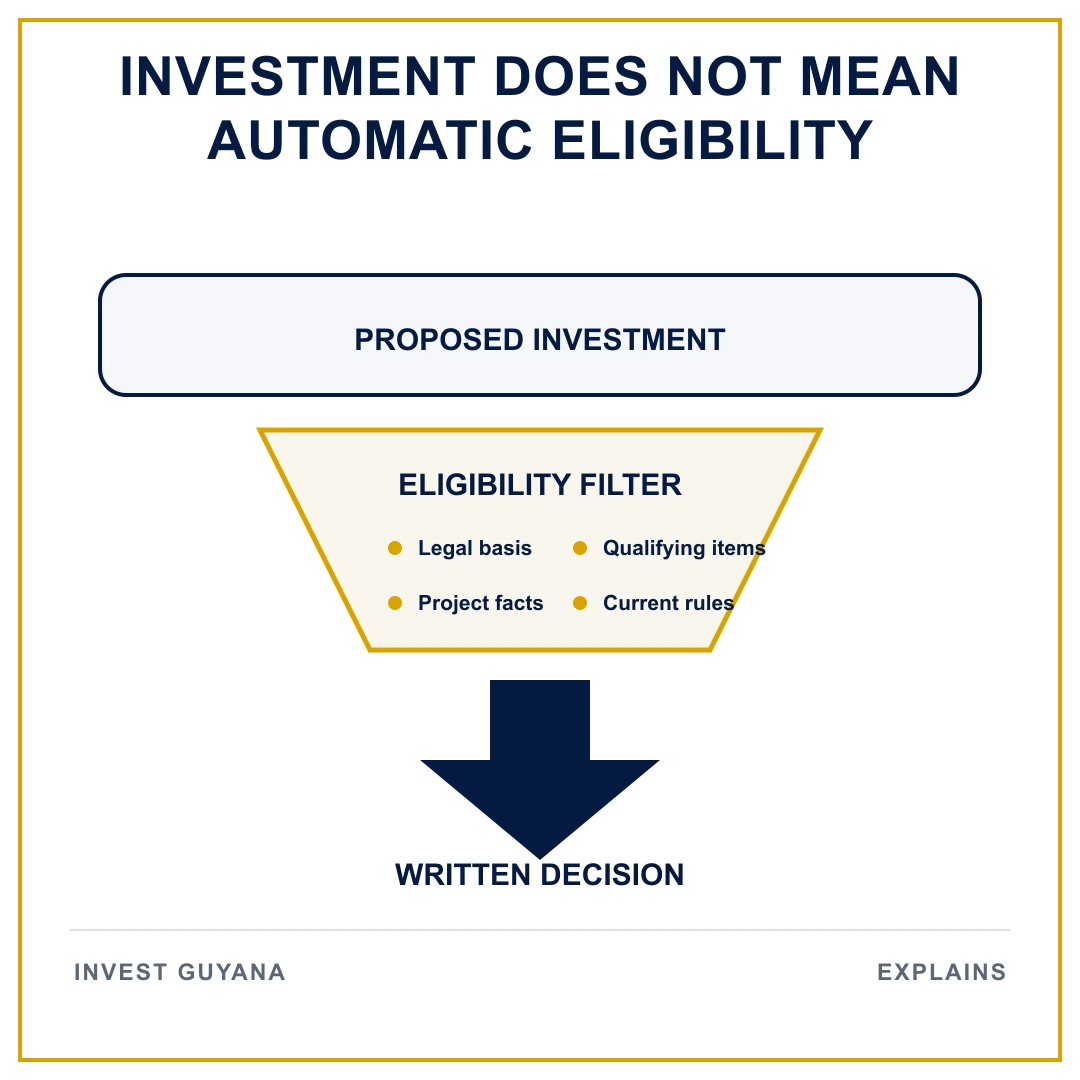
This means the first question is not, “Are we an investor?” It is, “What legal or policy basis might apply to this project and these particular goods or activities?”
Two companies can invest similar amounts and receive different treatment because their sectors, purchases, scale, agreements or intended uses differ. Even within one project, some imported items may qualify while others do not.
Eligibility Depends on the Project and the Current Framework
An incentive assessment begins with the actual project rather than the headline investment value.
The reviewing institutions may need to understand the company, ownership, sector, location, proposed activity, capital programme, employment, imported items and implementation timetable. Those details allow the request to be compared with the current legal framework and any applicable policy conditions.
This is why an investor should resist copying the concession assumptions from another project. A neighbouring business may operate under a different law, agreement, scale or approval period. Its treatment is evidence of its own circumstances, not a transferable entitlement.
Timing matters as well. Tax laws, tariff classifications and exemption policies can change. GRA expressly notes that the issuance of exemptions may vary with legislative changes and that other agencies can participate in evaluating applicants. GRA Tax Exemptions
For financial modelling, the safest information is therefore current and project-specific. Historic brochures and informal assurances may help generate questions, but they should not be entered as approved savings.
Application, Review and Written Approval
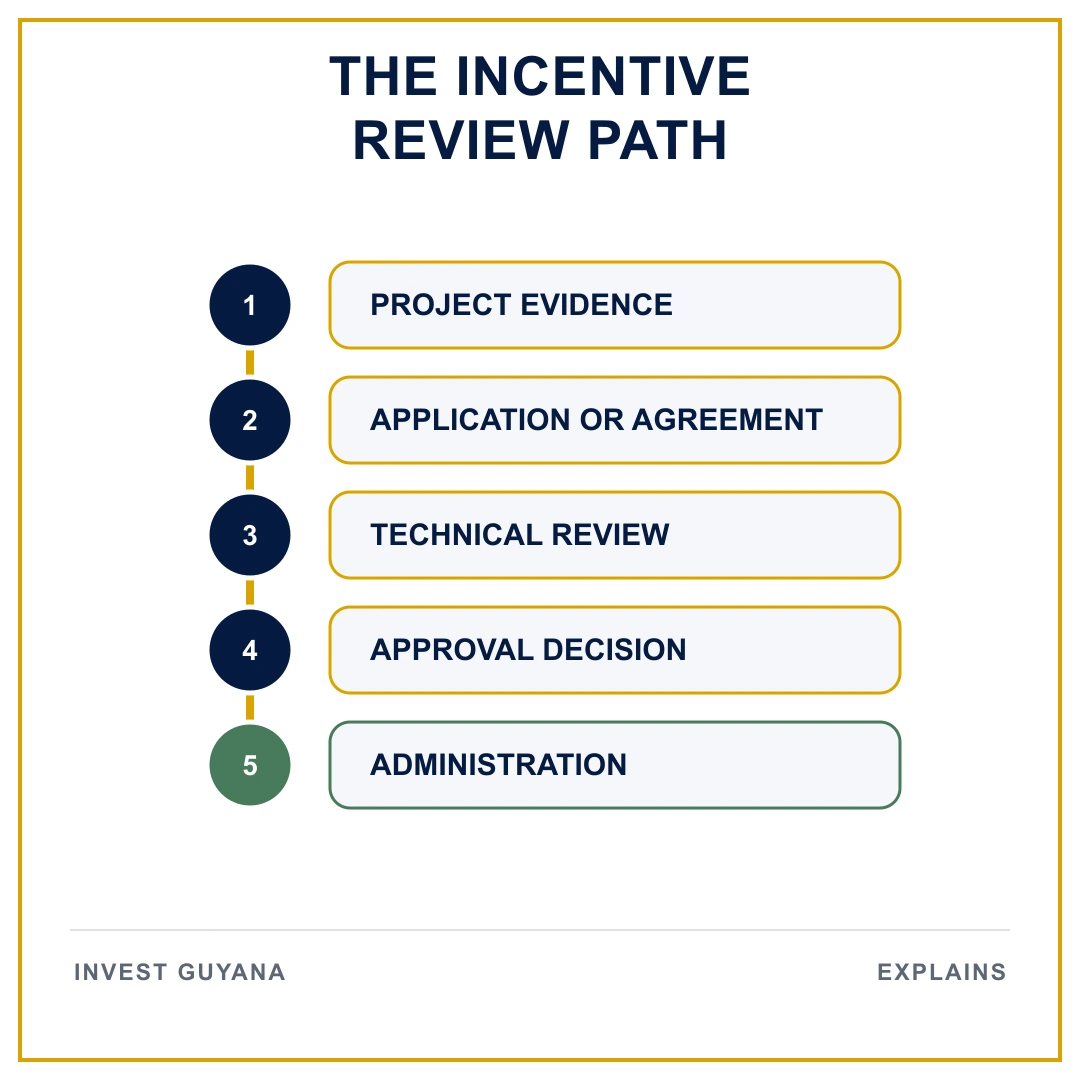
Where an incentive is available, the process normally requires evidence. The investor explains the project and identifies the items or treatment being requested, while the relevant institutions examine whether the request fits the governing rules.
For exemptions under investment agreements, GRA’s published guidance describes a coordinated process involving the Guyana Office for Investment, GRA and the Ministry of Finance. Go-Invest prepares the investment-agreement documents and item list, GRA reviews whether listed items qualify, and a recommendation can proceed for ministerial approval. GRA Investment Agreements
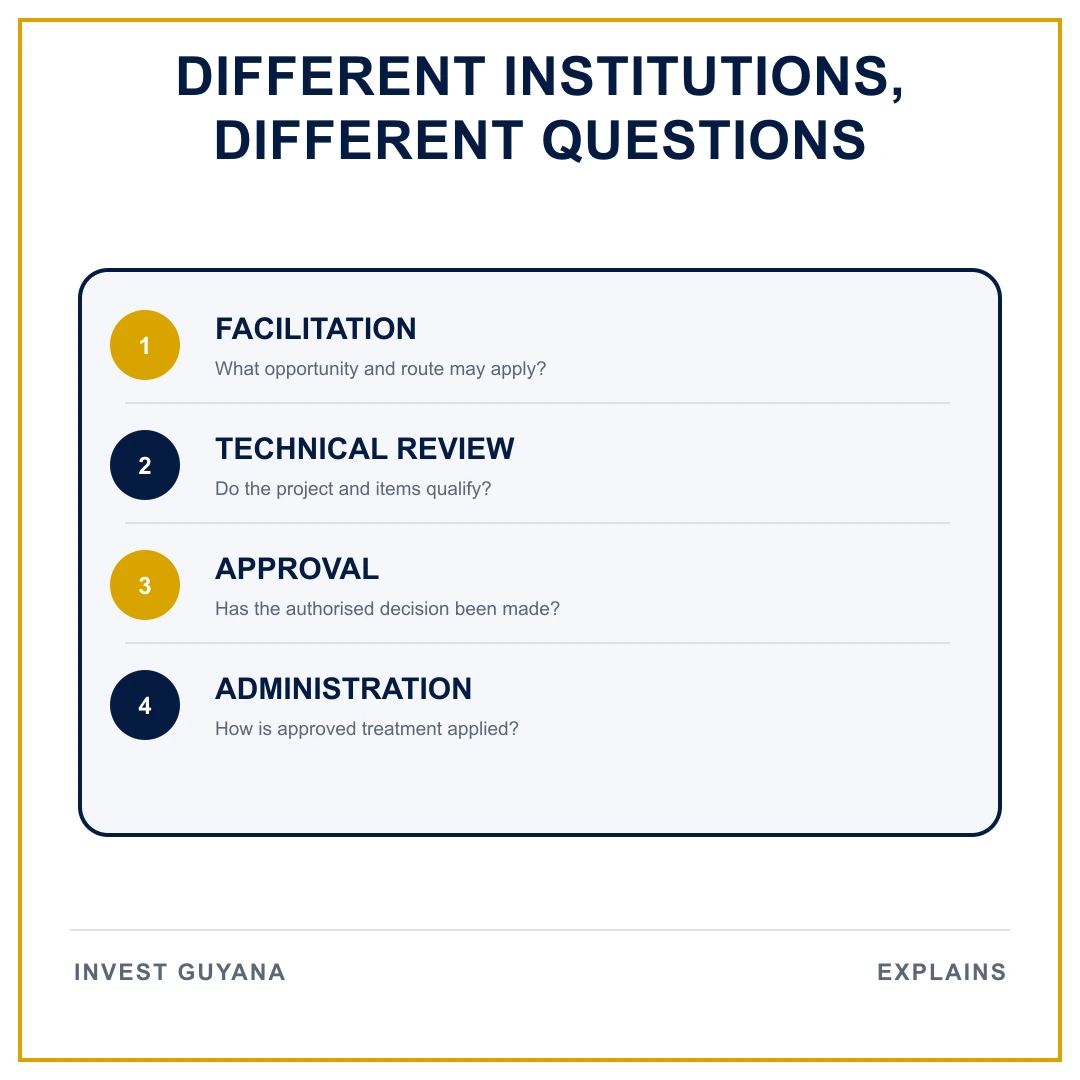
The important editorial lesson is not that every investor follows one identical route. It is that facilitation, technical review and approval can be separate stages, and the company should know the status of each.
A meeting, acknowledgement letter or positive discussion is not necessarily the final authorisation. The investor should retain the executed agreement, approval or exemption documentation and understand exactly which company, items, quantities, period and conditions it covers.
That precision protects both the public system and the investor. Customs and tax officers need a clear basis for applying treatment that differs from the ordinary rules, while the company needs reliable evidence for procurement, financing and audit.
Different Institutions Play Different Roles
Investment facilitation and tax administration are connected, but they are not the same function.
Go-Invest can help investors understand opportunities and facilitate the investment process. GRA administers customs and tax laws and processes qualifying exemptions. The Ministry of Finance may have an approval role in the investment-agreement route described by GRA, while sector regulators may confirm licences or project information relevant to eligibility.
An investor can become frustrated when one institution does not provide the final answer to every question. The better approach is to identify the decision being sought.
Is the company seeking general investment guidance, confirmation that its activity qualifies under a policy, approval of an agreement, or processing of an exemption against a particular import declaration? Each question may belong to a different part of the system.
This division of responsibility resembles the regulatory landscape explored earlier in the series. One project can touch several specialist institutions because each is responsible for a different public function.
Conditions Continue After Approval
Receiving an incentive is not the end of the compliance story.
The approval may be limited to specified items, quantities, values, uses or time periods. Imported equipment may need to be used in the approved project, and disposal or transfer can carry restrictions or reporting consequences.
GRA’s general exemption guidance requires supporting information such as invoices, proper descriptions and the taxpayer’s TIN. Current processing also operates through the customs system for relevant exemption requests. These controls connect the high-level approval to the actual goods being imported.
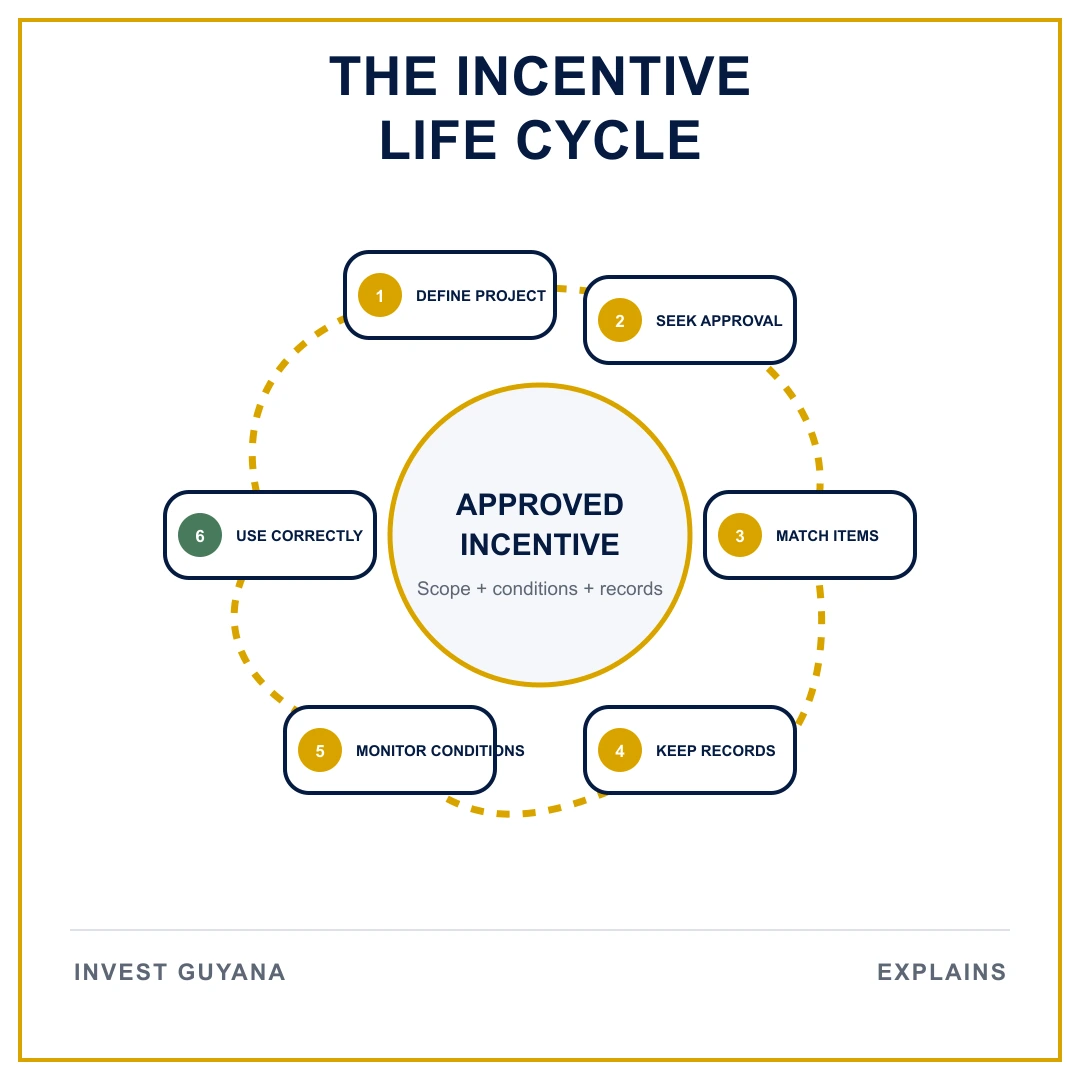
The company should therefore create an incentive register that reconciles the approval with purchase orders, invoices, tariff classifications, import declarations and assets received. Staff and customs brokers need access to the same current documents so that the concession is used only where it applies.
Good record-keeping also protects the financial model. It allows management to compare the approved benefit with the amount actually realised and to identify unused limits, excluded items or additional costs before they become year-end surprises.
Model the Project Before Counting the Benefit
An investment should first be tested on its underlying commercial logic. The company estimates market demand, construction and operating costs, financing, taxes, logistics and risk without turning an unapproved incentive into guaranteed income.
The potential incentive can then be presented transparently. One scenario shows the project without it, another shows the benefit if approval is received, and a sensitivity analysis considers delays, partial eligibility or changes in the final item list.
This approach does not make the investor pessimistic. It makes the investment committee honest about what is known, what is being applied for and what remains uncertain.
Procurement timing should follow the same discipline. Ordering or shipping equipment before the applicable approval and customs documentation are settled can expose the company to duties and taxes that were never included in the budget.
The right internal question is therefore not merely, “What incentives are available?” It is, “Which current incentive might apply to this precise project, what evidence and approval are required, and what happens if the answer is no?”
An Incentive Must Be Earned in the Model and Confirmed in the Record
The investment committee from our opening scene revised its financial model before making the final decision.
The assumed customs saving was moved out of the base case. The project team prepared a documented request based on the company, proposed activity and equipment list, then assigned responsibility for following the review through the appropriate institutions.
When written approval was eventually received, the finance and logistics teams examined its scope rather than assuming it covered every purchase. The approved items were matched to procurement and customs records, and the remaining equipment stayed at its ordinary landed cost.
The project did not become less attractive because the company asked harder questions. It became more investable because its costs and approvals could withstand scrutiny.
Investment incentives can make an important contribution to development, but their value depends on clear rules, eligible activity, documented approval and responsible use. Investors who understand that sequence are less likely to mistake interest for entitlement or a policy announcement for a concession already granted.
The most reliable incentive is therefore not the one mentioned in a conversation. It is the one the project qualifies for, the proper authority has approved, and the company can administer accurately from the first purchase to the final compliance record.
Editorial note: This article provides a general explanation of investment incentives and tax exemptions in Guyana. Eligibility, approval, scope and administration depend on current law, the project and the specific goods or activities involved. Investors should obtain current written guidance from Go-Invest, GRA, the Ministry of Finance where applicable, relevant sector regulators and qualified professional advisers.