
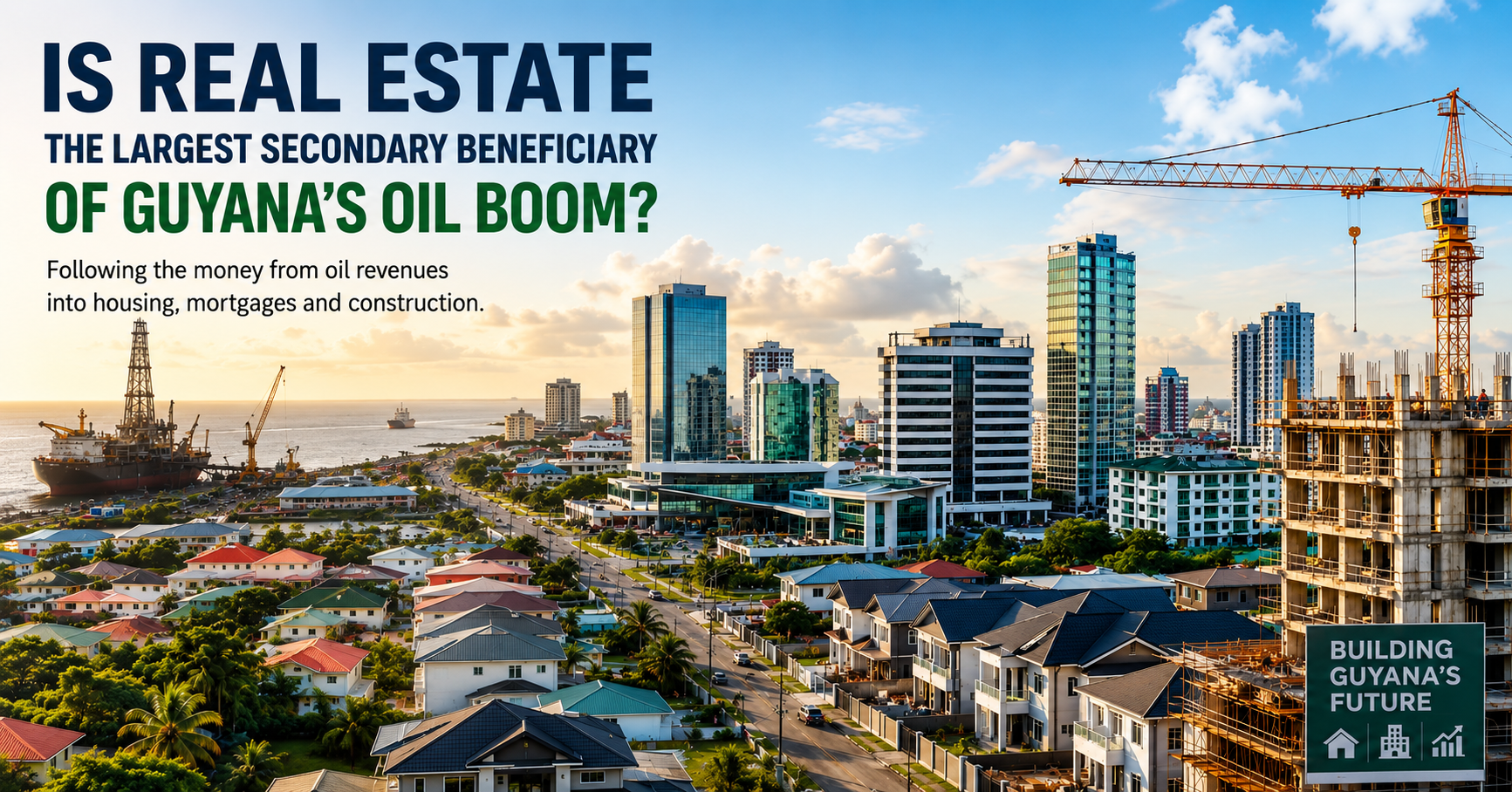
Guyana’s oil industry has transformed the country’s economic outlook, generating billions of US dollars in revenue, attracting foreign investment and driving some of the fastest economic growth rates in the world.
Much of the attention naturally focuses on offshore oil production. Yet one of the most important investment stories may be unfolding on land.
Across the country, housing developments are expanding, mortgage lending is rising and construction activity is accelerating. New communities are emerging while existing neighbourhoods continue to grow.
This raises an important question for investors:
Is real estate becoming the largest secondary beneficiary of Guyana’s oil boom?
The evidence suggests that housing, construction and mortgage finance have become some of the most significant channels through which economic growth is spreading across the broader economy.
Following The Money Beyond Oil
Oil revenues do not remain offshore. They flow into the economy through government spending, infrastructure investment, private sector activity, employment growth and increased household incomes.
As economic activity expands, demand for housing often rises alongside it. Families seek homeownership. Businesses require office space. Developers respond to new opportunities. Financial institutions expand mortgage lending. Construction companies take on additional projects.
These effects create what economists often describe as multiplier impacts, where growth in one sector generates activity across many others.
In Guyana, the housing sector appears to be one of the clearest examples of this process.
A Growing Number Of Households
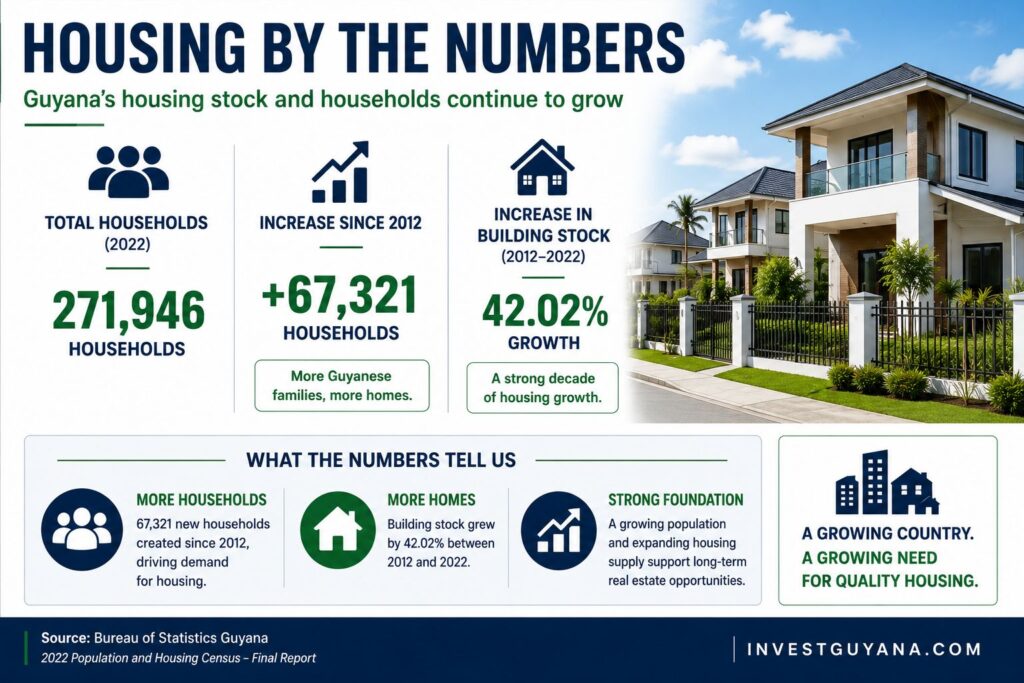
According to Guyana’s 2022 Population and Housing Census, the country recorded 271,946 households in 2022, compared with 204,625 households in 2012. That represents an increase of 67,321 households over the decade. At the same time, average household size declined from 3.65 persons to 3.23 persons.
This trend is significant because housing demand is influenced not only by population growth, but also by how people live.
When household size declines, more homes are required to accommodate the same number of people. For example, a population of 100,000 people living in households averaging four persons would require approximately 25,000 homes. If average household size falls to three persons, the same population would require more than 33,000 homes.
In other words, housing demand can increase even if population growth remains modest. The result is greater demand for land, homes, utilities, financing and supporting infrastructure.
Housing Supply Is Expanding
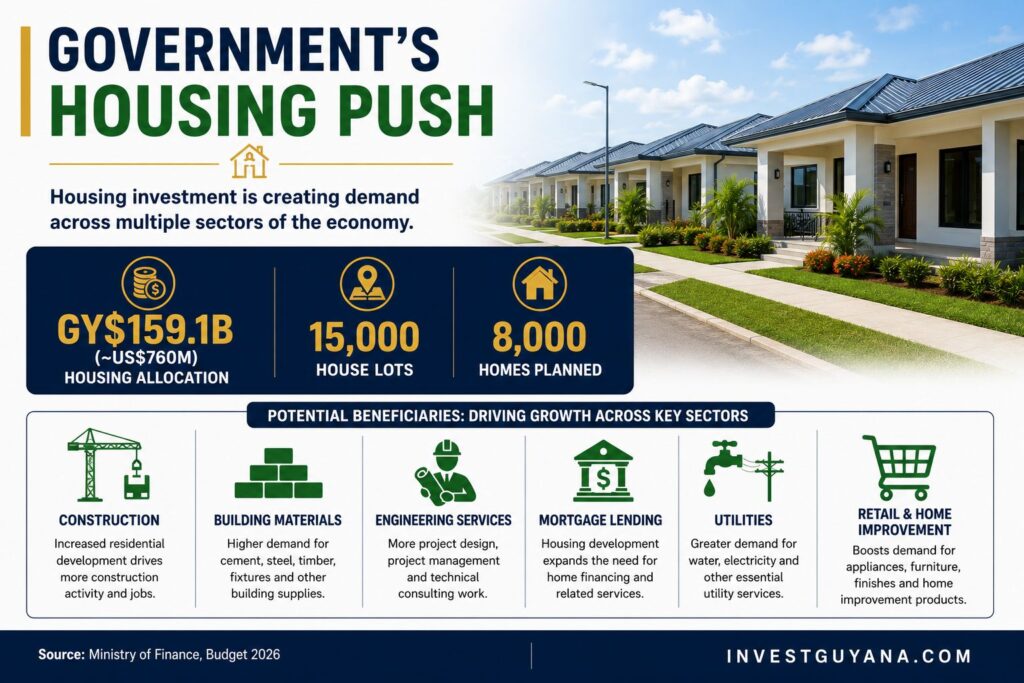
The increase in demand has been matched by significant efforts to expand housing supply. The Government of Guyana allocated approximately GY$159.1 billion, equivalent to roughly US$760 million, for housing programmes in Budget 2026.
Government has announced plans for approximately 15,000 house lots and 8,000 homes as part of its ongoing housing programme.
These initiatives are not only intended to improve access to housing, but also to stimulate economic activity across multiple sectors including construction, engineering, utilities, building materials and financial services. Housing investment therefore has effects that extend far beyond the homes themselves.
Mortgage Lending Continues To Grow
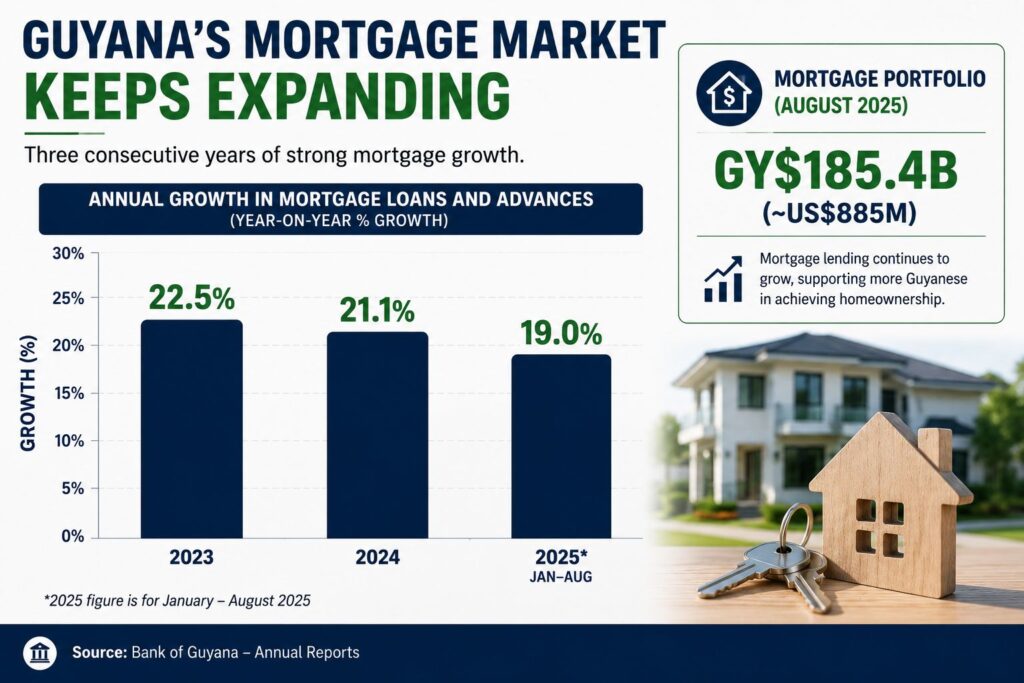
One of the clearest indicators of housing demand is mortgage lending. According to Bank of Guyana data, mortgage loans and advances have increased for three consecutive years.
Mortgage lending grew by approximately:
- 22.5 percent in 2023
- 21.1 percent in 2024
- 19.0 percent during the first eight months of 2025
By August 2025, Guyana’s mortgage portfolio had reached approximately GY$185.4 billion, equivalent to roughly US$885 million. The sustained growth in mortgage lending suggests that more Guyanese households are seeking financing to purchase or construct homes. It also indicates confidence among both borrowers and financial institutions.
Construction Has Become A Major Growth Engine
Housing demand is helping to support one of Guyana’s fastest-growing sectors. According to the 2026 Budget Speech, the construction sector is estimated to have expanded by approximately 31 percent in 2025. This growth is visible throughout the country.
New housing developments, commercial buildings, hotels, roads, bridges and industrial projects continue to reshape the physical landscape.
Construction activity supports employment, stimulates demand for building materials and generates opportunities for engineers, architects, surveyors, contractors and numerous supporting businesses.
As housing demand increases, construction becomes one of the primary channels through which economic growth spreads throughout the economy.
More Than A Housing Story
The significance of housing extends beyond real estate. A new home often generates additional spending on appliances, furniture, utilities, landscaping, insurance, maintenance and transportation.
Housing activity can therefore support retail trade, manufacturing, logistics and professional services. This broader economic impact helps explain why housing is often viewed as a leading indicator of economic confidence.
When households make long-term commitments such as purchasing property, they are expressing confidence in their future financial prospects.
What Investors Should Watch
Several indicators will help determine how the housing market evolves in the coming years. These include:
- Household formation
- Housing supply
- Mortgage lending growth
- Construction activity
- Interest rates
- Population trends
- Infrastructure expansion
Together, these indicators will provide important insight into the sustainability of Guyana’s housing market expansion.
Investor Takeaway
Guyana’s oil boom is creating opportunities far beyond the energy sector. The evidence suggests that housing, mortgage finance and construction have become major beneficiaries of the country’s economic transformation.
Households are increasing. Housing demand continues to grow. Mortgage lending is expanding. Construction activity remains strong. Government is investing heavily in housing development.
While oil may be the primary engine of economic growth, real estate appears to be one of the most important channels through which that growth is spreading throughout the wider economy.
For investors, the question may no longer be whether Guyana’s housing sector will benefit from economic expansion. The more important question may be how large that benefit ultimately becomes.