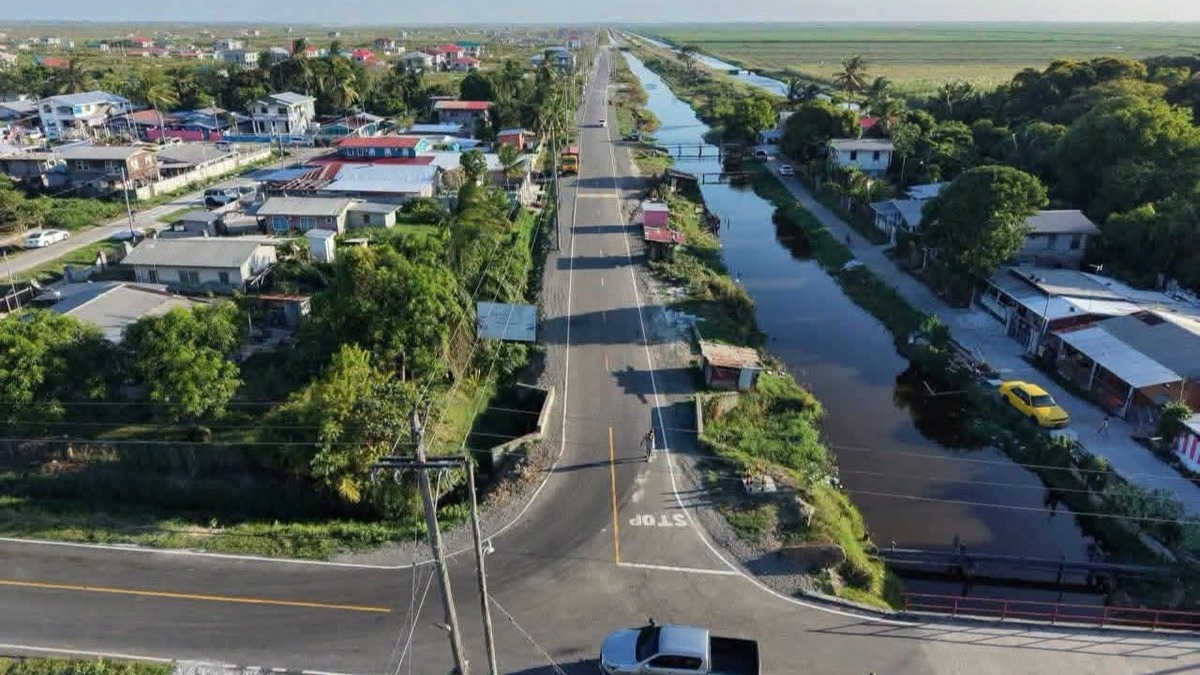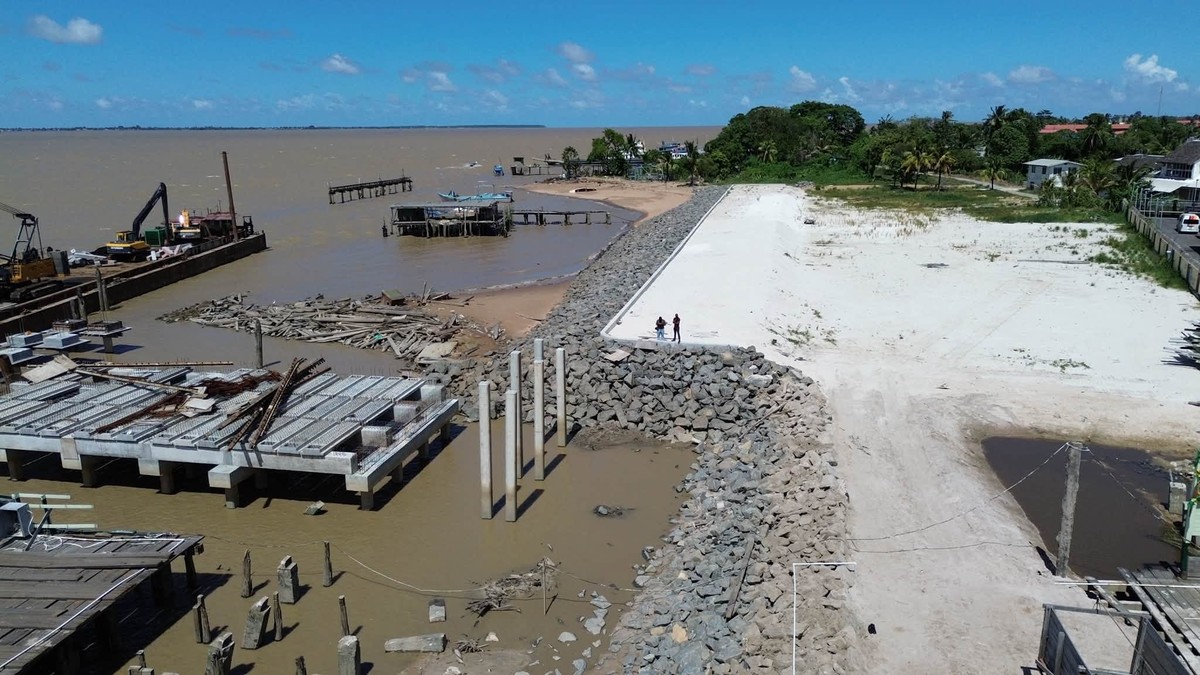
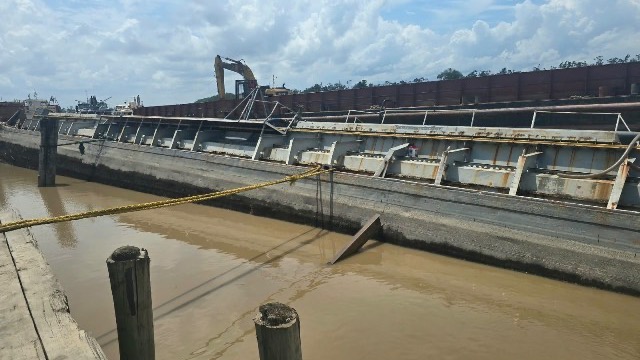
Photo: Department of Public Information, Guyana.
A barge reportedly carrying approximately 8,000 barrels of waste oil has been returned to an upright and stable position at a private wharf on the East Bank of Demerara, after authorities deployed containment booms and mobilised a multi-agency response to reduce the risk of pollution in the Demerara River.
The Civil Defence Commission said on October 21 that the vessel’s cargo remained intact and the situation was stable and under control. Monitoring and assessment were continuing, with personnel and resources available to support containment, recovery and environmental protection if required.
The update follows an initial government statement on October 20 that identified a potential spill risk after the barge was observed listing significantly while berthed. At that stage, authorities said no oil spill had been confirmed. The later statement did not report a release; instead, it said the vessel had been stabilised with its cargo intact.
That distinction is important. The verified event is an emergency response to a pollution risk—not a confirmed 8,000-barrel spill.
A coordinated response was activated
The response brought together the Civil Defence Commission, Maritime Administration Department, Environmental Protection Agency, Guyana Energy Agency, Guyana Fire Service, Ministry of Agriculture’s Fisheries Department and Guyana Defence Force Coast Guard.
According to the October 21 official update, containment booms were placed around the vessel as a precaution to restrict the movement of oil if a discharge occurred. Corrective measures were also taken to stabilise the barge.
The participating agencies reflect the range of risks involved when an industrial cargo is stored or moved close to a major waterway. Maritime authorities address vessel and navigation issues; environmental and energy regulators have sector-specific responsibilities; emergency and fire services manage response readiness; and the Coast Guard and Fisheries Department bring waterway, public-safety and aquatic-resource considerations.
The government has not identified the barge operator, the owner of the cargo or the private wharf. It has also not published the vessel’s route, the origin or intended destination of the waste oil, the cause of the listing, or the commercial and regulatory arrangements under which the cargo was being handled.
Those facts should not be inferred.
Why the incident matters to business
The Demerara River is central to Guyana’s commercial economy. Wharves along its banks support shipping, construction, fuel distribution, industrial operations and the movement of equipment and materials. An incident affecting the river can therefore create environmental, safety and operational consequences well beyond a single vessel.
For port operators, cargo owners, marine contractors and industrial businesses, the case is a reminder that risk management begins before an emergency. Vessel condition, berthing arrangements, cargo documentation, containment capacity, trained personnel, communications and a clear chain of responsibility all influence how quickly an incident can be controlled.
Waste oil also presents a different commercial issue from a normal saleable cargo. Its value chain depends on controlled collection, storage, transportation, treatment, recovery or disposal. Businesses participating in that chain need to establish which environmental, maritime, energy, fire-safety and site permissions apply to their specific activity rather than assuming that one licence covers the entire operation.
The public releases do not allege that the vessel, cargo owner or wharf operator breached a permit or law. They also do not disclose whether any licence, manifest, insurance policy, emergency plan or other compliance document is under review. Until an agency issues a formal finding, no conclusion about fault or regulatory compliance would be justified.
Containment is only the first performance test
Returning the vessel to an upright position and keeping its cargo intact prevented the immediate risk from becoming a reported major spill. The next test is whether monitoring confirms that the surrounding water, shoreline and wharf area remain unaffected and whether the authorities publish the outcome of their assessment.
An operational review may also identify lessons for private facilities that receive oil, waste oil or other liquid industrial cargoes. Useful follow-up information would include the technical cause of the listing, the duration of the response, the condition of the barge, whether cargo must be transferred, and any corrective action required before the vessel or wharf resumes normal operations.
For insurers, lenders and major contractors, an event of this kind can also affect due diligence. Companies may want evidence of emergency-response procedures, equipment inspection, contractor competence, environmental authorisations and appropriate liability coverage before entering a transport, storage or disposal arrangement.
That is not evidence of a new market opportunity by itself. It is evidence that operational resilience and documented compliance are material parts of doing business around Guyana’s expanding marine and industrial economy.
What to watch next
The most important next disclosure is a final status report confirming whether any oil escaped and whether environmental sampling or clean-up was required. Authorities may also identify the cause of the vessel’s instability and state what will happen to the cargo and barge.
Businesses should also watch for any formal notice from MARAD, the EPA or another agency concerning navigation, wharf operations, permits, enforcement or revised precautions. The two CDC statements do not announce a river closure, commercial restriction or enforcement action.
For now, the bounded conclusion is clear: agencies responded to a barge that posed a potential pollution risk, deployed precautionary containment and stabilised the vessel while its reported cargo remained intact. The incident is under continuing assessment and should not be described as a confirmed spill unless the authorities issue new evidence.