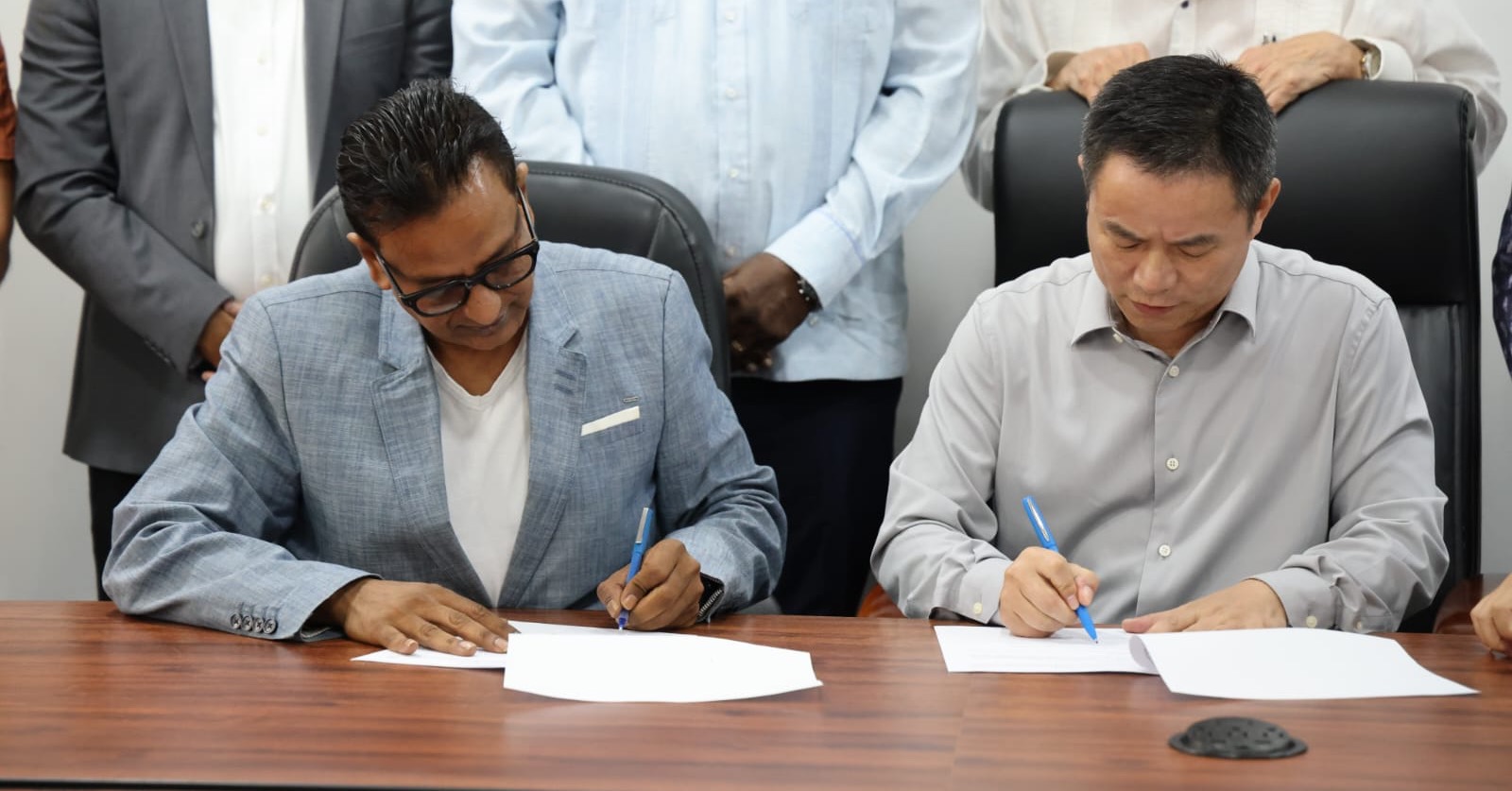
Signing of the 6MW generation donation agreement between GPL and Bosai Minerals Group Guyana. Source: GPL/Department of Public Information.
Bosai Minerals Group Guyana Inc. and Guyana Manganese Inc. have agreed to provide six one-megawatt generator sets and associated power-plant equipment to the Government of Guyana through Guyana Power and Light Inc.
The equipment represents six megawatts of generation capacity, but it is not yet supplying the Region 10 system.
The generator sets are currently located at Port Kaituma in Region One. GPL is responsible for dismantling, transporting and reassembling them as a single plant at what the utility described as a strategic location along the Soesdyke–Linden Highway.
GPL is targeting completion of the relocation and installation within four months. The official release did not identify a fixed commissioning date.
The donation agreement was signed by GPL Executive Management Committee Head Kesh Nandlall and George Zhao, representing Bosai Minerals Group Guyana.
Capacity is committed, but commissioning remains ahead
The distinction between donated capacity and operational capacity is important.
Until the units have been transported, installed, connected, tested and commissioned, they should not be included as electricity already available to customers in Linden, Region 10 or communities along the highway.
GPL said the plant is intended to support voltage regulation and grid stability while strengthening supply to the highway corridor and Region 10.
The release did not state the generator models, fuel type, age, appraised value, precise destination, expected annual generation, connection arrangements or the long-term allocation of fuel and maintenance costs. Those details should not be inferred.
They will matter when assessing the plant’s operating cost, reliability and contribution to available reserve capacity after commissioning.
Part of a wider response to Linden electricity demand
The six-megawatt plant is one of several interventions being advanced for the Linden and Soesdyke–Linden corridor.
On 24 August, the Ministry of Public Utilities and Aviation reported that a separate 1.5-megawatt addition had entered operation at Bosai’s Linden powerhouse. That increased the supply reported from that facility from 14 megawatts to 15.5 megawatts. Work was continuing on a second 1.5-megawatt addition intended to raise the total to approximately 17 megawatts.
That three-megawatt intervention at the Linden powerhouse is separate from the six one-megawatt units now being transferred from Port Kaituma. The figures should not be combined without system data confirming how much capacity is simultaneously available and how the units will be dispatched.
Solar and grid projects remain on a different timetable
Region 10 is also receiving three utility-scale solar farms with a combined planned capacity of 15 megawatts.
The identified sites are Dacoura, with three megawatts-peak; Retrieve, with eight megawatts-peak; and Block 37, with four megawatts-peak. The programme also provides at least 22 megawatt-hours of battery storage for the Linden isolated system.
The government reported a US$22.6 million project value and targeted full integration by the first quarter of 2027. Construction is being undertaken by a joint venture between SUMEC Complete Equipment and Engineering Co., Ltd. and XJ Group Corporation.
The latest GPL release also said a new substation is being developed at Kuru Kururu. Prime Minister Mark Phillips stated that Bosai is separately constructing a 10-megawatt solar farm in Region 10, with additional capacity expected by 2028.
These projects have different owners, technologies and delivery schedules. The six-megawatt generator transfer is a shorter-term capacity measure and should not be described as part of the 15-megawatt GUYSOL solar programme.
What businesses should watch
For businesses operating in Linden and along the highway, additional capacity is relevant only to the extent that it produces a measurable improvement in available supply, voltage quality and outage performance.
The next milestones are the final site announcement, arrival and reassembly of the equipment, grid connection, commissioning and confirmation of the dependable capacity available during peak periods.
Information on operating responsibility, fuel supply, maintenance arrangements and expected service life would also help establish the plant’s long-term value.
The donation agreement creates a defined six-megawatt capacity project. It does not yet establish that the plant is operating or that every reliability issue affecting the Region 10 system has been resolved.